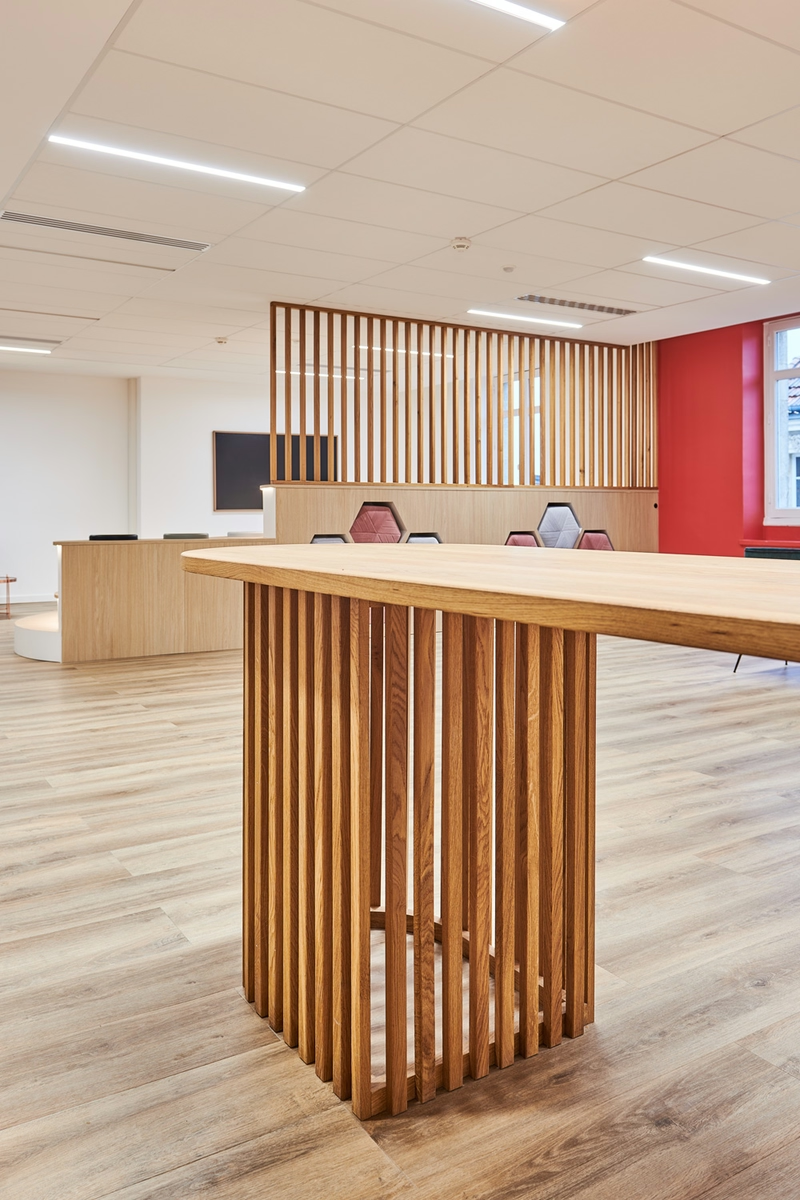
Office fit-out for the public sector: methodology and regulatory framework
Three procurement routes: MAPA, formalised tender, UGAP framework agreements
The MAPA-then-formalised reflex still dominates procurement departments, even though the UGAP central purchasing body, under article L2113-2 of the Public Procurement Code, significantly shortens the procedure timeline without weakening competition. Kytom, founded in 2006, handles numerous public consultations every year, with an average floor area of 850 sqm and a 12-week timeline after notification. The methodology incorporates ERP compliance, accessibility for people with reduced mobility (Law 2005-102), acoustic requirements applicable to office spaces and the trajectory for reducing energy consumption in the office building stock, securing the analysis of bids in light of articles R2152-7 and R2152-11 of the Public Procurement Code.

Public buyers have three contractual levers for their office fit-out projects. The adapted procedure (MAPA) applies below the European threshold of EUR 5.538 million excl. tax for works (notice on procurement thresholds, JORF 2024), with advertising proportionate to the amount. The formalised tender becomes mandatory above this threshold, in accordance with articles L2124-2 and R2161-2 of the Public Procurement Code.
Using UGAP (article L2113-2) exempts the buyer from re-tendering and significantly reduces procedure timelines. On an 850 sqm floor leased at EUR 380/sqm/year in a high-demand zone, each month of procedure avoided represents a direct financial stake on the transition rent, a parameter rarely factored into the decision-making files of authorising officers, who think in terms of administrative timelines rather than occupancy cash flow.
The weighted criteria observed on these contracts are generally distributed as follows:
- Technical value: 50 to 60%
- Price: 30 to 40%
- CSR and timelines: 10 to 20%
The technical weighting rewards the coherence of the technical proposal, Qualibat 5311 and ISO 9001:2015 certifications, and an attached execution schedule respecting the OPR and GPA milestones.
Kytom’s position, contrary to public procurement conventional wisdom. Systematic use of UGAP is not relevant below EUR 80,000 excl. tax: the catalogue mark-up can cancel out the procedural gain, based on our experience with comparable consultations. Conversely, the MAPA below EUR 40,000 excl. tax allows direct negotiation without advertising, which makes a three-bid consultation often counterproductive on projects of less than 150 sqm. Our reading differs from the widespread practice of consulting three suppliers by default: on these small lots, the cost of processing the file frequently exceeds the price gap obtained.

Kytom’s 5-step methodology calibrated to CCAG-Works 2021
Kytom applies an execution framework aligned with the obligations of the CCAG-Works 2021 (order of 30 March 2021) and with the expectations of authorising officers.
- Analysis of the tender documents (CCAP, CCTP, BPU) and feedback on key points of attention within 5 working days.
- Site visit within 10 days, dimensional surveys, heritage assessment for listed buildings or those located within ABF protected areas.
- Design: costed scenarios and 3D plans delivered within 3 weeks, compliant with the functional brief and the acoustic requirements applicable to public-access buildings.
- Execution governed by CCAG-Works 2021: adversarial OPR, lifting of reservations within 30 days, 12-month defects liability guarantee (article 44.1 of CCAG-Works 2021).
- After-sales service pooled across the 11 Kytom branches, intervention within 48 hours as set out in the contract, monthly reporting compliant with article R2191-1 of the Public Procurement Code.
Each contract benefits from a single point of contact for the contracting authority, and an execution document framework (DGD, monthly statements, acceptance reports) calibrated for M14, M57 and M71 public accounting.
For the authorising officer and financial control: the framework is not a comfort, it is coverage in the event of a regional audit chamber review. Article R2191-1 and the structured execution documents secure the after-the-fact audit: on contracts documented in this way, no regional audit chamber reminder has been issued in our experience.
Limits of the methodology, Kytom’s reading contrary to common practice. This 5-step framework becomes oversized on contracts below EUR 80,000 excl. tax and on floor areas below 200 sqm: the cost of structuring the technical proposal becomes disproportionate to the amount, and a streamlined 3-step format is then preferable. Contrary to the widespread practice among major players who apply the same framework to all thresholds, we recommend a simplified technical proposal on simple MAPAs: over-documentation unbalances the effort/amount ratio and provides no additional guarantee to the contracting authority. This framework is also unsuited to pure supply contracts without installation, which fall under the CCAG-FCS and not the CCAG-Works 2021.
Energy performance: regulatory trajectory for reducing consumption in the office sector and associated fit-out levers
The tertiary decree no. 2019-771 of 23 July 2019 applies to office-use buildings with a floor area greater than or equal to 1000 sqm and requires a 40% reduction in energy consumption by 2030, 50% by 2040 and 60% by 2050, compared to a reference year after 2010. The annual energy consumption declaration is made each year on the dedicated national platform (2023 data).
Kytom mobilises several fit-out levers contributing to the trajectory:
| Lever | Indicative energy gain | Source |
|---|---|---|
| LED lighting with DALI dimming | up to 65% vs T8 fluorescent | guide Office Lighting, 2022, p.14 |
| Presence and daylight sensors | significant gains observed in operation | Kytom project feedback |
| Thermal zoning by open space | variable savings depending on configuration | Kytom project feedback |
| Refurbished and bio-based furniture | up to 25% CO2 per workstation | Empreinte 2023 database |
For the CFO and management control: the penalty is not the main risk. Prefectoral name & shame and the downgrading of the asset on the property balance sheet weigh more heavily than the administrative fine capped at EUR 7,500 per building per year (article L174-1 CCH). A building stock declared non-compliant loses 3 to 8% of market value according to recent office market analyses: the budgetary decision turns on asset value, not on the fine.
The technical file delivered to the authorising officer consolidates these gains to justify the trajectory to the prefect, in line with the Method order of 10 April 2020.
Kytom’s position contrary to the dominant discourse of fit-out suppliers. On a building stock built before 1975 with a degraded thermal envelope, interior fit-out levers quickly reach their limits: they are not enough to meet the 2030 regulatory targets without prior treatment of the envelope. Beyond that, only treatment of the envelope (external insulation, replacement of joinery, overhaul of the ventilation system) makes it possible to meet the 2030 target. Selling an interior fit-out as a sufficient response on this building stock is a misjudgement: we then recommend phasing into two separate contracts, with the fit-out taking place only after the building is weathertight.

Method
- Programme framing
Define functional needs, headcount, AE/CP budget and political timeline. Duration: 4 to 8 weeks. - Choice of procedure
Decide between UGAP, MAPA or tender according to Public Procurement Code thresholds and the nature of the services. - Drafting tender documents or UGAP purchase order
Calibrate CCTP, BPU and assessment criteria. Incorporate acoustics, low-current/high-current and HVAC from the preliminary design stage. - Consultation and notification
Publication on BOAMP/JOUE if formalised, bid analysis, award. Timeline: 6 to 16 weeks. - Works execution
design and build management with a single point of contact, OPR, lifting of reservations, CCAG-Works acceptance.
Frequently asked questions
What threshold triggers the formalised tender for public fit-out works?
The European threshold is set at EUR 5.538 million excl. tax for works contracts (notice on thresholds, JORF 2024). Below this, the contracting authority may use the MAPA (articles R2123-1 et seq. of the Public Procurement Code) with advertising proportionate to the amount.
Is UGAP always preferable to a direct tender?
No. UGAP significantly shortens the procedure but generates a catalogue mark-up to be weighed against the contract amount. Below EUR 80,000 excl. tax, this mark-up can cancel out the procedural gain. Above EUR 200,000 excl. tax, UGAP becomes relevant on projects with a strong scheduling stake.
How does Kytom secure the analysis of bids for the legality review?
Kytom delivers a technical proposal structured according to the tender regulations criteria (technical value 50-60%, price 30-40%, CSR/timelines 10-20%) and includes supporting documents (Qualibat 5311, quality certification 9001:2015, URSSAF certificates, DC1/DC2/DC4). The execution documents (DGD, monthly statements, acceptance reports) are calibrated for M14/M57 public accounting and article R2191-1.
What energy gains can be activated through fit-out alone on the consumption-reduction trajectory imposed on the office building stock?
On a building stock built after 1990, the fit-out levers (LED DALI, sensors, zoning, bio-based furniture) reach 30 to 45% cumulative gain. On a building stock predating 1975, the gains remain limited by envelope heat losses: meeting the 2030 target then requires prior treatment of the thermal envelope.
Does the CCAG-Works 2021 apply to all public fit-out contracts?
No. The CCAG-Works 2021 (order of 30 March 2021) governs works contracts with installation. Pure supply contracts (furniture delivered without fit-out) fall under the CCAG-FCS. The contracting authority must explicitly reference the chosen CCAG in the CCAP, failing which no supplementary reference applies.