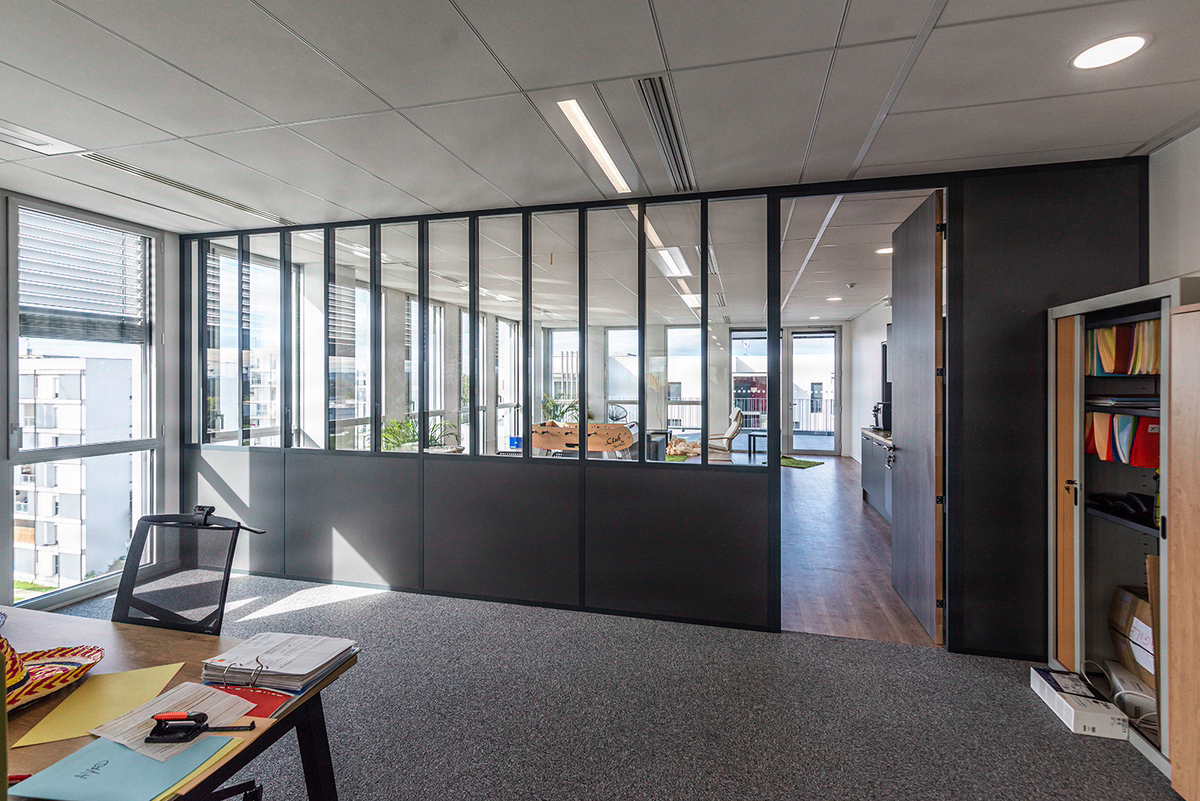
Real estate change management: managing people and space
Three structural tensions to arbitrate in the steering committee
Change management is not an incidental HR expense: it is insurance against losing adoption of new spaces. Without a formalized change unit, fit-out projects struggle to reach satisfactory adoption at six months; with a structured method, teams’ appropriation of spaces progresses markedly. For an Asset Manager or a CFO, the decision is financial before it is human: a moderate support budget per employee prevents post-delivery underoccupancy that devalues the leased sqm. Kytom has worked on office fit-out since 2006 and observes one constant: most resistance stems from a lack of upstream user involvement.

Every office space transformation confronts management with three tensions identified in Kytom operations supported since 2006.
- Speed of deployment versus gradual appropriation. Abrupt change generates rejection, while a drawn-out deployment dilutes the disruptive effect. The compromise observed lies between 12 and 20 weeks of operational transition. Contrary to conventional wisdom advocating the big bang to make an impression, we find that transitions spread over 14 to 16 weeks foster better adoption than those carried out in under 8 weeks.
- Standardization versus business-line personalization. Engineering teams require concentration conditions and a sound level compliant with the minimum acoustic performance applicable to demountable partitions, namely RA=38 dB for solid partitions, RA=28 dB with integrated door and RA=36 dB for glazed partitions, while sales teams favor bright collaborative clusters. The reference framework must absorb both typologies without fragmenting overall coherence.
- Top-down communication versus co-construction. Strategic framing remains with management, while appropriation comes through structured user workshops, 3 to 5 sessions of 2 hours per business-line typology.
Projects that balance these three tensions in writing show markedly higher adoption rates at six months post-delivery. The decision must be set down in writing, shared in the steering committee and recorded in the functional program to avoid any renegotiation at the prototyping stage.

Four recurring mistakes that undermine buy-in
Analysis of our projects of more than 150 workstations reveals four recurring mistakes that compromise adoption.
- Underestimating the behavioral diagnosis. Starting from technical constraints without observing actual usage produces spaces ill-suited to everyday practices. The useful observation phase generally lasts a few weeks before engaging design decisions.
- Communicating only on the final rendering. Presenting computer-generated images without explaining budget decisions and the schedule fuels fantasies. The sequenced sharing of stages appreciably reduces critical feedback in the monitoring committee.
- Neglecting business-line ambassadors. Relying solely on the management line deprives the project of credible operational relays. Identifying business-line ambassadors within each team makes it possible to relay the project as close to the ground as possible.
- Omitting post-move-in monitoring. Support often stops at the handover of keys, whereas the first weeks determine the lasting anchoring of new behaviors.
Each mistake taken in isolation reduces the buy-in rate by 10 to 15 points in our post-delivery feedback. Combined on a single project, these mistakes can drive adoption below half of the employees concerned.
The Kytom method in five steps over 12 to 24 weeks
The Kytom real estate change management method is organized into five steps calibrated to the scale of the project, from floor resizing to multi-site mergers. Each step produces traceable deliverables that can be presented to the steering committee.
| Step | Duration | Deliverables |
|---|---|---|
| 1. Behavioral audit | 4 to 6 weeks | Usage mapping, identification of influencers |
| 2. Co-construction | 3 to 5 weeks | Usage framework by business-line typology |
| 3. Pilot prototyping | 6 to 8 weeks | Test floor, user feedback |
| 4. Sequenced communication | ongoing | Editorial plan, managerial materials |
| 5. Post-delivery monitoring | 6 months | Adoption measurements at D+30, D+90, D+180 |
The method integrates with design and build projects led by the Kytom agencies, with systematic articulation to the architectural program.

An Asset Manager and CFO reading: why a 5% change budget protects asset value
For the CFO and Asset Manager, change management is not an HR cost line to be optimized: it is a lever to protect asset value and headline rent.
Spatial segmentation relies on two dominant typologies in French office space. Sales and collaboration spaces are organized into dynamic, bright clusters. Engineering and concentration spaces are treated as partitioned workstations or with acoustic walls to maintain a sound level compliant with the acoustic requirements applicable to offices. This distinction conditions acceptance by the business lines concerned and structures the co-construction workshops of phase 2. It avoids the pitfall of the uniform floor plate that simultaneously displeases both typologies.
The usage framework defines for each population: the target density, the ratio of assigned to shared workstations, the acoustic retreat zones, and the booking rules for collaborative spaces. The financial translation is direct: a flex office project underused at 55% instead of the 80% target undermines the optimized-surface argument that justified the operation to the investment committee.
The works council is formally involved in validating the framework, in accordance with articles L.2312-8 and L.2312-14 of the Labor Code on consultation regarding working conditions and major fit-out. This upstream involvement avoids late challenges and secures the transition schedule, hence the effective date of the new lease or sublease.

Measured indicators and indicative budget
On the transformation projects we support, appropriation times generally range over a few months depending on the scale of the change, whether a simple relocation, flex office, ABW or site merger. The change unit budget generally represents 3 to 7% of the works budget depending on organizational complexity, an order of magnitude of 80 to 250 EUR per employee.
Four indicators are measured and reported in the steering committee: actual workstation occupancy rate, booking rate for collaborative spaces, user satisfaction score at D+90, number of post-delivery facilities tickets over 6 months.

Method
- Audit of actual usage
Measure occupancy rates using sensors over a minimum of 3 weeks. Supplement with manager interviews and an employee survey. Avoid purely declarative data, which is biased in 70% of cases. - Mapping of resistance
Identify at-risk populations (field staff, seniors, frontline managers). Build a targeted action plan by segment. Anticipate the works council step from this phase to secure the schedule. - Network of ambassadors
Appoint 1 business-line referent per 25 employees. Train them over 2 days on the new ways of working. They become your communication relays and weak-signal sensors for 6 months. - Test phase on a pilot
Deploy on a representative floor for 8 weeks. Measure adoption, satisfaction and friction points. Adjust the general program before rollout, otherwise you pay again on furniture. - Measurement and anchoring
Track 5 KPIs over 6 months: adoption, satisfaction, perceived productivity, turnover, sick leave. Document for CSRD ESRS S1 reporting and correct the irritants detected during operation.


