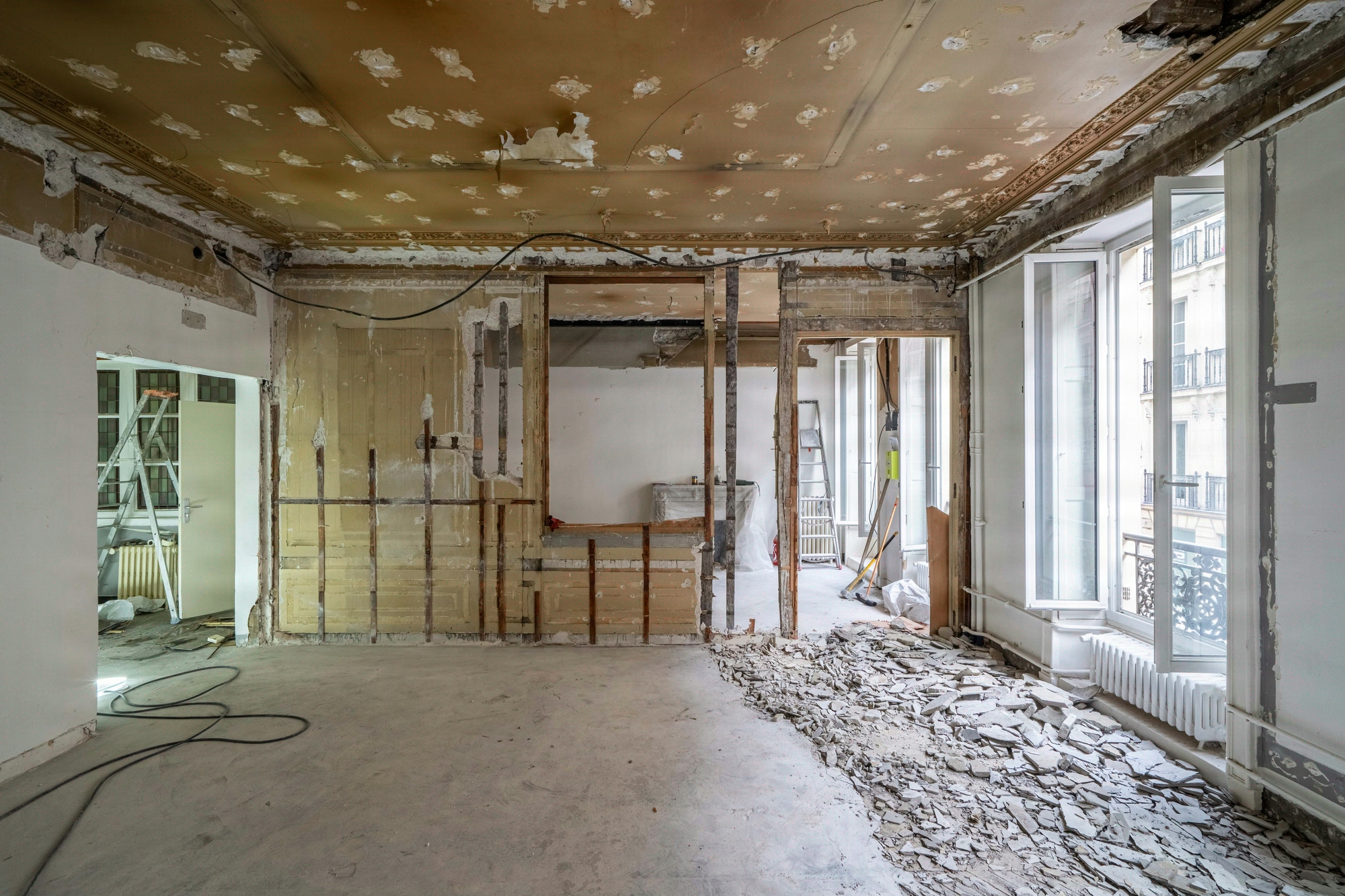
Highway permits and construction site management
Three distinct and non-substitutable administrative acts
17 days of administrative delay on a highway construction site means 76,500 EUR in avoided rent lost (4,500 EUR/day x 17). The French Roadways Code (articles L.113-2 et seq.) requires three distinct acts whose combined processing reaches 8 weeks in dense areas. Any fit-out project generating an occupation of the public domain triggers a highway permit, a parking permit and a traffic order. Processing times range from 2 to 8 weeks depending on the municipality, and fees from 1.50 EUR to 25 EUR per m² per day according to municipal pricing schedules. Kytom has managed these files since 2006 on projects averaging 850 m², with a very high approval rate without any request for additional documents across our recent portfolio.
The administrative management of a commercial construction site impacting the roadway relies on three complementary acts, each with its own competent authority and its own timeframe. Contrary to a widespread belief among project owners, a parking permit NEVER exempts you from the highway permit as soon as there is anchoring or connection: confusing these two acts is one of the leading causes of work stoppages we encounter.
- Highway permit: issued by the manager of the public domain, it authorises works affecting the roadbed or the subsoil (connections, trenches, anchorings). Processing of 2 to 6 weeks (Roadways Code, articles L.113-2 et seq.).
- Parking permit: governs occupation without ground impact (skip, scaffolding, site base) and falls under the mayor’s policing powers. Average timeframe of 10 to 15 days.
- Traffic order: organises diversions and parking suspensions, with a legal notice period of at least 7 days before intervention (order of 24 November 1967 on road signage).
| Act | Competent authority | Processing time | Signage installation notice |
|---|---|---|---|
| Highway permit | Highway manager | 2 to 6 weeks | 7 days |
| Parking permit | Mayor | 10 to 15 days | 7 days |
| Traffic order | Mayor / Departmental Council | 15 days | 7 days |
An omission exposes you to a 5th-class fine (1,500 EUR, article R.116-2 of the Roadways Code) and to the immediate stoppage of works. On commercial fit-out sites in urban environments, it is common to have to combine all three acts simultaneously.

Kytom’s 5-step method aligned with the construction site reverse schedule
The approach fits into the standard reverse schedule, with 10 weeks of anticipation for filing authorisations, in order to absorb processing times that vary according to local authorities.
- Step 1 (W-10), Roadway audit: survey of constraints by the local office (PLU, pedestrian zone, bus line, weekly market, ABF perimeter).
- Step 2 (W-8), File preparation: temporary signage plan compliant with IISR part 8 (amended order of 6 November 1992), ten-year civil liability insurance certificate, construction site safety notice.
- Step 3 (W-6), Simultaneous filing: applications to the town hall, the highway manager and, for departmental roads, the Departmental Council.
- Step 4 (W-2), Signage installation: 48 hours before intervention, in accordance with the order of 24 November 1967.
- Step 5, Daily monitoring: weekly reporting to the client by the dedicated site supervisor.
Coordination relies on 11 offices in France and Spain, which allows town hall procedures to be handled in a limited time.
Our reading differs from professional practice on this specific point: W-10 over-anticipation is not universal. Below the threshold of 5 days of cumulative occupation and without impact on the roadway, the W-10 formalism is disproportionate. A simple declaration to the town hall 15 days in advance is enough, and administrative outsourcing degrades the ROI: the internal workload of an Office Manager (2 to 3 hours) remains lower than the cost of delegated management. Likewise, in a rural municipality of fewer than 3,500 inhabitants where the one-stop counter processes the request within 8 days, the W-10 reverse schedule introduces an artificial wait. The Kytom method becomes useful from 850 m², in a dense urban area, or with a combination of at least two administrative acts.

For the CFO and the Asset Manager: a secured start-up valued in avoided rent
The roadway matter is not a technical file: it is a cash-flow line. Each day of start-up delay pushes back by the same amount the date the premises become available and therefore the end of the double rent (former site and new site under construction). Clients who have delegated roadway administrative management to Kytom benefit from a more predictable construction start, a sharply reduced administrative burden for their support teams, and better control of roadway fees, all of which are levers that shorten the double-rent period and secure the date the premises become available.
For the Asset Manager, delegating roadway administrative management secures the start on the contractual date and avoids the holding costs associated with delays, for a controlled administrative management fee. For the CFO, regulatory compliance avoids 5th-class penalties and the administrative liability of the applicant. The fee budget for a commercial site with a skip and scaffolding varies significantly depending on the municipality and the duration of occupation, and is included in the quote from the commercial phase onwards.

ABF zones, protected sectors and variability of timeframes
Three constraints warrant particular vigilance on commercial construction sites in dense urban environments.

Variability of timeframes depending on the municipality
Processing times can range from a few weeks in outlying municipalities up to several weeks in central Paris for a highway permit in a protected sector. The Kytom prudential rule is to file 10 weeks before start-up.

Binding ABF opinion in historic city centres
Architecte des Bâtiments de France zones and historic monument perimeters require a binding opinion within an additional 4 months (Heritage Code, article L.621-32). This constraint affects a significant share of the commercial addresses we handle in historic city centres.
Frequently asked questions
What are the timeframes for obtaining a highway permit?
Processing a highway permit ranges from 2 to 6 weeks, a parking permit from 10 to 15 days and a traffic order around 15 days (Roadways Code, articles L.113-2 et seq.). In a protected sector in central Paris, the timeframe rises to 8 weeks. The Kytom prudential rule is to file 10 weeks before start-up.


