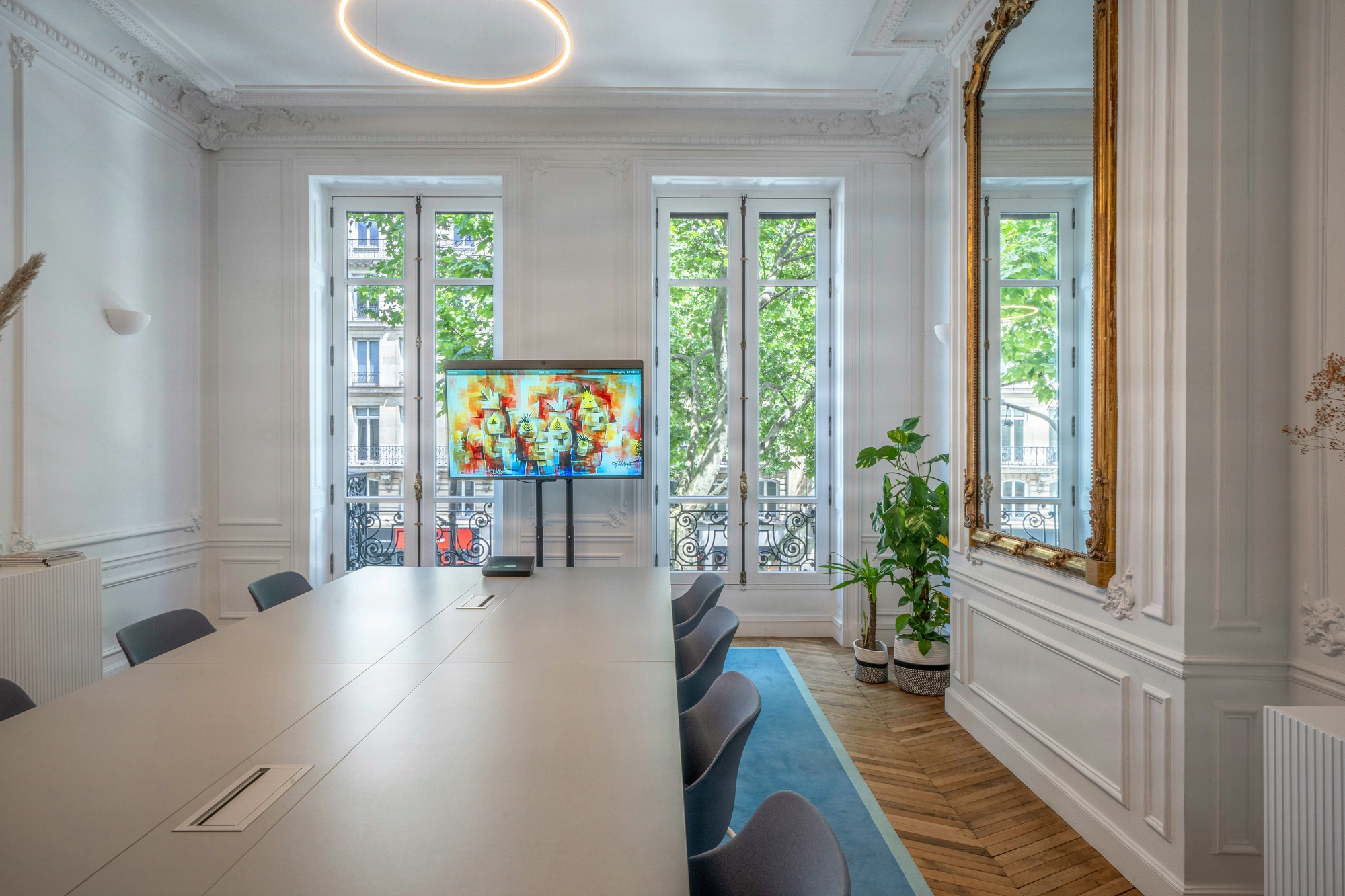
Mixed-use building: transforming your office asset into lasting value
High vacancy and a regulatory obligation of -40% in energy consumption: cash-flow reshapes the trade-off
Kytom has been orchestrating this transformation in 12 weeks since 2006, with 11 offices across France and Spain. We handle the programmatic audit, design compliant with R. 4214 and NF S 31-080, the coordination of 12 to 25 trades, and we align your asset with the trajectory of the Décret Tertiaire, which sets an initial target of at least -40% in final energy consumption by 2030, while securing the environmental certifications required by core+ and value-add funds. A useful word of caution from the outset: below 1,500 sqm GFA, a renovated single-use office remains preferable.

The framework
Vacancy at 8.5% and a regulatory obligation of -40% in energy consumption: cash-flow reshapes the trade-off
For the Asset Manager and the CFO, conversion is no longer a peripheral ESG topic, it is a matter of cash-flow and asset value. Greater Paris vacancy exceeds 8.5% in the fourth quarter of 2023 (Immostat, Q4 2023). According to the Actineo barometer, roughly a third of executives work remotely at least one day per week. The regulatory trajectory mandates -40% in final energy consumption by 2030, -50% by 2040, and -60% by 2050 compared with 2010.
Three levers structure the response on an obsolete asset: diversify uses with 2 to 4 complementary functions (flexible offices, food service, coworking, fitness, concierge services, daycare, local retail), align the envelope and building services with regulatory energy thresholds to secure green refinancing, and target an ESG framework recognised by institutional investors. Environmental certification frameworks break down into complementary profiles: Low Carbon, Circular Economy, Air Quality and Biodiversity, covering environment, operations and occupant well-being.
An obsolete asset is discounted by 25 to 40% relative to its appraised value. A well-calibrated mixed-use conversion recovers this discount in 36 to 48 months and unlocks access to core+ and value-add funds, where a simple pure-office renovation caps value at its market level. The trade-off between initial CAPEX, target yield and local market depth relies on mobility and pedestrian flow data in urban centres, two decisive parameters for calibrating the share of ground-floor services.

Your gains
Value uplift of 10 to 18% and a smoothed WALT of 1.8 to 2.4 years
The mixed-use operations we deliver combine three revenue streams to smooth rental risk: a 3-6-9 commercial lease on offices, a short-term derogatory lease on services and coworking, and multi-year service contracts on leisure and food service. This diversification reduces reliance on a single tenant and cushions the impact of a departure on annual NOI. Renovating the envelope and HVAC equipment significantly improves the EPC, securing regulatory compliance applicable to the office stock and avoiding administrative penalties.
On the usage side, footfall for ground-floor services rises appreciably twelve months post-delivery, and occupant feedback reports a high level of satisfaction. Delivered operations confirm a reduction in vacancy, an uplift in the weighted headline rent and a marked improvement in energy performance, with better-managed WALT volatility over time.

Points of vigilance
Four OPEX/CAPEX zones to nail down before committing
Mixed-use is not a given. Four zones frame the equation on the OPEX and CAPEX side, and we systematically cost them during the scenario phase.
ERP/ERT compatibility. Combining offices, food service and leisure triggers reinforced fire safety obligations (category 5 to 3 depending on combined occupancy) and sometimes requires 2 additional staircases, in accordance with the safety regulations (decree of 25 June 1980 as amended).
Rental management complexity. Going from 1-3 to 5-12 tenants appreciably increases property management costs, a gap we systematically factor into the business plan from the scenario phase, before the trade-off and not after delivery.
Inter-use acoustics. A fitness facility beneath offices requires a floating slab and a significant additional budget per sqm, with regulatory acoustic validation between levels.
Market depth. A preliminary marketing test over 4 to 8 weeks validates local demand for services and leisure before committing CAPEX. This is our safeguard against overly optimistic scenarios on the leisure share open to the public.

Commercial honesty
Three cases in ten where we advise against mixed-use
Contrary to the doctrine of systematic mixed-use held by part of the profession, we hold a different position: mixed-use conversion is not the right answer in 3 cases out of 10. Better to say so during the audit phase than discover it at the delivery phase.
Below 1,500 sqm GFA. Multiplying uses runs up against a profitability threshold: the additional costs of fire safety, inter-use acoustics and property management absorb the rental gain. The tipping point is clear: below 1,500 sqm, the value uplift falls under 6% and a renovated single-use office remains preferable.
More than 600 m from a major transit station. Pedestrian flow does not support the share of ground-floor services. Programming must then be limited to a mix of offices and internal food service, without a leisure component open to the public.
Above 1,500 people in projected combined occupancy. Reclassification to ERP category 2 triggers obligations that make the economic equation unfavourable compared with demolition-reconstruction.
In these three configurations, we steer toward an aligned office renovation, more effective in terms of the CAPEX/value-uplift pairing. Same team, same 12-week timeline, a different trajectory.

Method
- Programmatic audit
We analyse the catchment area within an 800 m radius, study pedestrian flows, carry out the technical building diagnosis and benchmark the asset against similar operations we have delivered. This step qualifies the mixed-use potential and identifies any disqualifying factors (floor area below 1,500 sqm GFA, distance from transit, insufficient services market depth). - Programming scenarios
We build 2 or 3 costed hypotheses with office/services/leisure floor area ratios, a 10-year rental income simulation and a framed projected CAPEX. Each scenario incorporates the ERP/ERT impact, inter-use acoustics and the induced property management cost. - Design and compliance
Our layout plans incorporate the regulatory requirements applicable to workplaces (articles R. 4214 et seq.), accessibility for people with reduced mobility, acoustic separations between contrasting uses, and the targeted certification trajectory, whose framework offers 5 performance levels (Pass, Good, Very Good, Excellent, Outstanding), calibrated according to the investor profile (core+, value-add) and green refinancing requirements. - Works coordination
We coordinate 12 to 25 trades with weekly monitoring and monthly financial reporting. Delivery is phased to maintain 30 to 60% occupancy during the works. A price guarantee covers the structuring technical packages (HVAC, facade, fire safety). Our certifications and compliance secure the chain from studies to as-built documentation.
Frequently asked questions
From what floor area does mixed-use conversion create value?
The threshold of economic relevance generally sits around 1,500 sqm GFA. Below this, the additional costs of fire safety, inter-use acoustics and property management absorb the rental gain and the value uplift falls under 6%: a renovated single-use office remains preferable. Above it, capital value uplift reaches 10 to 18% on a like-for-like basis and the weighted headline rent rises by 15 to 25% compared with a pure single-use office. We validate this threshold from the programmatic audit, before any CAPEX commitment, and we steer toward an aligned office renovation when mixed-use is not the right answer.


