Skip to content
Indoor air quality in the office
Comfort

Indoor air quality in the office

Headaches, high CO2, insufficient ventilation: our IAQ guide to diagnose and correct the air quality in your offices in 12 weeks on average.

11 cities covered
1 200+ spaces transformed
66 passionate people

"Headaches, lack of oxygen"

What our clients tell us.

You will recognise your situation if…

  • Drop in concentration measured as early as 11 am in open spaces.
  • Recurring complaints in closed meeting rooms used for more than an hour.
  • Increased absenteeism on poorly ventilated floors in winter.
  • A sense of stale air as soon as 8 people gather in 20 m².

Issues and impacts

Hidden cost

A Harvard study puts the loss of productivity linked to degraded air at 6500 dollars per employee per year. On a floor of 50 people, the hidden bill exceeds 300,000 euros annually, far more than the cost of a new, properly sized and regularly maintained AHU.

Human risk

Above 1000 ppm of CO2, there is a direct link with headaches, drowsiness and irritation. Indoor pollution is associated with 3.8 million premature deaths per year worldwide. In dense office settings, 1500 to 2000 ppm is commonly recorded in a closed, unventilated room.

Regulatory risk

The Labour Code (R4222-1 to R4222-26) requires a minimum airflow of 25 m³/h per occupant in offices. Decree no. 2022-1689 extends IAQ monitoring to tertiary public-access buildings. Non-compliance exposes you to a report to the works council (CSE) and a formal notice from the labour inspectorate.

How Kytom approaches it

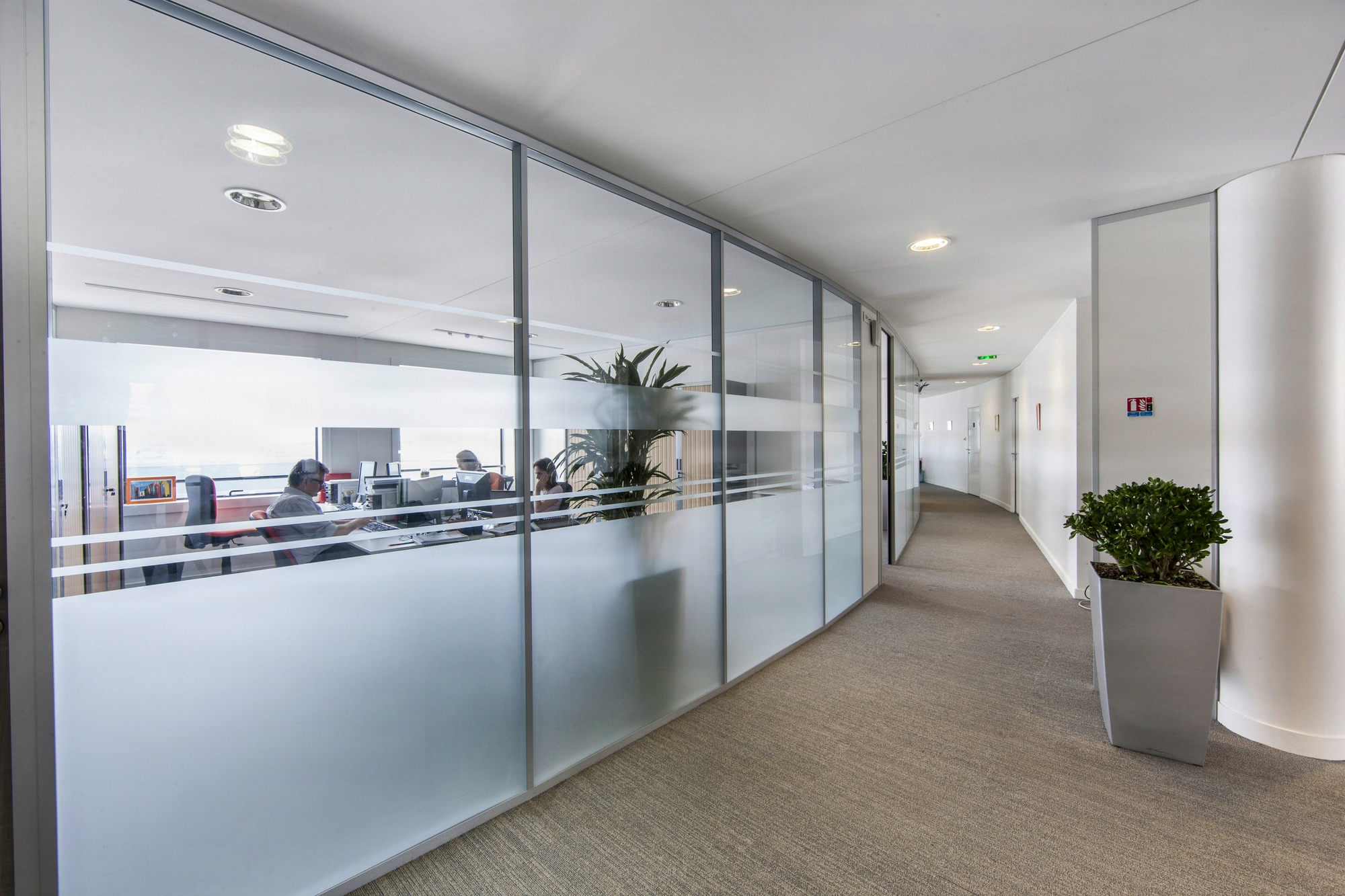
With more than 1200 clients supported since 2006, Kytom treats IAQ as a fit-out matter and not as a simple HVAC line item. From the very first sketch, our interior architects incorporate the measurement of CO2, VOCs and fine particles (PM2.5), the sizing of air renewal according to the European standards in force and the choice of A+ materials compliant with the mandatory health labelling. We cross-reference the target occupancy density with the capacity of the existing AHU, then weigh up rebalancing the vents, adding connected sensors and creating planted buffer zones. The deliverable is a costed action plan, prioritised by return on investment and compatible with your obligations to reduce energy consumption in the tertiary sector.
Our method

  1. 1. Diagnose

    A 2-week measurement campaign with CO2, VOC, PM2.5, temperature and humidity sensors placed across 100% of critical zones. Deliverable: hourly thermal mapping, identification of black spots and benchmarking against ANSES and REHVA thresholds.

  2. 2. Scope

    Workshop with project management, HR and facilities to prioritise zones, validate the budget (typically 80 to 180 euros excl. tax per m²) and decide between a quick intervention and a major renovation. Deliverable: signed functional brief and an 8 to 14-week schedule.

  3. 3. Design

    Technical plans validated by a fluids engineering firm, selection of A+ labelled materials, integration of air-purifying plants (NASA Clean Air Study) and choice of connected sensors. Deliverable: complete tender documents, airflow simulation per zone and health product datasheets.

  4. 4. Deliver

    Works carried out on occupied sites or outside working hours, acceptance measurement (CO2 below 800 ppm at nominal occupancy) and training of facilities teams to read the IAQ dashboard. Deliverable: acceptance report, 2-year warranty and quarterly maintenance plan.

Cost and ROI

Cost range per m²
80 to 180 euros excl. tax per m²
Includes connected sensors, HVAC rebalancing and A+ materials on a standard floor.
Timeframe
8 to 14 weeks
From diagnosis to acceptance, 12 weeks on average for 850 m² of occupied offices.
Typical ROI
Payback in 18 to 24 months
Calculated on productivity gains (+8%) and reduced absenteeism (-12%) observed.

An anonymised field feedback

"Headache complaints dropped from the very first month, and our afternoon meetings became productive again. The CO2 dashboard convinced the works council."

from 1650 to 720 ppm
Drop in average CO2
-68% in 3 months
IAQ complaints
-14% over six months
Short-term absenteeism

Frequently asked questions

What CO2 threshold should you aim for in offices?

ANSES recommends staying below 800 ppm at nominal occupancy, with an alert at 1000 ppm. Above 1400 ppm, cognitive functions drop by 15% (Harvard study). In a closed meeting room, 2000 ppm is regularly exceeded without suitable mechanical ventilation.

Do you need to install sensors everywhere?

No. A grid every 80 to 120 m² is enough in open spaces, supplemented by one sensor per meeting room. Allow 150 to 300 euros excl. tax per connected sensor. The aim is trends and alerts, not exhaustive scientific measurement.

Is IAQ mandatory in private offices?

The regulations require minimum airflows of 25 m³/h per occupant in premises with non-specific pollution. Formal indoor air quality monitoring targets public-access establishments, but employer obligations apply to any office, with a possible inspection by the labour inspectorate.

Are plants enough to purify the air?

No, they complement but do not replace ventilation. The NASA Clean Air Study shows a real but marginal effectiveness (less than 5% of the effect of a well-sized AHU). They mainly act on perception and relative humidity between 40 and 60%.

Can you act without major HVAC works?

Yes, in 60% of cases. Rebalancing vents, cleaning ducts, changing filters (F7 minimum), clearing grilles and using controlled sensors are enough. Typical budget: 40 to 80 euros excl. tax per m², with measurable gains within 4 weeks.

How do you bring the works council on board with this topic?

Share the pre-works measurements and set contractual acceptance thresholds (CO2 below 800 ppm, PM2.5 below 10 µg/m³). A dashboard accessible to the works council defuses most tensions; we have seen this across more than 1200 projects since 2006.