Skip to content
Biophilia and nature in the office
Comfort

Biophilia and nature in the office

Office biophilia: the Kytom method to integrate plants, light and natural materials in 12 weeks on average. Budget, ROI and measured field feedback.

11 cities covered
1 200+ spaces transformed
66 passionate people

"We want something alive"

What our clients tell us.

You will recognise your situation if…

  • Grey floors with no greenery, perceived as cold by teams.
  • Rising absenteeism and repeated complaints about visual fatigue.
  • Difficulty attracting young talent after they visit the premises.
  • Plants bought in a hurry, dead within 3 months for lack of maintenance.

Issues and impacts

Hidden cost

A vacant workstation costs between 8000 and 12000 euros per month including overheads (CBRE 2023). When premises look dull, turnover climbs by 15%, and each failed recruitment adds 6 months of lost productivity. Poorly managed greenery becomes a disposable consumable, not a design asset.

Human risk

Environments poor in nature are associated with a 23% increase in cognitive fatigue. In open-plan spaces, 41% of employees report daily stress. Without thoughtful biophilia, short sick leaves rise and concentration drops, particularly for analytical and creative functions.

Reputational or regulatory risk

Real estate certification frameworks now include explicit biophilic criteria (air quality, natural light, presence of greenery). A real estate department that delivers offices without this dimension loses 2 to 4 points in ESG rating, and weakens its employer brand against the 76% of candidates sensitive to the work environment.

How Kytom goes about it

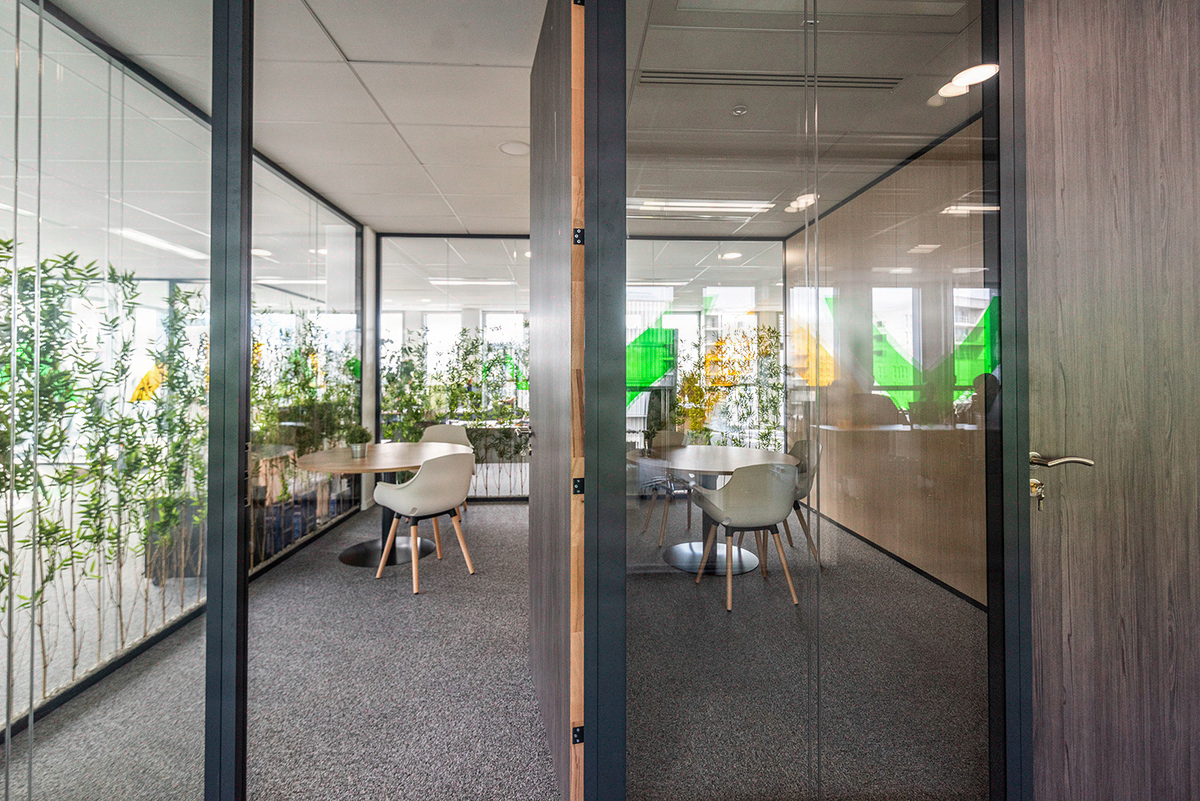
Kytom approaches biophilia as an integrated system, not as decoration. Since 2006, our 11 agencies have rolled out projects across more than 1200 office sites in France and Spain. Our approach combines five levers: living greenery calibrated by exposure, natural materials (certified wood, linen, cork), natural light maximised at 80% of workstations, organic shapes in furniture, and preserved views of the outdoors. We work with Vitra and Herman Miller references for seating, and systematically include a 36-month plant maintenance contract. Each project is framed around environmental quality and workplace wellbeing criteria, with a dedicated biophilia lead within the project team.
Our method

  1. 1. Diagnose

    Audit of the existing situation: natural light measurement with a lux meter, hygrometry readings, mapping of outdoor views, interviews with 15 to 20 employees. Deliverable: a 25-page report identifying priority zones and a baseline biophilic score rated out of 100.

  2. 2. Frame

    Framing workshop with general management, HR and facility manager to define the level of ambition, the target budget (typically 80 to 150 euros excl. VAT/sq m dedicated to biophilia) and the success indicators. Deliverable: a signed biophilic charter, aligned with the employer brand.

  3. 3. Design

    3D plans, plant selection by a botanist, choice of bio-based materials, integration into workflows. Each species is calibrated according to exposure (Pothos, Kentia, Monstera, Sansevieria). Deliverable: a detailed design dossier with material boards and an automated watering plan.

  4. 4. Deliver

    Coordinated installation in 12 weeks on average, training of internal teams (half a day), implementation of the monthly maintenance contract. Deliverable: an operational site with a 95% plant survival guarantee in the first year, and a quarterly review of the biophilic score.

Cost and ROI

Cost range per sq m
80 to 150 euros excl. VAT/sq m
Includes greenery, organic furniture and bio-based materials, excluding structural works and acoustic partitioning.
Timeline
12 weeks on average
From diagnosis to delivery, with a plant phase calibrated to employees' arrival.
Typical ROI
Payback in 2 to 3 years
Through lower turnover, enhanced attractiveness and reduced short-term absenteeism.

Anonymised field feedback

"Teams have stopped asking to work from home on Tuesdays. The greenery changed the perception of the place, and our shortlisted candidates now accept 90% of the time after visiting."

-28% over 12 months
Short-term absenteeism
clearly improved
Acceptance rate after visit
82/100 reached
Biophilia score assessed according to indoor environmental quality criteria.

Frequently asked questions

Is biophilia just putting in green plants?

No. Biophilia brings together 5 dimensions: living greenery, natural light, bio-based materials, organic shapes and views of the outdoors. Plants alone account for barely 20% of the perceived impact.

What budget should be planned for 1000 sq m?

Allow 80,000 to 150,000 euros excl. VAT for a complete biophilic approach across 1000 sq m, including 3 years of plant maintenance. The greenery item alone represents around 25 to 35 euros excl. VAT/sq m, the rest covers materials and furniture.

How can plants be prevented from dying within 6 months?

Three levers: selection adapted to actual exposure (lux meter), automated watering system or reservoir, monthly maintenance contract by a botanist. With this trio, the survival rate exceeds 95% at 12 months across our 1200+ referenced projects.

Is biophilia compatible with a constrained budget?

Yes, by prioritising 2 or 3 high-traffic zones (reception, cafeteria, meeting rooms). A targeted approach at 30 euros excl. VAT/sq m already generates most of the perceived benefit on projects between 400 and 600 sq m.

Which certifications recognise biophilia?

The most widely used frameworks are mainly Mind and Nourishment along with the environmental certifications of sustainable buildings. The French tertiary decree requires office buildings over 1000 sq m to reduce their energy consumption by 40% by 2030, and the ESG criteria of real estate investors now incorporate it into their assessment grids.

How long for a complete biophilic project?

12 weeks on average, from diagnosis to delivery, on a surface of 850 sq m. The diagnosis takes 2 weeks, the design 4 weeks, the execution 6 weeks, with a plant phase calibrated to the premises' re-occupation schedule.