Skip to content
Fitting out without interrupting operations (occupied site)
Management method

Fitting out without interrupting operations (occupied site)

Fitting out without closing: the Kytom method to manage a project on an occupied site, phasing by zones, ~12 weeks, zero days of lost activity.

11 cities covered
1 200+ spaces transformed
66 passionate people

"We can't close for 3 months"

What our clients tell us.

You will recognise your situation if…

  • Teams refuse a temporary relocation deemed too costly.
  • Management fears a drop in productivity exceeding 15%.
  • Acoustic disturbances are already generating regular HR complaints.
  • The supplier schedule does not hold up against business constraints.

Issues and impacts

Hidden cost

A temporary relocation of 100 employees costs between 25,000 and 60,000 € per month (flex rent, IT, furniture). Over a 14-week project, the hidden bill quickly reaches 200,000 €, excluding the loss of productivity estimated at 8% during poorly prepared transition phases.

Human risk

The average increase in musculoskeletal disorders reported during a poorly phased project reaches 22%. Noise, dust and repeated relocations impair concentration. Across 300 exposed employees, an average of 4 additional sick leaves per quarter is observed, a direct burden for HR and occupational medicine.

Regulatory risk

Regulations require the continuity of safety conditions during the works. A lack of a prevention plan engages the employer's liability. 31% of fire incidents in offices occur during a project, hence the obligation of a rigorously maintained PPSPS and permanently clear exits.

How Kytom does it

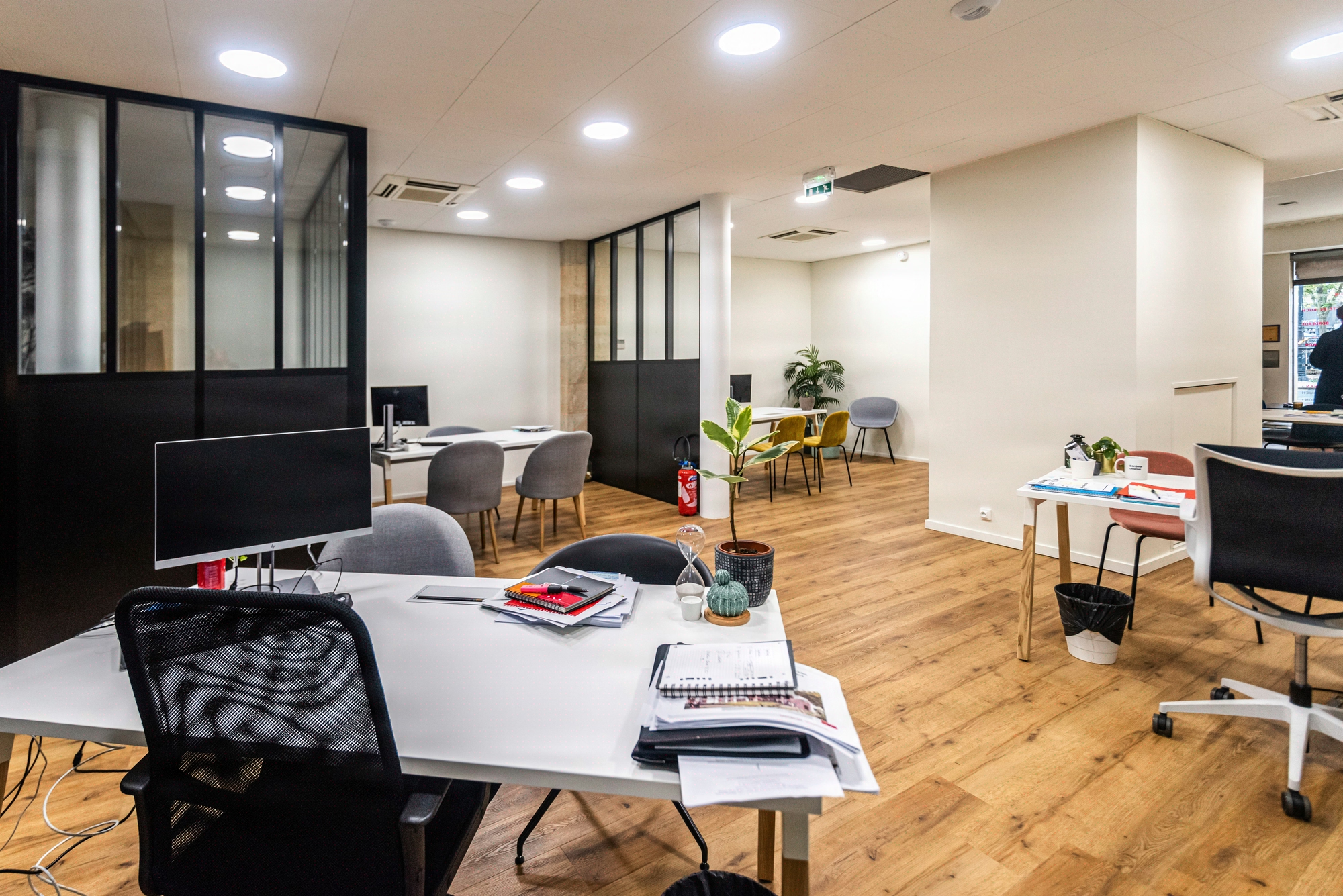
Kytom manages fitting out on occupied sites through a breakdown into zones of 80 to 150 m², delivered in cycles of 2 to 3 weeks. Each zone is isolated by temporary acoustic partitions (attenuation measured at 38 dB), with dedicated circulation and acoustically intrusive works postponed until after 6 p.m. Our 11 agencies mobilise a dedicated site manager for each project, responsible for the prevention plan compliant with R4214 and for weekly reporting to the real estate department. The method, deployed on more than 200 occupied sites since 2006, secures an overall timeframe of 12 weeks for 850 m² on average, without relocation, with an incident rate below 2%. Each phase is jointly validated with the works management director, HR and the works council.
Our method

  1. 1. Diagnose

    Audit of the occupied site over 3 to 5 days: mapping of flows, acoustic measurements according to the reference framework applicable to offices, survey of IT, safety and logistics constraints. Deliverable: a 25 to 40-page report with a zoning plan, identification of critical zones and a risk matrix validated by the works management director and the real estate department.

  2. 2. Frame the phasing

    Development of the sequencing by zones with HR, the works council and the operator. Definition of work slots (day, evening, weekend), the R4214 prevention plan and the internal communication plan. Deliverable: a detailed 12-week schedule, with weekly milestones and a budget framed within plus or minus 5%.

  3. 3. Design and prepare

    Technical design of the temporary acoustic partitions, validation of low-emission materials (A+ label), order of signature furniture (Vitra, Knoll) and calibration of the field teams. Deliverable: complete execution file, signed PPSPS, employee communication kit (signage, emails, internal FAQ) deployed 15 days before the start.

  4. 4. Execute and deliver

    Project carried out by successive zones, weekly reporting to the steering committee, regular acoustic and air quality measurements. Acceptance per zone with a contradictory checklist. Final deliverable: digital DOE, maintenance log, feedback at 3 months measured on employee satisfaction and real usage indicators.

Cost and ROI

Cost range per m²
950 to 1700 € excl. VAT/m²
Occupied-site additional cost of 8 to 12% versus an empty site, according to Cushman & Wakefield.
Timeframe
12 weeks for 850 m²
Phasing by zones of 2 to 3 weeks, without closure or temporary relocation.
Typical ROI
Payback over 2 to 4 years
Savings on relocation (180 €/m²) and productivity maintained at a minimum of 95%.

An anonymised field feedback

"We renovated 1,100 m² in 14 weeks without a single employee being forced to work from home. Acoustic complaints dropped from the eighth week onwards, and the works council praised the method."

-41% at 3 months
Acoustic complaints
0 over 14 weeks
Days of lost activity
clearly improved
Employee satisfaction

Frequently asked questions

Can all relocation really be avoided?

Yes, in 85% of Kytom projects on occupied sites, provided the floor area exceeds 600 m² and a buffer zone of at least 80 m² remains available. Below that, a partial relocation of 2 to 4 weeks sometimes remains economically preferable.

What additional cost should be expected versus an empty site?

Expect 8 to 12% additional cost, linked to phasing, temporary acoustic protections and work outside business hours. This additional cost remains well below the 180 €/m² of an average temporary relocation.

How is noise managed during business hours?

Noisy works (drilling, demolition) are postponed until after 6 p.m. or to Saturdays. Temporary acoustic partitions attenuate 35 to 40 dB. Weekly acoustic measurements ensure compliance with the 55 dB threshold applicable in office areas.

What is the role of the works council in this type of project?

The works council is consulted from the framing of the project onwards, in accordance with the obligations applicable to information and consultation on working conditions. Kytom provides a consultation file including phasing, forecast acoustic measurements and prevention plan. The legal consultation period remains a minimum of 1 month to be anticipated.

How is IT continuity secured during the phases?

A prior network audit identifies the critical points. Switchovers are scheduled on weekends with the IT department, with temporary redundancy activated. On our occupied-site projects, unplanned IT interruptions remain extremely rare thanks to scheduled weekend switchovers and temporary redundancy.

Does Kytom operate in the regions and in Spain?

Yes, our 11 agencies cover France and Spain, with a local dedicated site manager. Centralised management ensures the consistency of reporting for multi-site real estate departments, particularly useful for portfolios of more than 5,000 m².