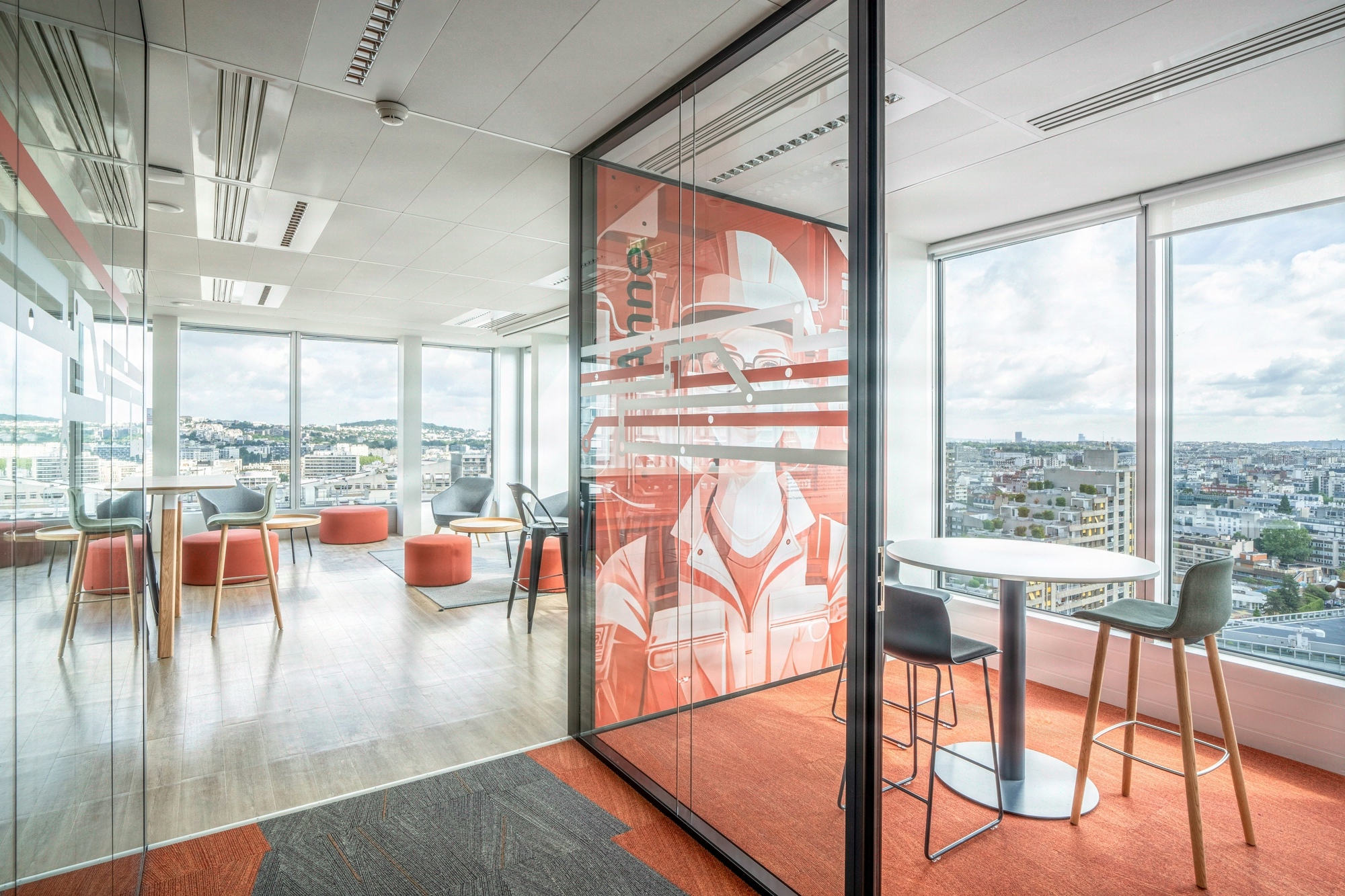
Energy consumption reduction solutions for your offices
Framework: three milestones up to 2050 and penalties of 7,500 EUR
-40% by 2030 is the regulatory floor, not the target: aiming for -45% from delivery secures the 2040 trajectory without a second round of works. Reducing energy consumption in offices is not decided on the 2050 trajectory, but on the reference year chosen between 2010 and the second-to-last declared year, which determines a major share of the reported result. Across a French tertiary stock of 960 million m², the savings potential per medium-sized floor plate can represent several tens of thousands of euros per year depending on the initial consumption level. Kytom, founded in 2006, combines standardised energy audits, dynamic thermal modelling and a works programme integrated into the fit-out, with 24 months of post-delivery monitoring that stabilises gains where an underused BMS fails to deliver on its promises over time.
The decree of 9 May 2017 on tertiary energy renovation, suspended by the Council of State then replaced by the 2018 ELAN law, requires an annual declaration for any tertiary site of at least 1,000 m², with penalties of up to 7,500 EUR per building (decree 2019-771, article R.174-32 of the Construction Code). The trajectory follows three regulatory levels:
- 2030: -40% relative to a reference year after 2010
- 2040: -50%
- 2050: -60%
The BACS decree (2020) adds an automation requirement for HVAC systems above 290 kW by 2025 (decree 2020-887). The European taxonomy and the CSRD directive increase investor pressure on the green value of assets held for more than 5 years.
On the occupational health side, articles R.4222-1 and following of the Labour Code govern indoor air quality, which prohibits any HVAC optimisation that degrades air renewal. According to Cerema (Tertiary stock and energy renovation, 2022, p.14), 35% of the tertiary stock predates 1975, which sets the works scope at 60-70% of envelope actions. For a typical floor plate, avoidable energy charges represent a significant potential, directly addressable within a low-carbon trajectory.
5-step audit method deployed over 12 weeks, compliant with the European standard applicable to building energy audits
The Kytom method is deployed in 5 measurable steps over 12 weeks on average, compliant with the energy audit standards applicable to the tertiary sector.
- Instrumented audit (4 to 6 weeks): HVAC, lighting and office equipment readings, identification of the most favourable reference year between 2010 and the second-to-last declared year.
- Dynamic thermal modelling: prioritisation of actions by cost/kWh-avoided ratio, calibrated to the current average tertiary MWh prices.
- Works programme: LED relamping, controlled BMS, pipe insulation, free-cooling, CO2 sensors, time zoning.
- Fit-out integration: high-performance partitions, acoustic dividers, reversible furniture, consistent with usage.
- Energy declaration and 24-month monitoring via a monthly dashboard.
The works partners are RGE-qualified, and the internal quality system relies on certification. Our view here differs from the common practice in the energy audit market: the profession largely delivers standalone audits, handed to the client who must then steer the works programme themselves. An audit not coupled with the fit-out scope leaves a significant share of the potential uncaptured, because envelope actions and fit-out actions are arbitrated separately by two project owners. The audit as a standalone deliverable is profitable for the engineering firm, not for the asset.
Prioritising actions at 0.08 EUR/kWh avoided: the capex sorting grid
Energy Savings Certificates (CEE) cover 8 to 22% of the capex depending on the standardised sheets mobilised (public sheets BAT-TH-127, BAT-TH-116, BAT-EQ-127 available on the Ministry for Ecological Transition website), which brings envelope actions initially beyond the relevance zone closer to the threshold.
When this grid does not apply. Below 400 m² or for an asset held for less than 3 years, controlled BMS and free-cooling fall outside the profitable scope: ROI mechanically above 8 years, capex not depreciable over the holding period. In these configurations, the scope narrows to LED relamping and pipe insulation, and the energy declaration relies on optimising setpoints rather than on works. Similarly, on a site already renovated post-2015 with an active BMS, the residual potential drops below 12% and does not justify a full energy audit: a targeted 2-week diagnostic is enough.
For the CFO and Asset Manager: how the energy consumption reduction trajectory of the tertiary stock changes the income statement
Read from the asset side, the regulatory obligation to reduce the energy consumption of tertiary buildings is not a CSR topic but a 5-year impairment risk and an immediate OPEX opportunity. On an 850 m² floor plate, integrated works (LED, BMS, pipe insulation) typically generate a significant annual OPEX saving, an ROI leveraging CEE via the BAT-TH-127 and BAT-EQ-127 sheets, and a reduction in Scope 1 and 2 emissions calculated according to ADEME’s Base Carbone methodology. Thermal comfort and the green value of the asset improve in parallel, according to tertiary market benchmarks.
For the CFO, the reading is mechanical: annual saving in recurring OPEX, capex depreciable over 7 years as a separate component (CRC regulation 2014-03), CEE as exceptional income at signature. For the Asset Manager holding the asset for more than 5 years, green value constitutes a divestment lever independent of the energy gain: an asset embedded in a documented sustainability trajectory positions itself in the upper range of the market, while an asset with no visible approach suffers an impairment at resale.
Method
- Initial energy audit
Complete building diagnostic: 3-year consumption readings, analysis of HVAC and lighting equipment, infiltrometry test. Deliverable: prioritised action plan with ROI per item. - Energy declaration and trajectory
Choice of reference year and method (relative or absolute), then declaration on the official platform. A strategic step that determines 25 years of compliance, not to be delegated without expertise. - Lighting and control quick wins
Deployment of controlled LED and HVAC time scheduling in 6 to 8 weeks. Immediate gain of 25-30% on the bill, ROI under 3 years. Mobilises CEE to reduce the budget by 20%. - Structuring HVAC renovation
Replacement of obsolete equipment, dual-flow ventilation, zone-based control with CO2 sensors. Phasing per floor plate to limit operational disruption. Gain of 30-40% on the HVAC item. - Targeted envelope works
Roof insulation, treatment of thermal bridges, joinery sealing. Infiltrometry test after works to validate the gain. Favour external insulation if the facade allows it. - Ongoing monitoring and awareness
Deployment of an energy dashboard per floor, training of internal champions, quarterly CSRD reporting. Maintains gains over time and captures 8-12% of lasting behavioural savings.
Frequently asked questions
Which reference year should you choose to maximise the -40% trajectory by 2030?
The reference year is chosen between 2010 and the second-to-last reported year (Article R.174-32). This choice drives 60–80% of the reported outcome: a high-consumption year—marked by full occupancy, a harsh winter or ageing equipment—mechanically makes the -40% target for 2030 easier to reach. The regulatory energy audit must factor in this baseline from the initial scope.