Urgent interventions: balancing time, quality and cost without overruns
Time, quality, cost: lock in the right trade-offs from day one
A well-scoped emergency intervention costs slightly more in materials, but avoids most site contingencies: the trade-off is no longer financial, it is operational. For the CFO and the Asset Manager, this observation changes the reading: the extra cost of pre-qualified components is in fact an insurance premium against budget overruns, not a burden. Kytom, founded in 2006, manages these situations through a Design & Build methodology in 4 accelerated phases, with an express diagnosis within 24 working hours and centralised coordination by a single project manager. Initial scoping strongly reduces the risk of overrun compared with a site launched without a prior audit. Damage, HVAC breakdown, ERP compliance imposed by the safety commission, sudden departure of an occupant: emergencies in a commercial environment require irreversible decisions within a constrained timeframe. Our internal feedback shows that 80% of financial overruns crystallise before the 3rd day, on scope and phasing choices that are rarely formalised. This page sets out the 3 structuring trade-offs, the 3 recurring mistakes, the 4-phase methodology, the conditions under which the model does not apply, and the performance ratios observed internally.
Any emergency intervention simultaneously triggers 3 incompatible trade-offs if you try to maximise everything. The classic triangle imposes an explicit compromise, set from the initial assessment.
- Scope vs imposed deadline: restrict the treated area (floor, open-plan level, technical room) to the minimum viable for operation, rather than extending the intervention.
- Level of finish vs budget: accept an intermediate standard (single-coat paint, dry-laid technical flooring) then schedule a deferred catch-up.
- Customisation vs speed: favour pre-qualified components (modular partitions, luminaires in supplier stock) over bespoke items.
Kytom’s contrarian position. Sector orthodoxy holds that on an emergency you should first seek to compress material costs. Our reading, after 200 express interventions, is the opposite: on an urgent site, material cost is the least sensitive variable (15% variance maximum), while coordination cost and lost-operation cost are the dominant variables (up to 30% unproductive time on separate assembly, internal Kytom observation 2021-2023). Optimising materials at the expense of pre-qualified components is an almost systematic false economy.
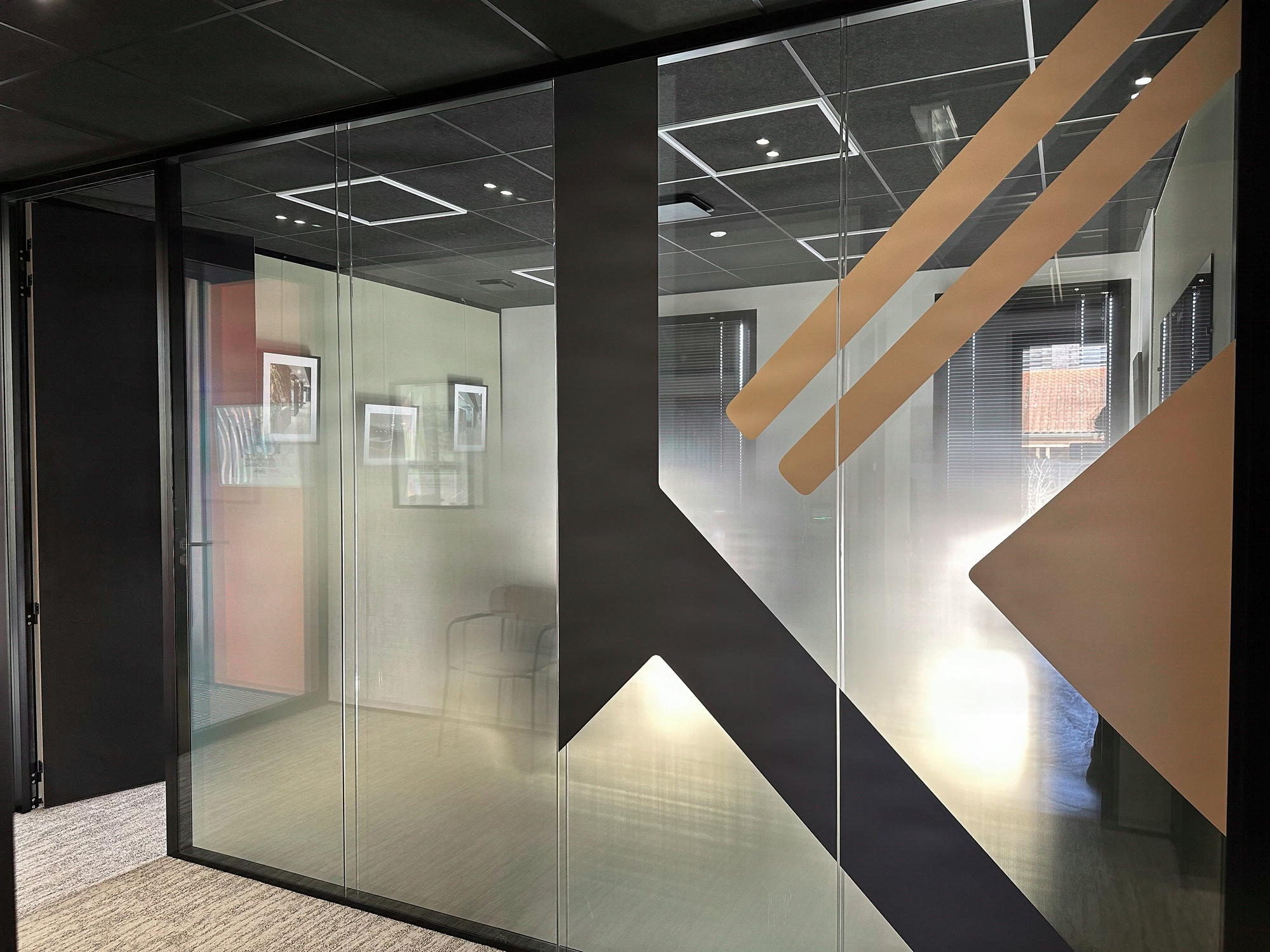
The most frequent illustration concerns partitions: opting for catalogue-referenced demountable partitions generates an extra material cost of around 15%, but halves the installation time compared with traditional masonry partitions.
The Design & Build approach, adopted by Kytom since 2006, consolidates these 3 decisions with a single point of contact. Design and execution are integrated within the same team, which avoids back-and-forth between project manager, general contractor and suppliers.
When this model does not apply. The accelerated Design & Build trade-off loses its relevance below 80 m² treated or for purely curative single-trade interventions (replacement of a chiller unit, repair of a locally flooded suspended ceiling): the extra cost of integrated coordination is not amortised, and a directly referenced tradesperson remains more efficient. Likewise, beyond 3,500 m² or in the presence of a complete new fit-out programme, the emergency gives way to a classic project cycle with a preliminary/detailed design phase.
Within what timeframe can Kytom intervene on a commercial emergency?
The express diagnosis is delivered within 24 working hours of contact, with a binding scoping note. The start of works depends on the scope: 48 to 72 h for a pre-qualified single-trade intervention, 5 to 10 days for a complete floor requiring specific supplies.
What minimum size justifies the accelerated Design & Build model?
The operational threshold is around 80 m² treated. Below that, the extra cost of integrated coordination is not amortised: a directly referenced tradesperson on a single trade remains more efficient. Accelerated Design & Build proves its economic return between 80 and 3,500 m². Beyond that, or in the presence of a complete new fit-out programme, the classic project cycle with prior design regains the advantage.


Planning a fit-out project?
Get a complimentary audit of your spaces: an expert eye, concrete recommendations, no commitment.