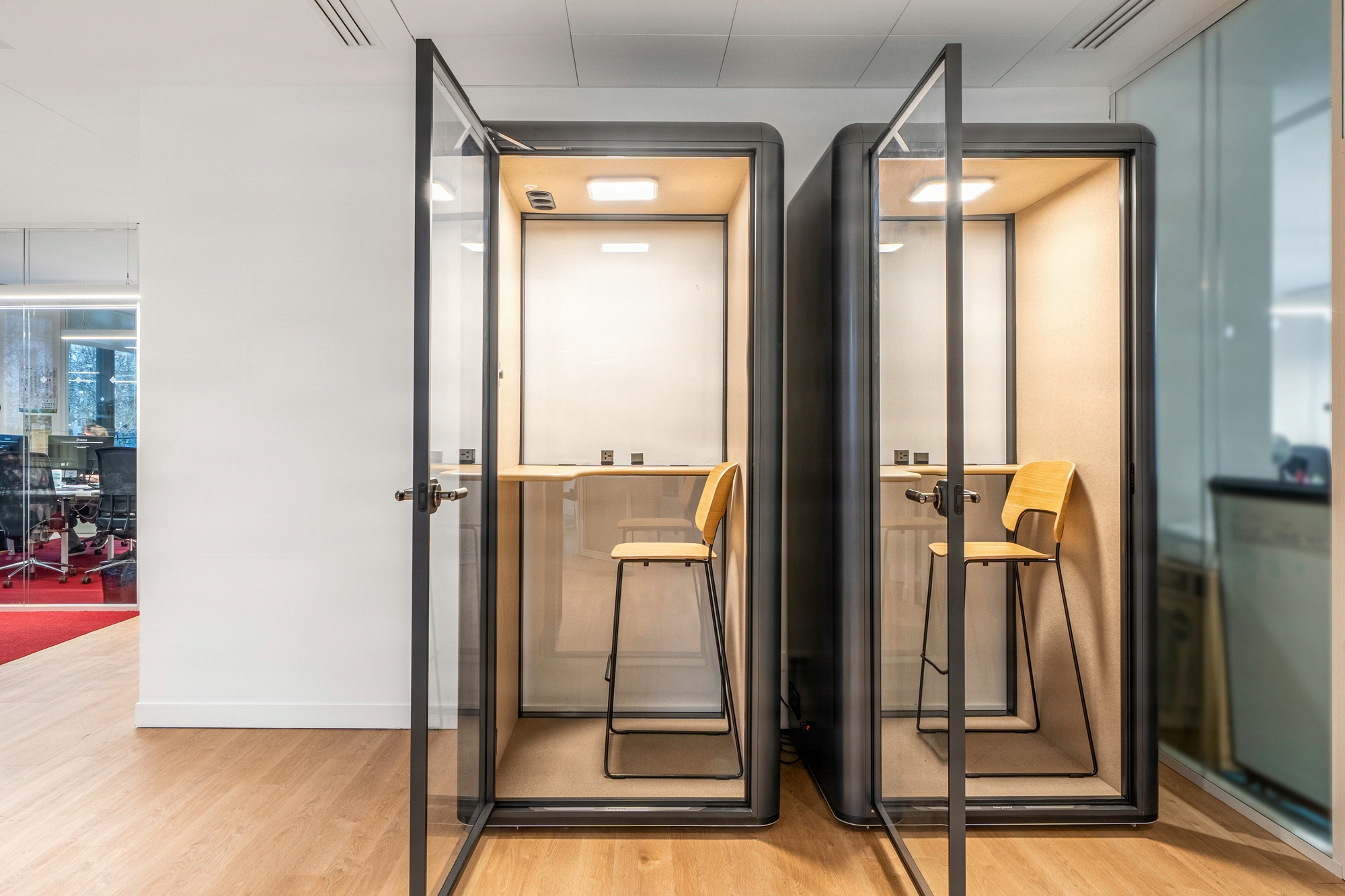
Acoustic booths and phone boxes: premium integration by Kytom
Three technical trade-offs to settle before signing
A poorly positioned acoustic booth loses a significant share of its perceived effectiveness, and the cost of reworking it reaches 1,500 to 2,500 EUR per unit: NF S 31-080-1:2006 sets a target isolation of 30 to 40 dB, but no catalogue holds this performance without prior HVAC coordination. Acoustic booths meet a real need for confidentiality in open-plan spaces, but their integration combines three technical trade-offs that are rarely anticipated: isolation versus ventilation, density versus accessibility, flexibility versus performance. Kytom has worked in the office fit-out sector since 2006, with 10 branches in France and Spain, and observes that these constraints are frequently underestimated at the programming stage, which forces recalibrations after delivery. This page details the structuring tensions to resolve, the recurring errors observed in operation, the audit methodology applied by Kytom, and the reference budget framework by typology.

The integration of acoustic booths reveals three technical tensions that projects underestimate in 7 cases out of 10.
- Isolation versus ventilation: an acoustic isolation performance of 35 dB(A), consistent with the requirements of NF S 31-080-1 at its creation for concentration zones, requires a specific ventilation system. The flow rate of 15 to 20 m³/h per occupant (Labour Code, articles R4222-1 et seq. for premises with non-specific pollution) must be ensured without breaking the acoustic sealing, which constrains positioning close to an HVAC return, or via an integrated silent fan below 30 dB(A).
- Density versus accessibility: optimising the booth/workstation ratio requires calibrating circulation distances. The minimum distance of 1.2 m between two booths preserves flows and accessibility for people with reduced mobility, in accordance with articles R4214-1 et seq. of the Labour Code.
- Flexibility versus performance: modular booths make reorganisations easier but generate acoustic bridges at the panel junctions, reducing the measured isolation by 3 to 5 dB compared with the catalogue value.
Our reading differs from the industry doxa on this precise point: the industry communicates heavily on catalogue isolation (Dn,e,w up to 40 dB), whereas real isolation systematically drops by 3 to 5 dB in operation as soon as there is modularity. Claiming 35 dB as a guaranteed on-site value therefore assumes a monobloc product, not a demountable booth, contrary to what most technical data sheets suggest.
When this trade-off logic does not apply: below 30 workstations on a floor, the ratio of 1 booth per 15-20 workstations often leads to a single unit, whose usage ROI becomes marginal if the rate of confidential calls remains below 5% of working time. In this case, Kytom recommends an acoustic armchair or a shared meeting room rather than a dedicated booth, whose installed cost (3,500 to 8,000 EUR) is only justified beyond 40 workstations or in the presence of intensive HR/commercial use.
To place this solution within an overall strategy, explore our acoustic correction strategy.


