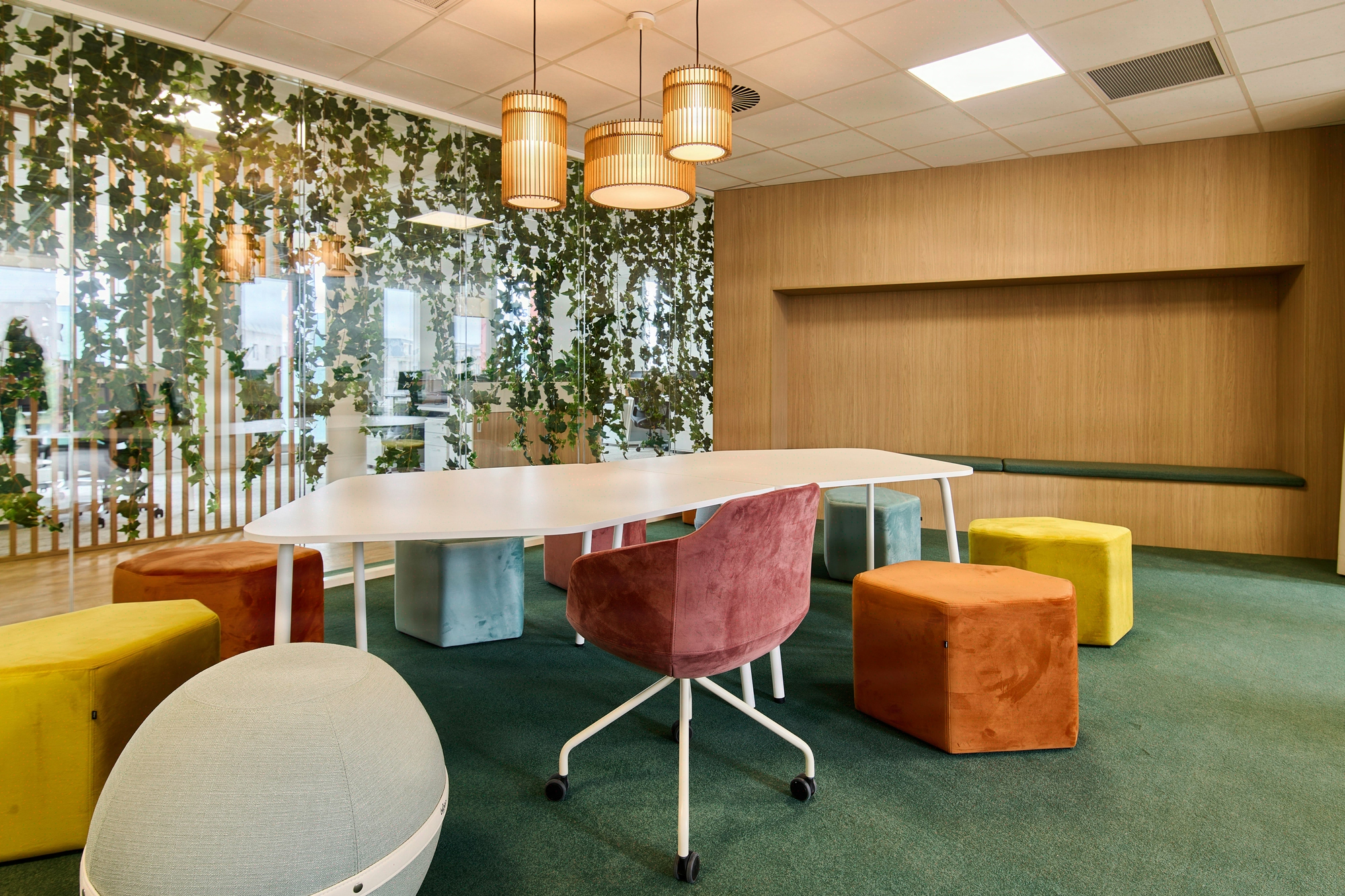
Reuse of raised access flooring
A resource present in the majority of post-1990 floor plates
On an 850 sqm office floor plate, the raised access flooring item accounts for 8 to 14% of the fit-out budget, meaning 30,000 to 60,000€ too often spent on new panels when the ones already in place have 30 years of technical service life ahead of them. Across 63 floor plates audited by Kytom between 2018 and 2024, we recover 70 to 95% of existing panels after controlled removal, with a managed breakage rate under 4%. In practical terms, we handle the entire chain: PEMD diagnosis, 10% sampling, sorting at removal, reconditioning to the applicable technical requirements for raised access floors and laser-levelled reinstallation, all within a 12-week schedule for a typical floor plate. The AGEC law has required PEMD traceability for 10 years since 2022: Kytom has structured this practice since 2006 and embeds it across its 11 branches. Here are the four levers that turn this dormant resource into immediate financial and asset value.
The framework
Since 2022, the AGEC law has required a Products-Equipment-Materials-Waste (PEMD) diagnosis for any demolition or renovation operation exceeding 1,000 sqm. The vast majority of office floor plates built after 1990 have a raised access floor that can be reused directly on site, without heavy external logistics.
The economic orders of magnitude frame the decision from the preliminary design stage: an equivalent new panel typically trades between 35 and 75 € excl. VAT before installation, versus 4 to 12 € excl. VAT for a panel reused on site, representing significant savings on this item. The 600×600 mm steel-mortar panel has a service life of over 30 years (NF EN 12825), which strengthens the relevance of reuse. The raised access flooring item typically accounts for a sizeable share of the fit-out budget.
Industry conventional wisdom puts forward the BREEAM Mat 06 credit and the carbon argument as decision drivers. In practice at Kytom, on floor plates with a valued resource, the budget trigger systematically precedes the extra-financial argument in investment committees. Environmental and certification frameworks value reuse through dedicated credits, but they act as validation accelerators, not as triggers.
Your gains
Several tens of thousands of euros freed up per floor plate, reallocable to user experience
On floor plates with a usable resource, raised access flooring reuse typically frees up several tens of thousands of euros that can be reallocated to user experience (acoustics, circadian lighting, ergonomic furniture), while significantly reducing the project’s carbon footprint. The schedule extension remains limited and controlled.
For the finance department, this differential does not disappear from the budget: it is redeployed onto items with immediate use value, and therefore onto the attractiveness levers that weigh in rental valuation.
For the Asset Manager, the documented circular action directly feeds extra-financial reports and the in-use environmental performance documentation, two items now examined during office acquisition due diligence. The project’s critical path remains under control, with the sorting phase integrated into the removal.
Points of vigilance
Asbestos before 1997, heterogeneous plenum, 2-year installation warranty
Reuse requires several technical and contractual points of vigilance that our teams track from the design phase, to spare you any unpleasant surprises during execution.
- Asbestos: panels predating 1997 may contain traces of asbestos in the vinyl covering. A pre-works survey is mandatory and conditions the entire project; we systematically include it in the initial diagnosis.
- Dimensional compatibility: plenum heights vary considerably between buildings, which sometimes limits the interoperability of panels from different origins.
- Floor plate history: the effective reuse rate drops sharply when the floor plate has undergone numerous successive refits or untreated water damage.
- Installation warranty: Kytom covers the reinstallation, backed by the reconditioner’s 2-year warranty on flatness and mechanical strength, regardless of the reused origin of the panels.
We document these points in a scoping note delivered before signing the works contract, so that your real estate department and your Asset Manager share the same reading of the residual risk.
Commercial honesty
When reuse is not the right answer
Reuse is not automatic. In our portfolio, four configurations make the approach counterproductive, and we say so frankly at the scoping stage rather than mid-project:
- Small-area floor plate: the sorting logistics become proportionally too heavy, and the budget gain is absorbed by site mobilisation.
- Raised access floor predating 1997 with no usable asbestos file: the cost and lead time of the R4412 survey exceed the expected savings.
- Floor plate that has undergone numerous successive refits: the effective reuse rate collapses and the ROI of selective removal becomes negative.
- Heterogeneous plenum height between zones: panel interoperability is compromised, and the projected breakage rate becomes unacceptable.
In these cases, we steer towards conventional removal with steel material recovery through a recycling channel and the supply of new panels sourced from our partner manufacturers. PEMD traceability remains ensured, the carbon assessment is less favourable but the overall budget is protected. This upfront transparency is what brings our clients back for subsequent operations.
Method
- Initial diagnosis and sampling
Our teams sample 10% of the floor plate’s panels, measure the plenum dimensions, check the existing flatness and identify the original manufacturer. This phase results in an AGEC-compliant PEMD diagnosis that precisely quantifies the reusable resource and sets the share of new supply to be planned. - Qualitative sorting at removal
During removal, each panel is classified into three categories: direct reuse, reuse after reconditioning, steel material recycling. Sorting is done on the fly to avoid any additional handling. Traceability sheets are filled in panel by panel. - Controlled reconditioning
Reusable panels go through a mobile workshop on site: cleaning, covering inspection, replacement of faulty pedestals, load tests with a minimum concentrated load of 3 kN and a distributed load of 8 kN/sqm. Non-conforming panels are set aside for the recycling channel. - Laser-levelled reinstallation
Reinstallation is carried out on a new or existing grid depending on the condition of the substrate, with laser levelling and flatness correction to the millimetre. Our teams sequence the work with the MEP engineering offices to avoid any rework after the networks are brought under load. - Delivery of the as-built file and 10-year traceability
The as-built file includes the traceability sheets for each batch, kept for 10 years in accordance with the AGEC law. This documentation directly feeds the extra-financial reports and the in-use environmental documentation for your asset.
Frequently asked questions
What is the real financial gain from raised access flooring reuse on an office floor plate?
On an average-sized floor plate, reusing raised access flooring frees up €12,000 to €35,000 (KYTOM internal benchmark 2022-2024), a 35 to 60% saving on this line item. Reused tiles, after inspection, come in at €4-12 excl. VAT, versus €35-75 excl. VAT for an equivalent new tile, including the added logistics cost of sorting and reconditioning. This budget is often redeployed to items with immediate use value: acoustics, lighting, furniture.