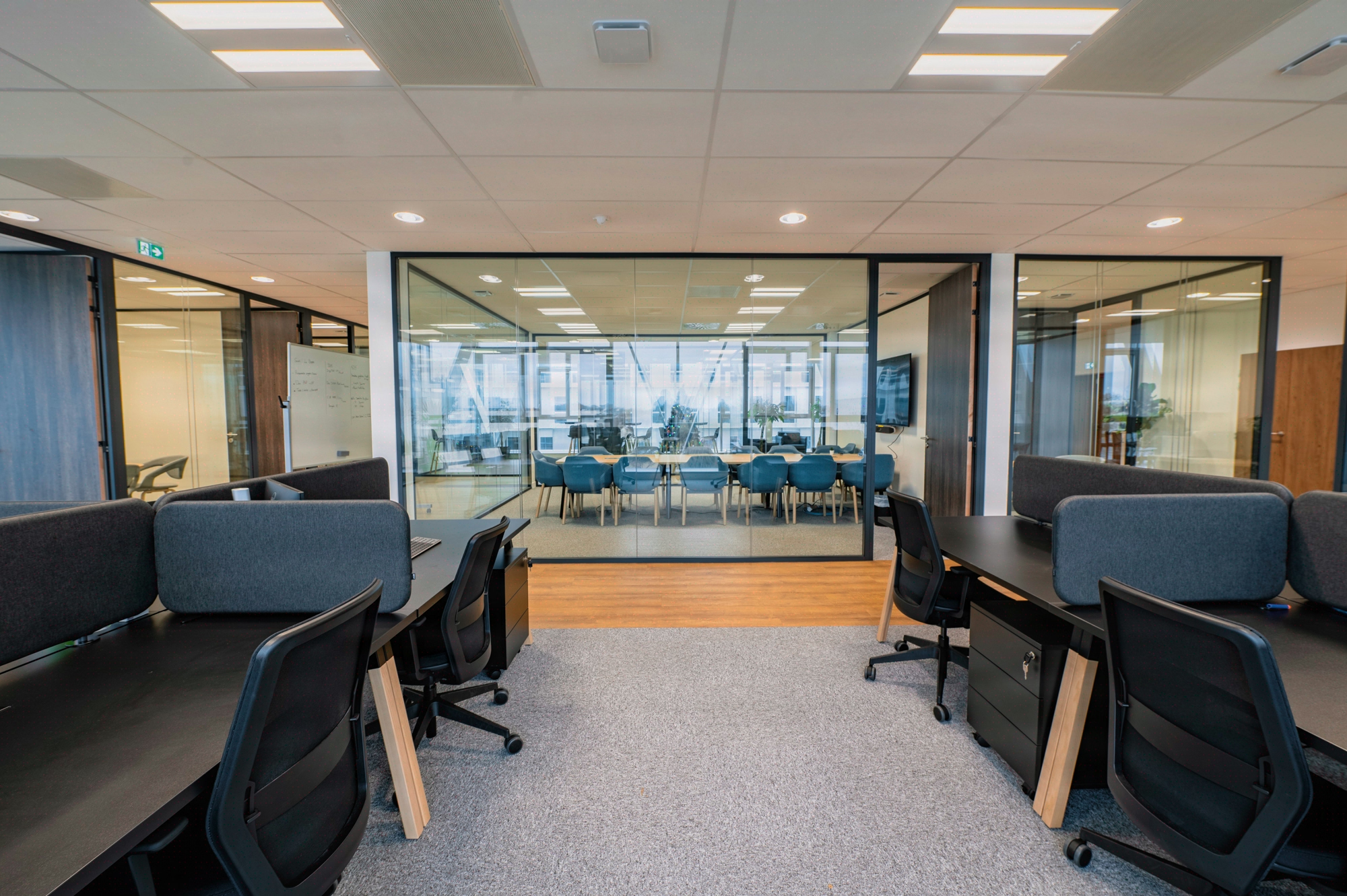
Change management workshops
Regulatory framework and the obligation to prevent psychosocial risks
An office fit-out project disrupts familiar reference points: according to the Actineo “Vie au bureau” 2023 barometer, a significant share of office employees report a loss of spatial markers during a relocation. Kytom workshops turn this concern into active contribution from the programming phase onward and engage groups of 8 to 12 people, noticeably reducing the post-project turnover observed on our recent projects. A well-supported office fit-out project generates markedly higher employee buy-in than a rollout without a structured framework, with a direct impact on talent retention.

The legal framework places on the employer an obligation to prevent psychosocial risks, which change management falls directly under. An unsupported relocation produces effects that are now well documented: loss of spatial markers, disruption of routines, uncertainty over usage rules. Kytom workshops address three operational challenges.
- Enforceable legal traceability: signed, compliant minutes, alignment with the works council (CSE) consultation, a minimum legal period of 30 days extended to 60 days in the event of an expert assessment.
- Reliability of programming choices: mapping of activities before trade-offs on concentration zones, collaborative spaces and phone booths, a step that significantly reduces change requests in the post-delivery phase.
- Talent retention: structured support limits departures linked to post-relocation disorientation, the replacement cost of which for an office manager is recognised as substantial by HR players in the sector.
Our reading differs from the profession’s received wisdom on this point: the industry treats change management as a soft HR deliverable. Kytom considers it an obligation of means under the prevention of psychosocial risks, the absence of which is enforceable against the employer in the event of post-relocation litigation. Environmental and quality-of-use standards value occupant consultation, but it is indeed legal traceability, not the label, that justifies the framework to a CFO.

CFO and Asset Manager perspective: ROI and avoided rent
For the CFO and the Asset Manager, the trade-off plays out on three lines of the operating account, not on declared well-being.
- Framework cost: 4 workshops of 90 to 120 minutes involving 8 to 12 employees, internal workload and external facilitation included, a preventive lever that significantly reduces post-delivery change requests. A single avoided move-add-change on a floor of 60 to 80 workstations pays for the workshop phase.
- Productivity recovered: the drop in productivity after move-in, often noticeable in the first weeks, is significantly reduced when employees have been involved upstream in fit-out choices. On a floor of 70 workstations, that is as many person-days recovered in the first year, a line directly monetisable at the average loaded cost.
- Asset value and energy trajectory: a floor whose uses are stabilised and documented (usage charter, target collaborative/individual ratios) facilitates consumption reduction trade-offs, with under-occupied zones identified from the usage workshop onward rather than at the first measurement campaign.
A well-run framework generates a return on investment in the very first year, with the break-even point generally reached in the first months after delivery. It is a programming investment, not an internal communication expense.

Framework architecture over 12 weeks
The method structures 4 workshops paced across the project cycle, each producing a specific deliverable signed by the executive sponsor.
Vision workshop (week 1, 90 minutes, 10 participants): presentation of strategic ambitions by the leader, alignment on 3 measurable objectives covering density, collaborative/individual ratios and target usage indicators. Deliverable: strategic framing note.
Usage workshop (weeks 3 to 4, 90 minutes, 8 to 12 per group): mapping of activities on a grid of 6 typologies (concentration, collaboration, informal exchange, confidentiality, creativity, rest), with quantification of time spent by job profile.
Mock-up workshop (weeks 6 to 8, 120 minutes, 10 participants including business representatives): review of 2D plans, 3D immersions, validation of zoning, integration of feedback in a maximum of 2 iterations to keep to the furniture ordering schedule.
Rituals workshop (week 11, 90 minutes, 12 participants): co-construction of the usage charter covering room booking, noise management, remote working and clean desk. The 8 to 12 person format preserves the quality of exchanges in participatory working groups.
Application limits of the full framework: the 4-workshop format over the standard timeframe is not relevant below 25 affected employees (diluted ROI, direct dialogue more effective) nor beyond 4 annual floor reconfigurations (the workshops cease to provide incremental value, and one must switch to permanent usage governance run by an internal facility manager). Likewise, when the project schedule requires delivery in less than 8 weeks, Kytom recommends limiting the framework to 2 workshops (vision and rituals) rather than artificially compressing the 4 sequences, at the risk of degrading the quality of trade-offs.

Measured results and conditions for success
The indicators collected by our internal observatory on supported projects make it possible to isolate the specific effect of the workshops. Projects supported by structured workshops consistently show better appropriation of the new spaces and higher employee satisfaction at delivery. Change management workshops significantly reduce the period of productivity decline observed after move-in, allowing teams to regain their working pace within a few days rather than a few weeks.
Three factors determine this effectiveness, observed across our portfolio since 2006.
- Executive sponsorship: without the presence of the leader or the CFO at the vision workshop, team buy-in is significantly reduced. The sponsor must sign each deliverable and resolve blockers within 5 working days.
- Representativeness of groups: sessions must cover all business functions and include one representative per 8 employees, failing which certain usage typologies remain under-documented. The 4-workshop format over three months applies from 25 affected employees onward; below that, direct dialogue with the leader produces the same effect.
Frequently asked questions
From what floor size are the workshops relevant?
The format of 4 workshops spread over 3 months applies from 25 employees affected. Below this threshold, a direct dialogue with the manager achieves an equivalent effect, without mobilising groups of 8 to 12 people. From 4 reconfigurations per year, KYTOM steers towards permanent usage governance led by an in-house facility manager.


