Skip to content
Tertiary decree and OPERAT obligations
CSR

Tertiary decree and OPERAT obligations

Tertiary decree and OPERAT: the Kytom method to declare without errors, reach -40% in 2030 and integrate the energy trajectory into your fit-out.

11 cities covered
1 200+ spaces transformed
66 passionate people

The regulatory platform dedicated to tracking tertiary energy consumption remains difficult to grasp for many stakeholders.

What our clients tell us.

You will recognise your situation if…

  • Your 2020-2023 consumption figures are not consolidated by site.
  • The reference year has not been chosen or justified.
  • No dedicated contact for tertiary energy reporting is identified between landlord and tenant.
  • The energy action plan does not formally exist.

Issues and impacts

Hidden cost

A failure to declare on the regulatory platform exposes you to an administrative fine of 1500 euros for an individual and 7500 euros for a legal entity. Above all, a building off-trajectory loses 8 to 15% of its market value, and uncontrolled overconsumption weighs 12 to 25 euros excl. VAT/m²/year on operating costs.

Human risk

Without energy management, decisions rest on the project manager alone, often isolated when facing 4 or 5 sites to declare. The risk of data entry error exceeds 30% on the first filing, and the mental load linked to CSR reporting soars from 1500 m² of portfolio onwards.

Reputational or regulatory risk

The names of non-compliant entities may be published on an official site (name and shame). For a firm or a listed group, this publication impacts the non-financial rating and the ESG criteria tracked by 78% of institutional investors according to <a href="https://www.jll.fr/" rel="noopener" target="_blank">JLL</a>, with a direct effect on the cost of capital.

How Kytom goes about it

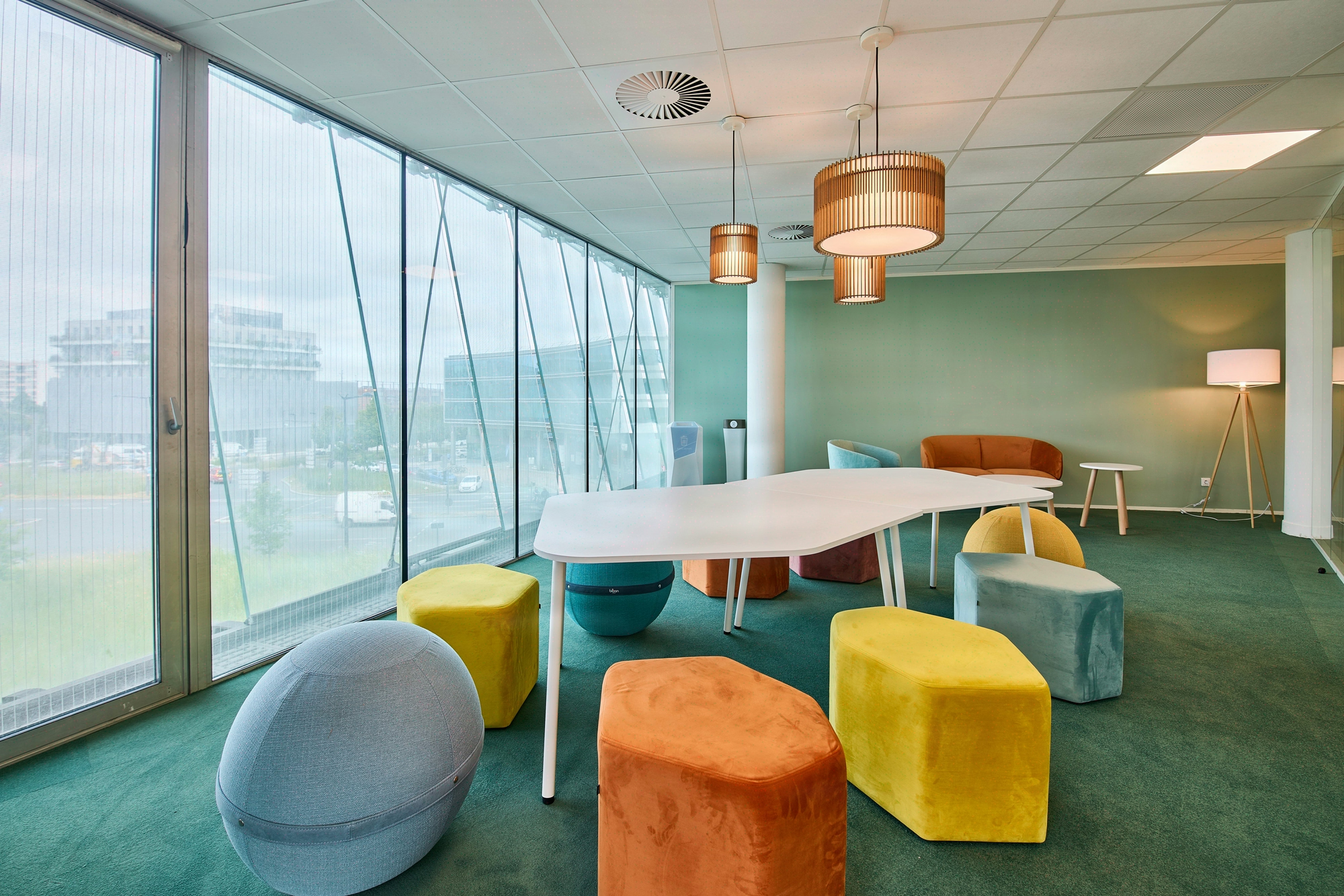
Kytom integrates the tertiary eco-energy trajectory right from the programming phase of the fit-out project, rather than at the end of the chain. Our teams cross-reference the building's energy audit, the target occupancy scenario (density, hours, remote working) and the technical levers (controlled LED lighting, BMS, free cooling, pipe insulation). On 850 m² on average, we identify 18 to 32% of savings potential that can be activated without structural work. The regulatory declaration is prepared with the landlord, the reference year is justified, and each action is costed in CAPEX, OPEX, and kWhFE/m²/year gain. Since 2006, more than 1200 clients have been supported on this type of real estate decision-making.
Our method

  1. 1. Diagnose

    Collection of 2010-2023 consumption data, audit of uses, on-site readings, lease analysis (who declares what). Deliverable: a framing note with a recommended reference year, declaration scope, and the gap to the 2030 trajectory quantified as a percentage.

  2. 2. Frame

    Definition of the target scenario aligned with the fit-out project: occupancy density, zones, hours. Trade-off between the relative method (-40%) and the absolute method (Cabs value). Deliverable: a functional program incorporating 6 to 10 energy actions ranked by ROI.

  3. 3. Design

    Detailed technical design: lighting, HVAC, BMS, thermal partitioning, energy-efficient workstations. CAPEX costing per action and estimation of kWhFE/m² gains. Deliverable: a tender consultation file and an action plan ready to be filed on the regulatory platform for tracking tertiary consumption, validated with the reference landlord.

  4. 4. Deliver

    Execution coordinated by a dedicated project manager, commissioning of equipment, BMS configuration, training of occupants. Deliverable: as-built documentation, certificates, the first regulatory declaration of energy consumption filed, and an annual tracking dashboard over 3 years included.

Cost and ROI

Cost range per m²
900 to 1700 euros excl. VAT/m²
Varies according to the density of energy actions and the initial condition of the tertiary building.
Timeframe
12 weeks on average
From diagnosis to delivery, with the annual regulatory declaration filed immediately afterwards on the dedicated platform.
Typical ROI
payback in 4 to 6 years
Calculated on actual energy savings plus the property's real estate value appreciation.

An anonymized field feedback

Before Kytom, the regulatory tracking of energy consumption was a file pushed back every quarter. Today, the trajectory is clear out to 2030 and the landlord is aligned on the action plan.

-27% vs reference year
Consumption reduction year 1
18 euros excl. VAT/m²/year
Energy costs avoided
reduced to 3 weeks
Filing time on the declaration platform dedicated to the Tertiary Eco Energy scheme.

Frequently asked questions

Who is concerned? All establishments located on a single land unit (contiguous plots) are subject to the tertiary decree.

Any building or group of buildings hosting tertiary activities over an area greater than 1000 m². Offices, retail, hotels, education, healthcare. Reference: the decree of 23 July 2019 published on Légifrance.

Which reference year should you choose?

A full year between 2010 and 2019, representative of normal operation. The choice is strategic: a high-consumption year makes reaching -40% easier. It is recommended to justify this choice with verifiable data.

Landlord or tenant, who bears the obligation to declare energy consumption on the dedicated platform?

Both can be subject to it depending on the contractual allocation. Common practice: the landlord declares the envelope and common areas, the tenant their specific uses. A lease amendment clarifies responsibilities and avoids duplicate data entry.

What happens if you do not declare?

A formal notice within 3 months, then a fine of 1500 euros for an individual or 7500 euros for a legal entity. Possible publication on an official site. Beyond the sanction, the value of the real estate asset is directly impacted.

Can the declaration of tertiary energy consumption be integrated into a fit-out project?

Yes, and it is in fact the most effective method. A fit-out managed with the tertiary eco-energy trajectory makes it possible to activate 18 to 32% of gains without major extra cost, by arbitrating lighting, HVAC, density and BMS right from the design stage.

How does it articulate with the other environmental building certification standards?

Several environmental certification standards in operation cover part of the consumption tracking indicators (energy, water, waste). A joint approach pools the audits and strengthens the ESG reading. The data from the regulatory declaration of energy consumption is accepted as documentary evidence within the framework of these certifications.