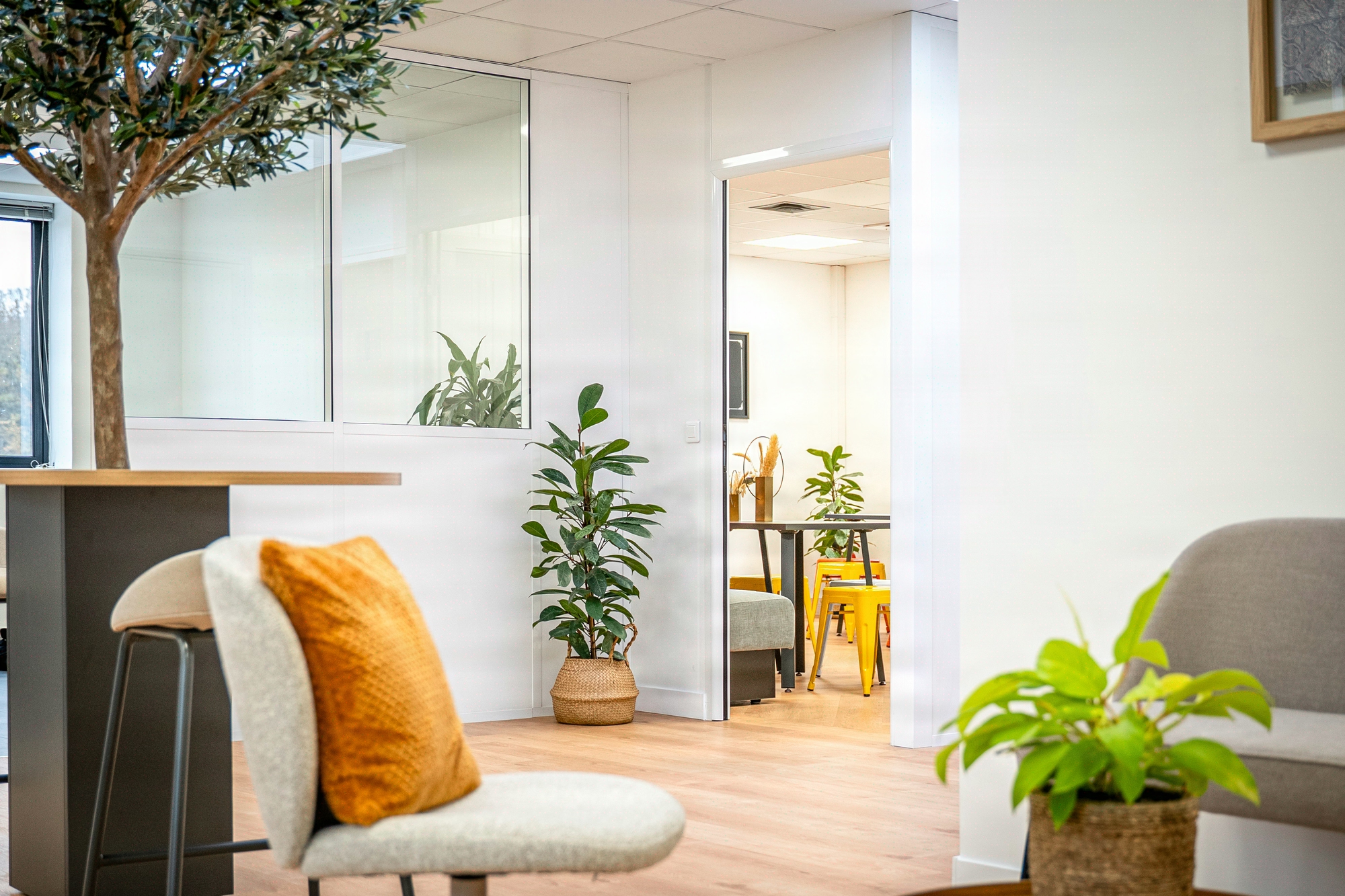
You sign the design, we carry the works coordination
Commercial property market and mandatory energy consumption reductions: why architectural intent is no longer enough
You are an architect or interior architect: this page describes concretely how Kytom works for you, from the first call to the clearing of snags. On a commercial property project, the breaking point is almost never the architectural gesture: it is all-trades coordination, which legally and economically falls outside the scope of a design firm. Kytom handles it as a general contractor, subject to your approvals: you keep the design, the artistic direction and the relationship with your client; we take on execution, deadlines and the contractual responsibility for the trade packages. Four architect approval milestones structure the project timeline, and four mission frameworks cover the common configurations, from simple execution to co-contracting.

Our reading differs from the professional consensus on this point: the EXE phase is not a by-product of the project, it is where architectural intent is won or lost. The commercial property decree mandates a 40% reduction in energy consumption by 2030 compared to a reference year later than 2010. On the client side, 78% now require an environmental performance component aligned with a recognised framework, it being understood that validity periods vary according to the nature of the framework: some operational certifications are valid for 3 years, whereas the new-build and major-renovation versions carry no expiry date.
In this context, a slippage of 4 to 6 weeks is enough to disqualify a rental project aligned with a 3/6/9 lease. The architects Kytom supports face 3 recurring constraints:
- occupied sites: 80% of projects take place in active environments, with phasing and off-hours works;
- tight budgets: 400 to 1,100 €/m² excl. VAT for standard commercial fit-out;
- lead times for bespoke furniture: 12 to 16 weeks.
When the all-trades general contractor approach is not the right answer. Below 150 m² or on simple single-package refresh projects (paint only, carpet replacement), the all-trades contract adds weight to the cost structure without any coordination benefit: opt for a direct tradesperson or a single package. Beyond 8,000 m² with phasing across 6 distinct geographical packages, the single general contractor model reaches its limit and a macro-package with an external OPC becomes relevant again. Finally, on heavy ICPE projects or data centres, the scope moves outside standard commercial property: Kytom refers you to specialised contractors.
Kytom positions itself as the execution arm: taking over the DCE, securing supplies, keeping to milestones. Your artistic direction remains fully preserved, with the 4 architect approval milestones structuring each critical phase.

A 5-step method set over 12 weeks and 4 architect approval milestones
For the architecture firm: coordinating the 14 trade packages represents between 18 and 25% of the mission time in fee-equivalent terms, with no design added value. That is the share Kytom absorbs, not the artistic direction. Our method is built around the average standard lead time measured across the Kytom portfolio, with 4 architect approval points to preserve the design intent.
- Onboarding (5 working days). Analysis of the DCE, contradictory site visit, identification of 8 to 12 sensitive technical points: HVAC, high- and low-voltage systems, smoke extraction, RGAA-PMR accessibility.
- All-trades costing (10 to 15 days). Line-by-line breakdown based on your bill of quantities, compliant with the NF P03-001 standard.
- Site preparation (3 weeks). Authorisations, PPSPS, execution drawings approved jointly.
- Coordinated execution of the 14 trade packages. Partitions, suspended ceilings, resilient flooring, painting, electrics, plumbing, air conditioning, joinery, furniture; weekly meeting, fortnightly photo reporting, Qualibat subcontractors.
- Handover and OPR. Snags cleared within 15 days, DOE delivered within 30 days.
Kytom process formalised and audited internally. The architect retains approval of samples, colours and 1:1 prototypes for signature works (reception desk, screens, custom-designed furniture).
A methodological limit to be aware of. This sequence assumes a DCE stabilised at 80% and a site vacated at handover. On projects with a DCE below 60% (sketch-APS delivered as a DCE), phase 2 balloons to 4 to 6 weeks and the schedule guarantee no longer holds: Kytom then switches to an assumed design-and-build mission, with a specific architect fee amendment. On sites occupied at more than 70% daytime occupancy, night/weekend phasing mechanically extends the schedule by 30 to 50%: the standard method does not apply.
Measured benefits for the firm: schedule kept, intent preserved, single all-trades contract
For the interior architect: 1 contract, 1 ten-year warranty, 1 invoicing over 4 to 6 instalments, 1 site contact. It is the legal structure that shifts the risk outside your professional liability cover, not a sales argument. Kytom measures 3 recurring effects for partner architects: schedule kept, architectural intent preserved, administrative and legal burden lifted.
| Indicator | Kytom | Commercial property market |
|---|---|---|
| Projects delivered on the contractual date | 94% | 70 to 80% |
| Average variance on delivery date | < 4 working days | 10 to 20 days (feedback from partner firms) |
| Post-handover rework rate | 1.8% | 3 to 5% |
The 4 milestones and the 1:1 prototypes for signature works secure the project’s signature. Your project management fees remain focused on design and artistic supervision, without being diluted into the coordination of the 14 trade packages. 7 firms entrust Kytom with 3 to 5 projects a year on a recurring basis, in formats ranging from 200 to 5,000 m².
When the all-trades benefit fades. On projects with a budget below 80k€ excl. VAT, the price difference between all-trades and separate packages (15 to 25% gap observed) is no longer justified: direct architect coordination becomes competitive again. Conversely, on projects with a strong design signature where more than 40% of the budget is in bespoke prototyped works, the risk of diluting the intent increases: the milestones should be strengthened to 6 instead of 4 and an extended prototype approval amendment should be provided for.

Target typologies and contractual scope: 4 architect mission frameworks
Contrary to the widespread practice of classifying commercial property projects by floor area, Kytom segments them by density of bespoke prototypes: it is this ratio that dictates the relevant contractual scope, not the number of m². Kytom targets 4 project typologies.
Do you regularly work on commercial property projects and want to formalise a recurring collaboration framework? See our partner programme dedicated to architects: written commitment, scopes defined upfront, your signature preserved on every project.


