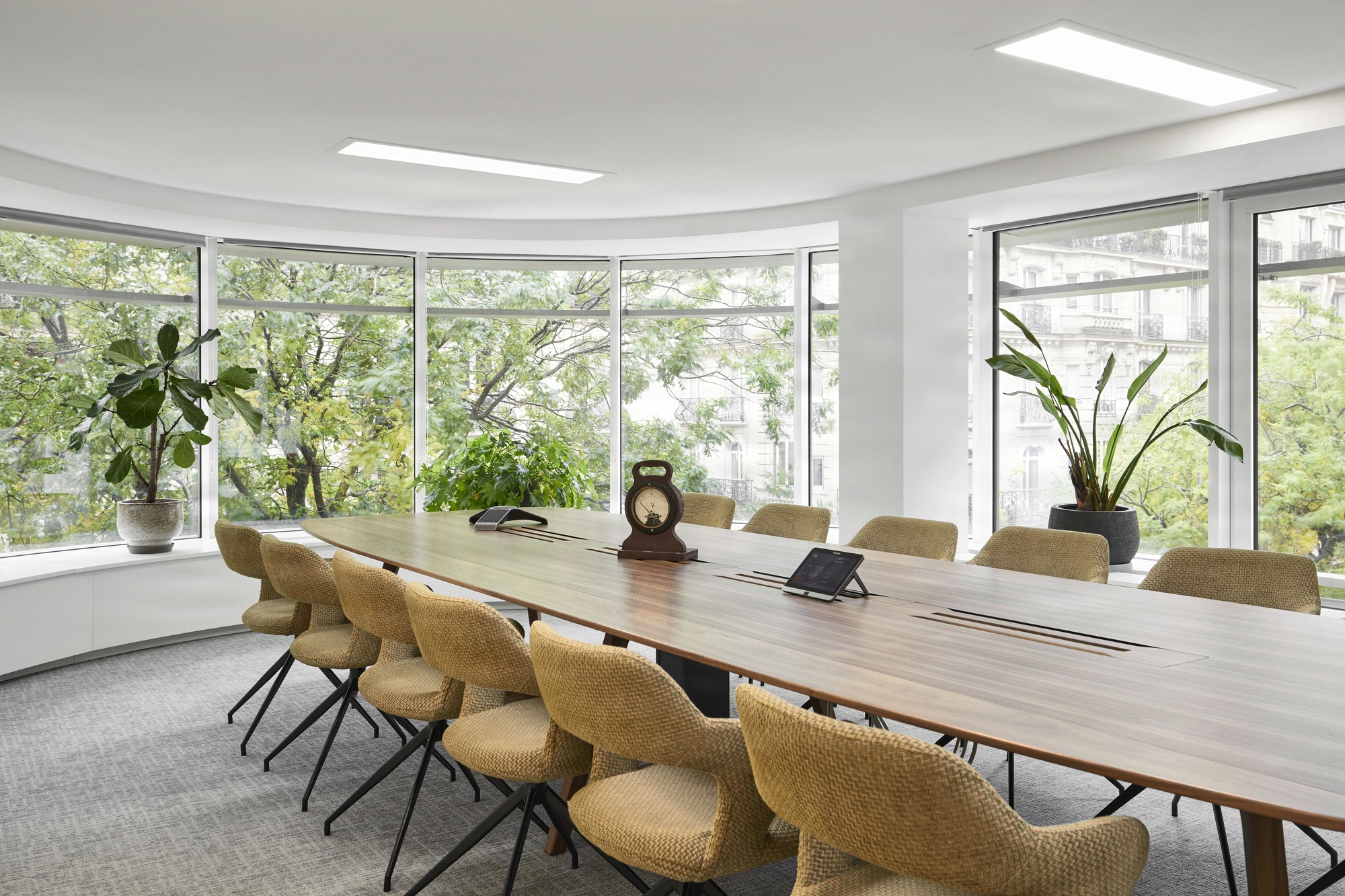
Recessed LED panel: calibrating energy performance and user comfort
Three structuring technical trade-offs for calibrating an LED panel
500 lux is enough: aiming for 600 lux costs 25% more energy for an imperceptible visual gain. NF EN 12464-1 sets 500 lux at the work plane, UGR < 19, CRI > 80. No more, no less. For offices, RE2020 caps the Cep,nr at a maximum average of 75 kWhep/m².year and the Cep at 85 kWhep/m².year (AICVF), and the LED panel concentrates most of the technical trade-offs on the lighting item. Three levers structure the total cost of ownership: lumens per installed watt, driver lifespan, colour temperature. On projects delivered under design and build since 2006, Kytom observes controlled costs including installation and a significant reduction in handover defects compared with operations delivered in separate work packages. This page sets out the calibration methodology, from the photometric audit to post-installation adjustment.

Choosing a recessed LED panel for commercial premises rests on three quantifiable trade-offs that weigh well beyond the initial purchase price.
- Light performance versus consumption. Aim for 500 lux at the work plane with 40 W panels rather than 600 lux with 50 W ones. The benchmark adopted in offices is 500 lux, with UGR strictly below 19 and CRI above 80. The difference in visual perception between 500 and 600 lux remains marginal compared with the additional energy consumption it generates.
- Lifespan versus initial cost. A panel rated for 50,000 hours costs significantly more to buy than a 30,000-hour panel, but significantly reduces the frequency of maintenance interventions over the operating period.
- Colour temperature versus comfort. Neutral white 4000 K is preferred over cool white 6500 K for long office days, a choice that aligns with established practices for commercial lighting environments.
Our reading here departs from the professional doxa that pushes 600 lux by default. In practice, on the projects we have delivered in recent years, no user feedback has reported a complaint about under-lighting at 500 lux when UGR and CRI were correctly maintained: it is glare that degrades comfort, not the absolute level. Oversizing to 600 lux is a legacy of fluorescent ranges, where the drift in luminous flux over time was compensated for. With a well-driven LED, that margin no longer makes sense.
The price range is generally between 45 and 65 €/m² including installation, the gap being explained by the UGR category selected, the quality of the driver and the control mode (standalone, DALI or KNX).
When a recessed LED panel is not the right answer. Below 200 m² of continuous area or in an open floor plate with a free height above 4 m, the recessed panel loses its relevance: the grid becomes oversized and linear suspensions or targeted downlights offer a better useful flux / installed watt ratio. On non-removable suspended ceilings or in heritage refurbishment, surface-mounted or wall-mounted installation remains more cost-effective. Finally, under 30 hours of weekly use, the ROI of switching to LED against an existing functional fluorescent stock exceeds 8 years and is not justified outside regulatory obligations for commercial energy renovation.

For the architect and lighting designer: integrate the panel as a ceiling component, not an isolated luminaire
The recurring trap at the detailed design stage is to treat the LED panel as a catalogue product fitted afterwards onto an already-finalised suspended ceiling plan. For the lighting designer, the panel is first and foremost a 600×600 or 1200×300 module that must fit within the structural grid (columns, technical drop-downs, HVAC ducts) before meeting a photometric objective.
Analysis of the installations delivered by Kytom brings up three frequent technical discrepancies that must be neutralised from the detailed design stage onwards.
- UGR neglected. A panel whose glare index exceeds 19 (the benchmark threshold applicable to offices, NF EN 12464-1) generates visual discomfort that prompts occupants to add task lamps, increasing actual consumption beyond design forecasts.
- Undersized driver. Low-end power supplies reduce the actual lifespan by 30% and produce flicker below the threshold of conscious perception, identified as a factor of visual fatigue in the technical literature on workplace lighting.
- Approximate suspended ceiling integration. Faulty thermal sealing raises the LED junction temperature and cuts luminous efficiency by 10 to 15% at 12 months.
Good practice consists of specifying the panel, driver and integration triplet as a coherent system. The observed occupancy ratios (7 to 12 m² per workstation in open space, 12 to 18 m² in enclosed offices) determine the grid, not the other way round. For the architect, this requires early dialogue with the MEP engineering office: the lighting grid must be locked before the suspended ceiling setting-out, not after.
Kytom’s four-step methodology, from audit to final adjustment
The design and build approach, deployed since 2006, removes the costly interfaces between separate work packages and structures the calibration into four steps.
- Audit of actual uses. Kytom’s engineering offices measure effective occupancy by zone, generally lower than the theoretical occupancy of the original plan, in order to set the grid on actual use and not on the initial plan.
- Integrated photometric calculation. The simulation takes into account the interaction between panel, suspended ceiling, furniture and finishes. Our experience of post-measurement recalibrations shows that standard calculations underestimate internal reflections by 8 to 12%, which leads to oversizing the number of panels if the actual reflection coefficients are not corrected.
- Structural and electrical coordination. Openings are validated before the concrete slab is poured or the suspended ceiling installed. Repositioning a panel afterwards significantly multiplies the intervention cost, between removal works, openings to redo and the induced delays.
- Post-installation adjustment. Each zone is calibrated with a lux meter against actual measurements, with adjustment of DALI or KNX scenarios if control systems are present.
This protocol falls within the regulatory framework whose “Method” Order of 10 April 2020 specifies the application terms for commercial buildings over 1000 m², with a target of -40% in energy consumption by 2030. Calibrated LED lighting contributes to this trajectory by 8 to 15 points depending on the state of the initial stock.
Conditions under which the full method does not apply. For a simple like-for-like replacement of fewer than 50 panels in a floor plate already calibrated and compliant with the photometric requirements in force for commercial spaces, the full photometric audit and integrated simulation are not justified: the engineering surcharge exceeds the marginal gain.
Frequently asked questions
What lighting level should be targeted in a commercial office?
500 lux at the work plane, UGR 80, with a maintained CRI value that must not drop by more than 5 CRI points from the nominal value, according to LightingEurope. Beyond 500 lux, the visual gain becomes imperceptible and consumption increases by 25% to reach 600 lux.


