Activity Based Working: calibrating the usage-space equation to fit your professions
4 usage profiles to quantify before any spatial trade-off
Activity Based Working delivers its full value in significantly sized organisations with proven hybrid attendance patterns: below these conditions, a conventional layout can offer comparable satisfaction for a substantially lower programming budget. When the conditions are met, the quality of the initial assessment makes all the difference: organisations that genuinely measure their usage patterns before deployment report markedly higher post-delivery satisfaction than those applying a normative ABW model without prior audit. Kytom maps 4 behavioural profiles through a 4-to-6-week field assessment, then sizes spaces according to the Actineo 2023 ratios and the NF S 31-080 acoustic thresholds. A methodology deployed since 2006.
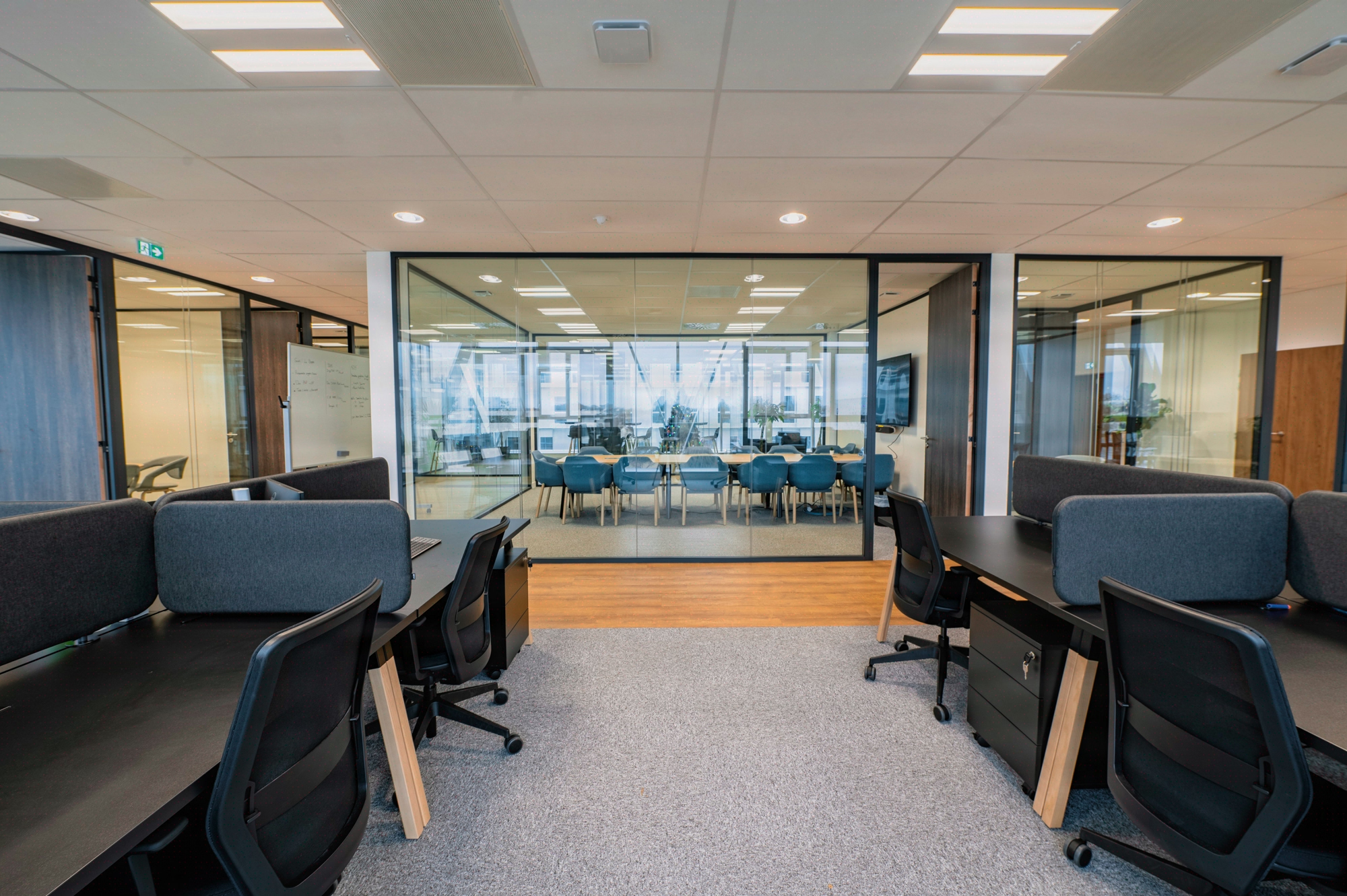
Activity Based Working relies on mapping actual behaviours, not on declarations in workshops. Our reading differs from the professional consensus that structures ABW around 3 generic profiles (focus / collab / social): this framework regularly masks the hybrid project profile, often the majority in real workforces, and leads to under-sizing concentration zones. Kytom identifies 4 structuring profiles to quantify across the target scope:
- Intensive collaborators: 25 to 35% of the workforce, modular spaces of 8 to 12 m², acoustic target of 45-50 dB(A) adopted for exchange zones, direct proximity to project rooms.
- Nomadic concentrators: 20 to 30%, enclosed alcoves below 35 dB(A) at the concentration threshold, low visual density.
- Project hybrids: 30 to 40%, full flexibility with personal lockers, alternating between collaboration and concentration over the course of the day.
- Territorial managers: 10 to 15%, semi-enclosed offices with visibility over the team, surface area of 12 to 18 m².
Each profession generates a specific usage-time equation. R&D teams devote the majority of their time to deep concentration, whereas commercial functions alternate more frequently between individual work and occasional in-person collaboration. This profession-specific distribution directly determines space sizing. Without this mapping, standard ratios produce saturation of enclosed zones and under-use of open-plan floors.

For the CFO and the Asset Manager: what ABW quantifies in the P&L
The ABW trade-off is rarely decided on user satisfaction alone: it is an asset allocation decision. Reframed from a financial angle, the equation becomes legible.
- Rent avoided through workstation pooling. In a hybrid configuration, an attendance rate of around 60 to 70% allows a pooling ratio of less than 1 workstation per employee to be applied, freeing up a significant share of the leased surface. On a 200-workstation portfolio in the Greater Paris office market, this can represent several hundred square metres avoided.
- Relevance threshold. Below a significant single-site headcount, the programming overhead (4-to-6-week behavioural audit, modelling, 6-to-9-month support) exceeds the usage gain. Above a very high weekday attendance rate, pooling does not materialise and the ABW investment is dilutive.
- OPEX vs CAPEX. The adoption protocol (6 to 9 months post-delivery, floor leads, rituals, quarterly adjustments) shifts into recurring OPEX: to be factored into the operating budget, not the works envelope.
- Asset value. A properly calibrated ABW stabilises the occupancy rate within a range compatible with due diligence requirements on office transactions subject to energy consumption reduction obligations.
For the Office Manager, the reading is different: average time to access a suitable space, satisfaction by profile, acoustic compliance zone by zone according to the standard applicable to office spaces. The two readings intersect on a single monthly dashboard.

Three structural errors that compromise adoption
The post-delivery assessments conducted by Kytom isolate three recurring structural errors in ABW deployments.
- Under-sizing of concentration zones. Initial programmes generally allocate 15 to 20% of usable surface to quiet spaces, whereas observed usage reveals a need closer to 25 to 30%. The shortfall generates occupancy conflicts and a fallback onto meeting rooms.
- Undifferentiated acoustics. ABW requires graduated ambiences: applicable acoustic standards target a sound ambience between 48 and 52 dB(A) for predominantly telephone-based activity in open space, while collaboration zones tolerate 45 to 50 dB(A). Treating acoustics as a single global lot, with no gradient, is one of the most frequently encountered errors.
- Change management reduced to a training session. Adopting an ABW model requires 6 to 9 months of user support (floor leads, team rituals, quarterly adjustments); compressing this process into a half-day presentation durably compromises adoption.
These combined errors explain the satisfaction gaps observed in the post-occupancy phase, sometimes very pronounced depending on the level of project preparation. The preventive approach integrates these three constraints from the spatial programming stage, before the partition layout is drawn.
When ABW is not the right answer. The model ceases to be cost-effective for small single-site workforces: the granularity of the 4 profiles no longer justifies spatial differentiation. It becomes counterproductive for organisations with strong regulatory territoriality (sensitive legal, banking compliance, R&D under defence secrecy) or single-activity engineering sites where almost all working time falls within a single profile: in these cases, a conventional layout with a fixed ratio of 10 m²/workstation delivers equivalent satisfaction for a substantially reduced programming budget.

5-step methodology and post-delivery management indicators
The ABW protocol deployed by Kytom structures the engagement over 12 to 18 months depending on organisational complexity. The behavioural audit (4 to 6 weeks) relies on direct observation, workstation sampling every 2 hours over 3 weeks, coupled with profession-specific interviews. Flow modelling (2 weeks) identifies the critical adjacencies between project teams and support functions. Differentiated sizing (3 to 4 weeks) applies reference surface ratios: 7 to 12 m² per workstation in open space, 12 to 18 m² in enclosed offices. Technical integration (6 to 8 weeks) segments zones with graduated acoustics by usage type and lighting tailored to professional requirements. The adoption protocol (6 to 9 months) tracks monthly KPIs with corrective adjustments at 3, 6 and 12 months.
The recommended management indicators: occupancy rate by space type, satisfaction measured by profile at 3, 6 and 12 months, time to access a suitable space, and acoustic compliance assessed zone by zone according to the thresholds adopted in the project standard. These 4 indicators feed the monthly dashboard shared between Real Estate Management, HR and Office Management.
Frequently asked questions
From what headcount does Activity Based Working become relevant?
The break-even point is at 80 single-site workstations. Below that, the programming overhead (usage diagnostics, space typology, change management) outweighs the square metres saved: simple zoning with a few shared spaces delivers most of the benefit. Above 80 workstations, desk pooling absorbs that overhead and frees up floor area for collaborative spaces.


