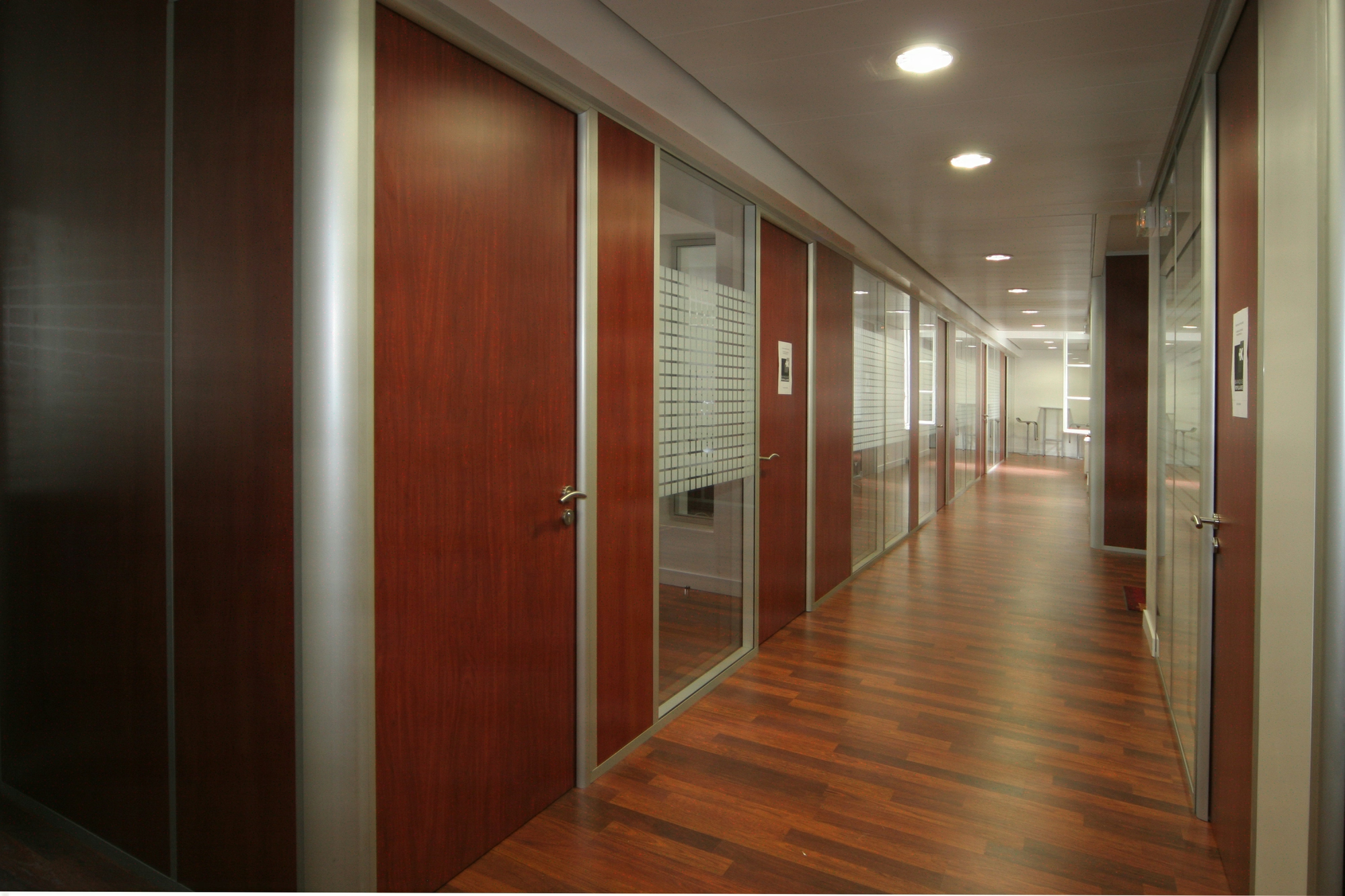
Door accessories: handles, hardware, door closers
4 accessory families governed by 3 enforceable NF EN standards
In a head office, a standard-range handle wears out quickly under the strain of daily traffic: it is a false economy that ends up costing far more over the life cycle. Door accessories account for a modest share of a doorset’s cost but determine the entirety of daily use, with 80 to 200 operations per day on the circulation areas of a heavily occupied office floor. Durability standards rate handles up to 200,000 cycles, door closers are calibrated from EN1 to EN7, and the decree of 20 April 2017 requires an opening force below 50 N. For the architect in the detailed design phase, the trade-off is not primarily aesthetic: it is first regulatory, then ergonomic, and only then formal.

Office door accessories fall into 4 distinct functional families:
- Grip : lever handles, horizontal/vertical bars, pull handles, thumb latches
- Rotation : bearing hinges, electrified hinges, floor pivots, concealed hinges
- Controlled closing : cam or rack-and-pinion door closers, hydraulic pivots, door coordinators
- Protection : stainless steel push plates, wall/floor stops, corner guards, recessed thresholds
Handles are classified according to 8 criteria, including the usage category (1 to 4) and durability (up to 200,000 cycles in class 7). For a high-traffic head office, the specification targets usage class 4 and a minimum of 100,000 cycles. Door closers come in 7 strengths (EN1 to EN7): a 1100 mm leaf requires an EN4, a 1300 mm fire-rated leaf a minimum of EN5. On EI30, EI60 or EI120 doors, the CE marking and fire-certified hinges are enforceable: any mix-and-match outside the test report voids the doorset’s certification.
Our reading differs from the trade’s conventional wisdom on one specific point. Common practice aligns all the doors of a floor to the same usage class, for the sake of supply consistency. This uniformity generates extra cost on the hardware line item with no gain in service life: an archive room will never cross the threshold of 20,000 cycles per year. Segmentation by actual traffic (class 3 on secondary rooms, class 4 on circulation areas and open spaces) is more relevant than alignment by default.
When this regulatory logic does not apply. On a low-traffic technical room such as archives or cleaning storage, class 3 is sufficient: specifying class 4 generates extra material cost per door with no gain in service life. Likewise, on a project of fewer than 15 doors outside EI zones, over-investing in branded hardware does not pay off: a homogeneous mid-range office line is preferable.

The Kytom method in 4 steps for 80+ approved references
Accessory selection follows a structured protocol built around site feedback and inspection body reports:
- Traffic audit : categorisation of doors into 3 intensity levels (0-50, 50-150, 150+ operations per day) with assignment of a regulatory usage class (3 or 4)
- Design/function matrix : cross-referencing 5 standard finishes (brushed stainless steel, brushed brass, matt black, bronze, polished chrome) and 3 grip typologies (lever, bar, pull handle), validated by the architect in detailed design
- Sample prototyping : grip test, measurement of the opening torque (target below 47 N, safety margin vs the 50 N regulatory threshold), acoustic check of the closing, verification of the door closer’s travel
- Site acceptance : 12-point checklist (leaf/frame alignment, hinge play below 3 mm, angular travel 90-180°, push plate tightening, fire report compliance for EI doorsets)
The catalogue pools 80+ references already approved by CSTB or under a Technical Approval, which appreciably reduces supply lead times compared with a one-off specification. The hardware rework rate observed at acceptance remains very low thanks to the 12-point acceptance protocol.
Limit of the pooled method. On a strong-identity project (corporate head office, high-end hospitality, retail flagship), the approved catalogue may be too restrictive: the architectural signature then calls for a dedicated specification, accepting an extended supply lead time and a significant extra cost on the hardware line item. The pooled method is only relevant from 25 equipped doors upward, or where EI zones require strict traceability of test reports.
For the architect in detailed design: arbitrating the hardware line item without breaking partition consistency
On a typical office floor, the accessories line item varies significantly depending on the chosen range level.
| Level | Reference class | Typical finish | Price excl. VAT/equipped door |
|---|---|---|---|
| Functional entry | Class 2-3 | Standard brushed stainless steel | 80 to 150 EUR |
| Mid-range office | Class 4 | Brushed brass, matt black | 180 to 320 EUR |
| Branded signature | Class 4 / 200,000 cycles | Patinated bronze, special finish | 450 to 800 EUR |
| Certified EI60 fire-rated | Class 4 + fire resistance | 304 stainless steel | 280 to 520 EUR |
These ranges are exclusive of special installations and electrified automation.
The architectural trade-off is not made on unit price but on system consistency. For the architect or the project owner’s representative, the hardware line item must be read in step with the interior joinery and complete doorset references: a glazed partition frame with a 60 mm aluminium frame does not accept the same hinges as an 80 mm timber frame, and the hardware finish must dialogue with the partition profiles, the furniture locks and the lighting controls.
3 ROI levers emerge from completed operations:
- Durability : a class 4 / 200,000-cycle handle offers a service life markedly higher than class 2, appreciably reducing the amortised cost over the occupancy period
- Maintenance : cam door closers generate significantly fewer service calls than rack-and-pinion models over a 5-year horizon
- Quality perception : hardware is regularly cited by users in their post-move feedback, a sign that the detail matters in the lived experience of the space
The target hardware/joinery ratio lies between 6 and 9 %: below that, the trade-off is undersized; above it, you enter the signature range.
When trading up is not worthwhile. For an operation with a planned occupancy of less than 5 years, the extra cost of class 4 vs class 3 does not pay off: class 3 remains the rational trade-off outside EI zones.
Frequently asked questions
Which handle class should I choose for office buildings?
Class 4 (100,000 to 200,000 cycles) on circulation areas and open spaces at 80-200 operations per day, class 3 on secondary rooms at fewer than 20 operations per day. Segmentation by traffic allows the hardware budget to be concentrated on high-traffic zones, without degrading durability on the main circulation areas.


