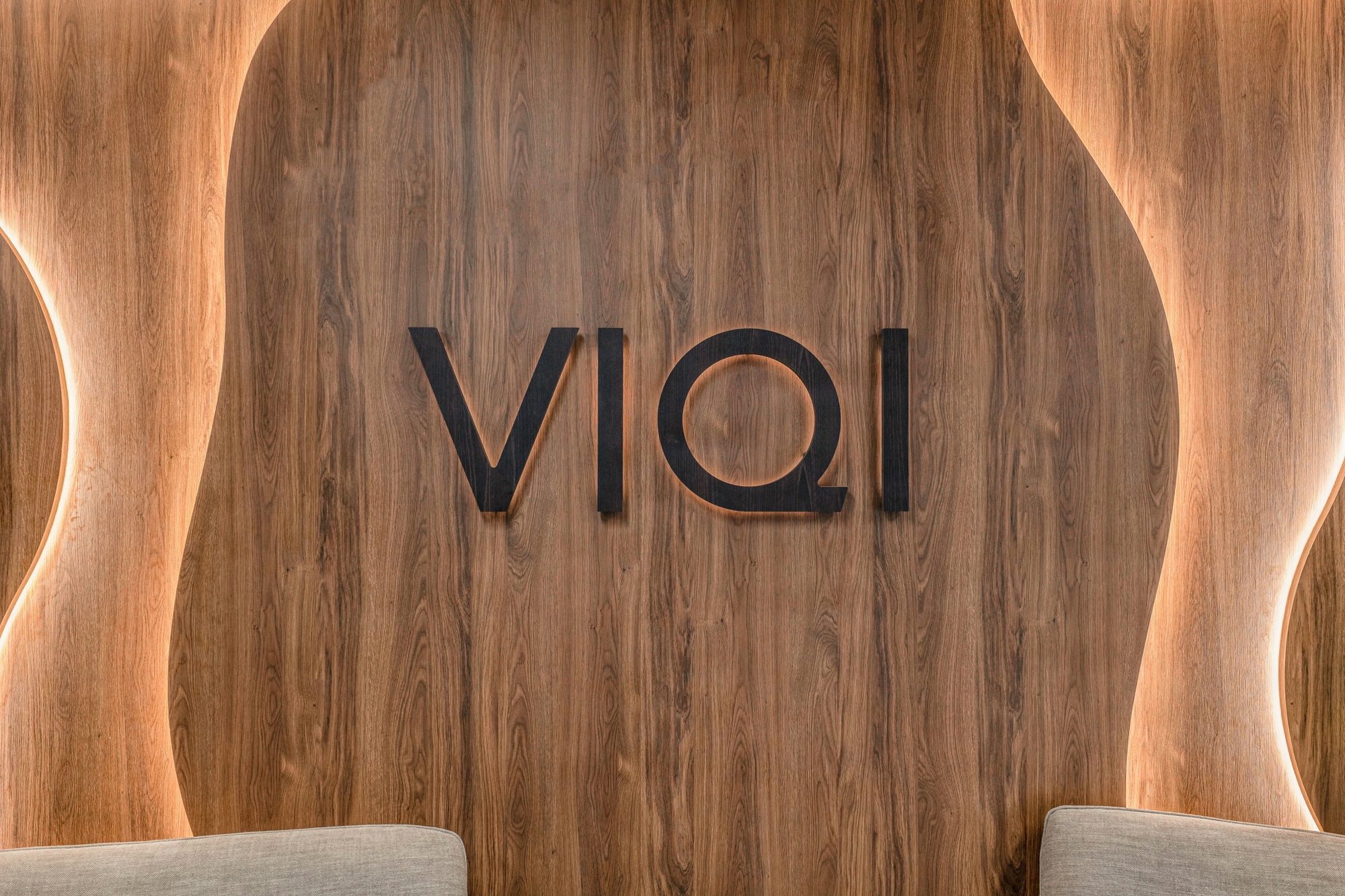
Decorative wood and stone wall cladding: signature wall coverings
Standards, acoustics and safety: what your cladding must guarantee
The budget for decorative cladding is determined first by its location: concentrated on 30 m² of high-exposure areas (lobby, boardroom, executive floor), it produces maximum image impact; spread across a generic open-plan floor, this effect is greatly diluted. The question is therefore not “choosing between wood and stone” but “where to install, on what useful surface, for what asset value.” Kytom specifies oak, walnut and ash veneers and stones (Carrara marble, travertine, onyx) under NF DTU 36.5 and NF DTU 52.2, fire classification B-s2,d0 (EN 13501-1) in ERP and IGH buildings. Budget from 180 to 1200 EUR/m² supplied and installed depending on the species, the stone and the installation complexity, average lead time 12 weeks.
Decorative wall covering addresses three converging challenges: brand identity, acoustic performance, material durability. According to INSEE (Tableaux de l’économie française 2024, Employment-Labour chapter), a service-sector employee spends an average of 1 607 hours per year at the office; the quality of perceived surfaces conditions cognitive comfort and the image projected to visitors.
- Acoustics: grooved or perforated wood cladding absorbs up to 6 dB of reverberation, which contributes to the NF S 31-080:2006 targets (32 dB Rw shared office, 38 dB executive office).
- Durability: natural stone cladding (Calacatta marble, Roman travertine, backlit onyx) has a service life exceeding 50 years, compared with 5 to 7 years for high-end paint before refurbishment.
- Regulatory: wood installation follows NF DTU 36.5 (interior joinery), and bonded stone follows NF DTU 52.2.
- Fire safety: minimum B-s2,d0 classification per EN 13501-1 in 1st to 4th category ERP buildings and IGH buildings, in accordance with Title I of the Labour Code (R4216 evacuation).
Kytom’s position. Industry orthodoxy equates “wood cladding” with “biosourced material, BREEAM bonus.” Our reading differs: an oak veneer not certified PEFC/FSC installed on an MDF panel with urea-formaldehyde binder degrades indoor air (VOC emissions beyond A+) and forfeits HQE credits. Among the species we reference, we exclude urea-formaldehyde substrates even when the veneer is certified: it is the complete system that matters, not the species.
The BREEAM (BRE), HQE (Certivea) and WELL (IWBI) standards reward biosourced materials and local sourcing, priorities built into the Kytom specifications.
When wood or stone cladding is not the right answer. Below 30 m² of cumulative signature wall on the floor, the effect on image remains marginal: decorative matte paint and signature furniture prove more cost-effective. Likewise, on movable partitions intended to be reconfigured more than twice in five years, stone cladding is counterproductive (removal impossible without breakage); the choice shifts to removable wood acoustic panels or stretched fabric.
What budget should be planned for wood or stone cladding in an office?
The budget ranges from 180 to 1200 EUR/m² supplied and installed depending on the species, the stone and the installation complexity. A standard oak veneer is around 220 EUR/m², a 20 mm Calacatta marble at 850 EUR/m², a backlit onyx at 1200 EUR/m². We set the range according to the project typology: concentrating the cladding on 30 m² of high-exposure areas serves the image more than spreading it across a generic floor.


Planning a fit-out project?
Get a complimentary audit of your spaces: an expert eye, concrete recommendations, no commitment.