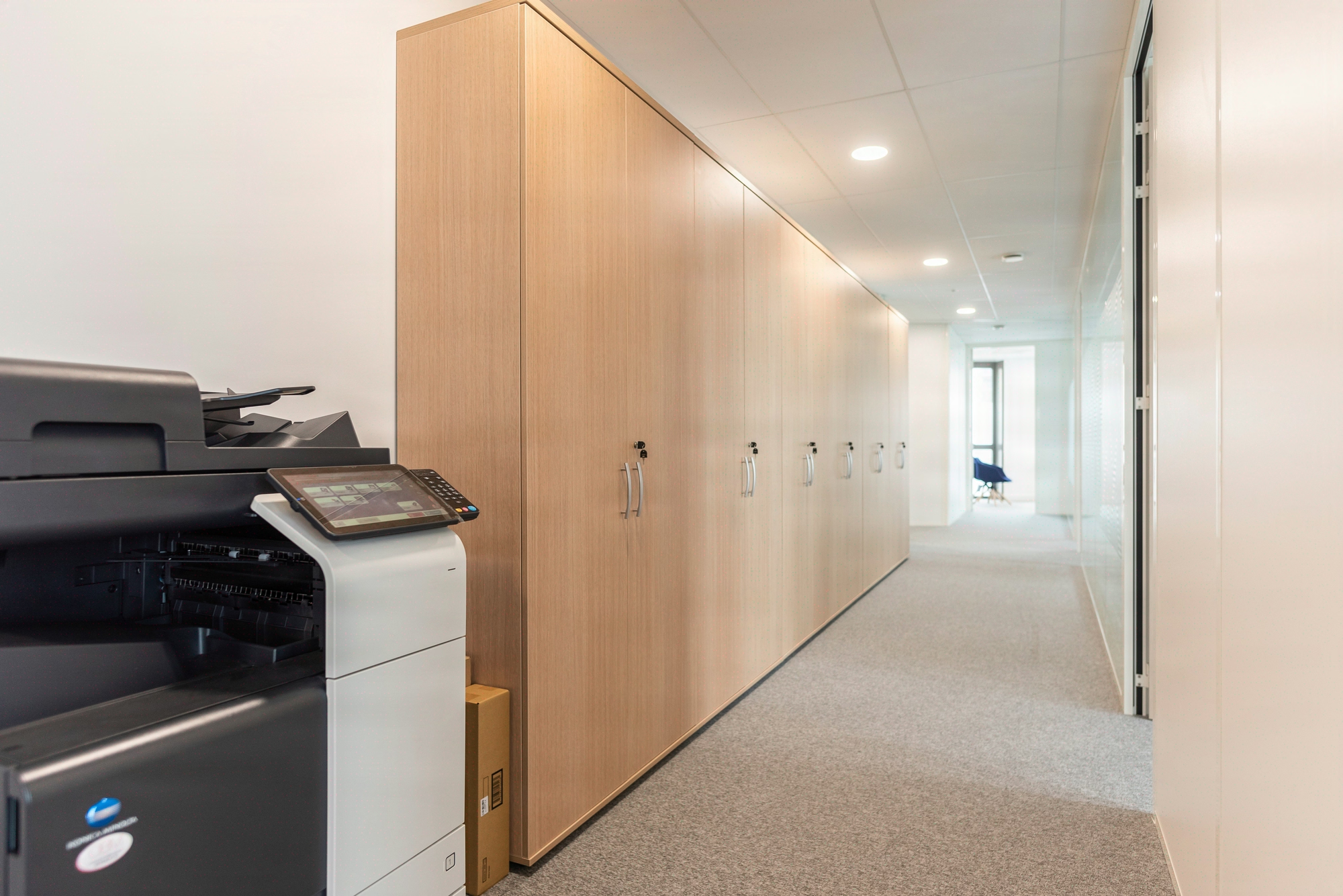
Professional storage and archiving: free up rent, not paper
Four criteria to calibrate your storage
Between 15 and 25% of your office floor space lies dormant in archiving, representing 1,800 to 3,000 EUR/m²/year of Parisian rent tied up in paper that is consulted, in 80% of cases, fewer than 5 times a year. Across 64 office projects audited between 2022 and 2024, Kytom systematically measures this hidden reserve, consistent with the 2023 ARSEG Buzzy Ratios. Our team handles the volumetric audit, scenario modelling and delivery of the final storage solution in 12 weeks on average, across our 10 branches. To calibrate the right density/accessibility ratio, we cross-reference 4 criteria: volume per m², consultation frequency, legal retention periods (Commercial Code art. L123-22, Book of Tax Procedures art. L102 B), and a 5-year growth margin factoring in the decline of B2B electronic invoicing (ordinance 2021-1190). The typical gain: 100 m² of archives converted into 6 to 10 workstations, with no lease extension or premises search required. Here is how we proceed, what you gain from it and the pitfalls we eliminate during the study phase.
the framework
Every office storage project balances 4 structuring parameters: usable density per m², access frequency, legal retention constraints, and 5-year flexibility. Fast-rotation archiving consulted daily requires 1.80 m in height and 1.20 m aisles, meaning 40% more floor space than a high-density system. Conversely, dead archives lend themselves to mobile shelving on rails that significantly multiply storage capacity, but limit simultaneous access to a single operator.
| Solution | Relative capacity | Min aisle | Floor load |
|---|---|---|---|
| Open fixed shelving | 1.0 (reference) | 1.20 m | 350 kg/m² |
| Mobile compactor shelving | 2.5 | 0.90 m | 500 kg/m² |
| Outsourced archives | not applicable | not applicable | not applicable |
Legal retention periods guide the mix: 10 years for commercial correspondence, 6 years for tax documents, 5 years for dematerialised pay slips (Labour Code art. L3243-4). These thresholds determine the share that can be transferred to cold or digital storage.
Our take against the compactor orthodoxy. Below 80 linear metres, the additional cost of rails plus carriages does not pay off over 7 years compared with fixed shelving. For archives consulted more than 5 times a day by several operators, the compactor creates a bottleneck that cancels out the space gain. Across several recent installations, some projects were scaled down after a flow audit, confirming that real usage takes precedence over theoretical space gains.

your gains
100 m² of archives = 6 workstations or 95,000 EUR of avoided rent
Storage is not a question of layout, it is a question of real estate cash flow. In the Paris central business district, prime rent ranges between 800 and 950 EUR/m²/year excluding tax and charges; at La Défense or Lyon Part-Dieu, expect 350 to 550 EUR/m²/year. The direct consequence: 100 m² of poorly calibrated archives tie up between 35,000 and 95,000 EUR of annual rent, for documents that are most often very rarely consulted.
The CAPEX/OPEX trade-off is clear: mobile compactor shelving pays off over 7 to 10 years, while contractual outsourcing of dead archives costs 3 to 8 EUR/linear metre/month, as pure OPEX. On a 5-year dematerialisation trajectory (B2B electronic invoicing phased in between September 2026 and September 2027), outsourcing becomes the financially superior option below 200 linear metres.
For the Asset Manager, the stakes are also rental-related: a floor where 22% of the space is occupied by metal shelving weighs on re-letting. Tenants value effective workstation density. Converting 100 m² of archives into 6 densified workstations (8 to 10 m²/workstation in open space) increases capacity without reopening a lease.

the pitfalls
Three mistakes we eliminate during the study phase
Our experience accumulated since 2006 across 1200+ projects highlights 3 recurring mistakes that undermine the efficiency of archiving spaces.
- Underestimating floor loads. Fixed shelving carries a minimum of 350 kg/m², a compactor 500 kg/m². On an existing slab, structural reinforcement is frequently required. We anticipate it systematically during the study phase, never during the works phase.
- Neglecting real flow analysis. The Pareto rule applies in 80% of cases, but the distribution varies: a law firm consults its active files over 24 months, an accounting department over 90 days. A 3-month audit avoids costly reorganisations.
- Ignoring the dematerialisation trajectory. B2B electronic invoicing, with the timetable published on Legifrance (amended ordinance 2021-1190), mechanically reduces paper volumes. Sizing based on the existing situation produces overstock from the second year onwards.
honesty
When our approach is not the right one
We prefer to direct you elsewhere rather than sell you a pointless study. Two configurations fall outside the scope where our method creates value.
Small volumes, small headcount. Below 30 linear metres of archives or for a headcount under 25 workstations, a 3-month flow audit represents a disproportionate cost relative to the space gain. In these cases, standard off-the-shelf fixed shelving combined with contractual outsourcing of dead archives remains more cost-effective than an in-depth study. We recommend a third-party archiving provider.
Non-substitutable physical retention obligations. For companies subject to specific constraints (patient records in healthcare establishments, notarial originals, legal archives in active litigation), dematerialisation and outsourcing do not replace secure internal storage. The rent/workstation calculation does not apply: documentary security and traceability take precedence over the economic trade-off. Our involvement is then limited to calibrating the secure room (loads, access, fireproofing), with no space-optimisation logic.
Method
- Volumetric audit
Over 3 weeks, we measure your current linear metres, count boxes by category and record existing floor loads. The deliverable consolidates volumes by legal retention period (10 years commercial correspondence, 6 years tax documents, 5 years dematerialised pay slips). This objective baseline replaces expert-opinion estimates that are often overstated by 15 to 30%. - Flow analysis
Over 3 months, we track actual consultations by department to distinguish active, semi-active and dead archives. This measurement reduces dedicated floor space by 3 to 8 points across the 22 Kytom volumetric audits in 2023. The deliverable is a frequency/volume matrix that secures the trade-offs of the next phase. - Scenario planning
We model 3 to 7 layout variants (fixed shelving, compactor on rails, outsourcing, mix), cost the CAPEX and OPEX over 7 years and simulate floor loads. You make decisions based on comparable figures, not on manufacturers’ intuitions. - Works and delivery
Our team manages any structural reinforcement, the installation of shelving and commissioning. The total time for the method, including the audit, fits in 12 weeks on average, in line with our delivery standard for projects with a significant archiving component.


