Skip to content
Natural and Artificial Lighting in the Office
Comfort

Natural and Artificial Lighting in the Office

Office lighting: targeting 500 lux, managing biorhythm and the tertiary decree. Kytom method, 3-4 year ROI, energy savings of up to 50%.

11 cities covered
1 200+ spaces transformed
66 passionate people

"The back of the floor is dark"

What our clients tell us.

You will recognise your situation if…

  • Workstations along the partition under 300 lux from 3 PM.
  • Blinds kept down permanently to avoid screen glare.
  • Repeated complaints of afternoon visual fatigue.
  • Inconsistent light fixtures inherited from three successive fit-outs.

Issues and impacts

Hidden cost

Uncontrolled artificial lighting accounts for 25 to 30% of the office electricity bill. Over 850 m², the excess consumption quickly reaches 4,500 euros per year. Added to this is the early replacement of inherited halogen or fluorescent sources, i.e. 8 to 12 euros per light point and per intervention.

Human risk

Illuminance below 300 lux doubles cervical musculoskeletal disorders. <a href="https://www.actineo.fr/" rel="noopener" target="_blank">Actineo</a> 2023 measures that 42% of employees cite lighting as the leading source of discomfort in the office. The circadian biorhythm is desynchronised under constant cold light, with a notable drop in alertness after 2 PM.

Regulatory risk

The Labour Code (R4223-4) requires lighting adapted to the nature of the tasks. The Tertiary Energy Efficiency scheme requires a reduction in final energy consumption of at least 50% by 2040 compared with 2010, a significant share of which comes from the lighting category. A demanding environmental certification becomes unattainable without DALI control and calibrated brightness sensors.

How Kytom approaches it

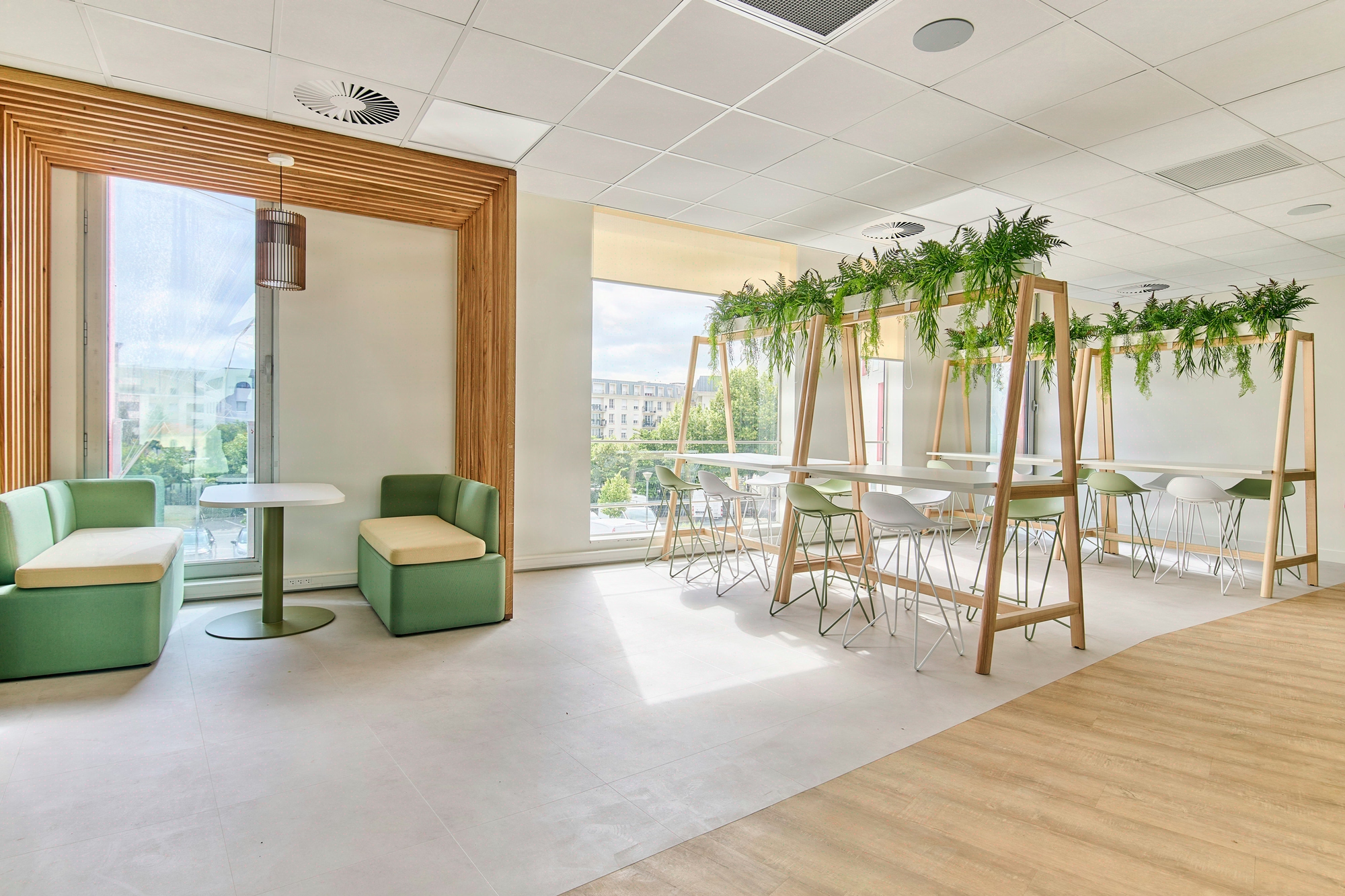
Kytom approaches lighting as an integrated system, never as a separate lot. Our space planners first map solar gain hour by hour, then position concentration zones along the facade and circulation areas at the heart of the floor. The luminaire layout is set to an average of 500 lux at workstations and 300 lux in circulation areas, in line with the standards applicable to indoor workplaces. We specify adjustable colour temperatures (2700 K to 5000 K) to respect the circadian biorhythm and deploy DALI control with presence and brightness sensors. Across the 1,200+ projects delivered since 2006, this method reduces lighting consumption by 35 to 50% while improving measures of reported comfort.
Our method

  1. 1. Diagnose

    Lux measurements at 3 times of day (morning, midday, afternoon) across the entire floor, mapping of solar gain by facade, audit of existing luminaires. Deliverable: thermal map of current illuminance and list of zones under 300 lux to be addressed as a priority.

  2. 2. Define

    Definition of usage scenarios by zone (concentration, collaboration, relaxation), selection of lux and colour temperature targets, budget trade-off between luminaire renovation and control. Deliverable: framing note with quantified energy assumptions and associated consumption reduction trajectory.

  3. 3. Design

    3D luminaire layout, Dialux simulation to validate 500 lux at workstations, selection of control protocols (DALI, KNX), integration of motorised blinds to manage glare. Deliverable: complete execution file with quantitative schedule and validated manufacturer technical sheets.

  4. 4. Deliver

    Installation coordinated with the technical trades, commissioning of the control system, sensor calibration, training of occupants on the scenarios. Deliverable: lux measurement report at handover and operational energy dashboard for the energy manager.

Cost and ROI

Cost range per m²
80 to 180 euros excl. VAT/m²
Includes LED luminaires, DALI control, sensors and motorised blinds for a standard floor.
Lead time
6 to 10 weeks
From the lux audit to full commissioning, excluding associated structural work.
Typical ROI
Payback in 3 to 4 years
Based on energy savings of 35 to 50% observed under real-world conditions.

An anonymised field report

"Our staff on the north side complained every winter. After Kytom's intervention, the lux measurements are consistent and HR feedback on visual fatigue dropped significantly within a quarter."

-42% over 12 months
Lighting energy savings
-58% in one quarter
Visual fatigue complaints
520 lux versus 280 lux
Average workstation illuminance

Frequently asked questions

What lux level should you target at an office workstation?

In renovation, the installed power must remain less than or equal to 2.8 W/m² per 100 lux of average illuminance to be maintained. Kytom validates these thresholds through Dialux simulation, then by lux measurement at handover.

Should natural light be prioritised even in cases of glare?

Yes, provided glare is managed with controlled motorised blinds and suitable glazing. Each metre gained in solar penetration reduces artificial lighting by 8 to 12% over the day.

What does DALI control concretely provide?

DALI modulates each luminaire individually according to occupancy and external brightness. On our sites, energy savings reach 35 to 50% compared with conventional switched lighting, with an extended LED lifespan.

How do you respect the circadian biorhythm of teams?

We deploy tunable white luminaires, 2700 K in the morning and at the end of the day, 5000 K in the middle of the day. This modulation supports alertness and limits sleep desynchronisation.

Is the project eligible for CEE?

Yes, LED luminaire renovation with control falls under sheet BAT-EQ-127. Energy Savings Certificates generally cover 8 to 15% of the material cost, an amount that Kytom factors in from the budget framing stage.

Can work be carried out without stopping operations?

Yes, we schedule removals and reinstallations in zones of 80 to 120 m², in the evening or in half-days. Across 1,200+ projects delivered, business continuity has been preserved in more than 90% of lighting renovations.