Skip to content
Improving the acoustics of an open space
Comfort

Improving the acoustics of an open space

Open space acoustics: the Kytom method to reduce office noise, quantified acoustic treatment, ROI within 30 months and an average lead time of 12 weeks.

11 cities covered
1 200+ spaces transformed
66 passionate people

"We can't hear ourselves work"

What our clients tell us.

You will recognise your situation if…

  • Employees book meeting rooms just to make phone calls.
  • Informal meetings disturb the entire adjacent row.
  • Headphones have become permanent equipment.
  • Noise ranks at the top of the discomforts the teams report.

Issues and impacts

Hidden cost

The loss of productivity linked to noise is estimated at between 5 and 10% on cognitive tasks. On a floor of 80 people paid 55,000 euros including charges, nearly 250,000 euros per year are dissipated in re-listening, errors and repeated interruptions throughout the day.

Human risk

<a href="https://www.anact.fr/ressources" rel="noopener" target="_blank">ANACT</a> links prolonged exposure to ambient noise to a 25% rise in self-reported stress and to sleep disorders. For an HR Director, the issue fuels short-term absenteeism, end-of-week cognitive fatigue and premature departures among expert profiles that are difficult to replace.

Regulatory risk

Regulations require employers to limit noise nuisances in tertiary premises, notably through articles R4213-5 and R4217-1. Without a diagnosis or acoustic treatment, the manager's liability may be engaged, in particular following a CSE report or a labour inspectorate visit on a floor of more than 50 workstations.

How Kytom approaches it

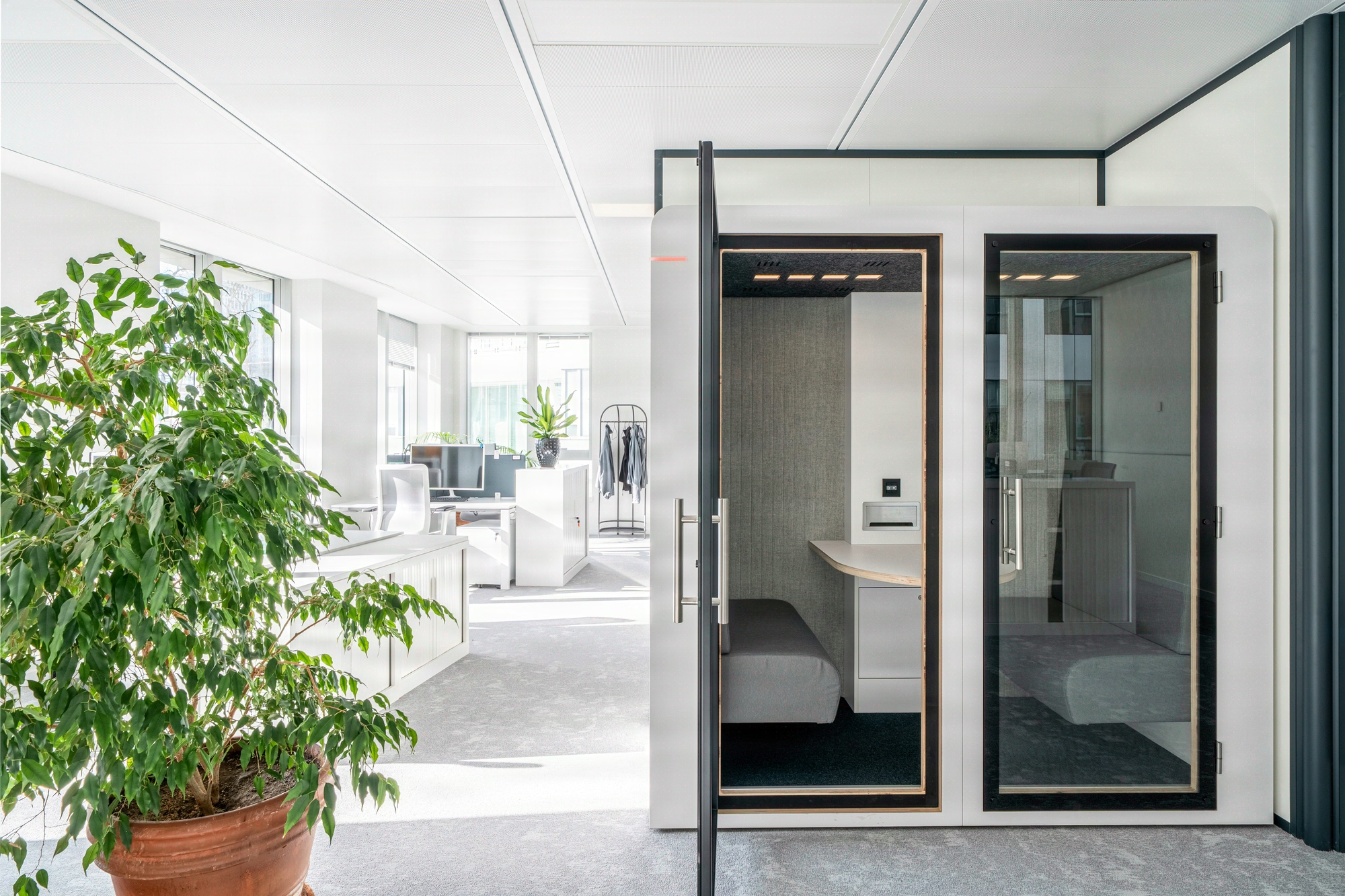
Kytom approaches acoustics as a system, not as an accessory. Since 2006, our 11 agencies have handled an average of 850 m² per project, with an average lead time of 12 weeks. We first measure the reverberation time (RT) and the actual noise level, then we work on three complementary levers: absorption (ceilings, baffles, wall panels), insulation (acoustic partitions calibrated at 35 to 44 dB) and zone organisation (pods, phone boxes, quiet zones). Vitra furniture references and Class A ceiling solutions (maximum acoustic absorption) are favoured. Each scenario is quantified, compared and arbitrated with the real estate department before execution.
Our method

  1. 1. Diagnose

    On-site acoustic measurement over 2 to 3 working days: calibrated sound level meter, RT readings by zone, mapping of sources. Deliverable: a quantified report with gaps against the reference acoustic thresholds applicable to offices and identification of priority zones. Qualitative interviews conducted with the HR Director and a sample of 8 to 12 employees.

  2. 2. Frame

    Framing workshop with the Workplace Director and senior management to arbitrate the target level (45 or 50 dB), the budget per m² and operational constraints. Deliverable: quantified acoustic programme, zoning plan, scenarios compared across 3 investment levels and a provisional 12-week schedule.

  3. 3. Design

    Detailed design by our engineering office: selection of absorbent materials (αw greater than 0.90), positioning of baffles, sizing of phone boxes (1 per 10 workstations on average). Deliverable: technical file, 2D and 3D plans, product sheets, physical samples validated by the client before ordering.

  4. 4. Deliver

    Works carried out in occupied or unoccupied premises, coordination of trades, acceptance acoustic measurement. Deliverable: acceptance report, new RT measurement compared with the initial state, usage guide handed to managers. Ten-year warranty and 6-month follow-up with any adjustments included.

Cost and ROI

Cost range per m²
150 to 400 euros excl. VAT/m²
Acoustic treatment only, excluding heavy partitioning and pod furniture.
Lead time
8 to 14 weeks
From diagnosis to acceptance, depending on the area and complexity of the floor treated.
Typical ROI
Payback in 18 to 30 months
Calculated on productivity gains, reduced absenteeism and talent retention.

An anonymised field feedback

"Before the project, our developers went to work in the nearby cafés. Six months later, the floor occupancy rate rose by 40 points and complaints dropped drastically."

-62%
Drop in acoustic complaints
down from 1.2 s to 0.5 s
Measured reverberation time
clearly improved
Floor occupancy rate

Frequently asked questions

At what noise level should you intervene?

Above an average of 55 dB(A) in an open space dedicated to concentration work, discomfort becomes measurable. The acoustic standards applicable to offices distinguish three levels of requirement (standard, high-performance, very high-performance) between 45 and 50 dB(A). An objective diagnosis settles the matter in 2 days.

Should you partition or simply absorb?

Both levers are complementary. Absorption (ceilings, panels) addresses reverberation and accounts for 60 to 70% of the gains. Acoustic partitions and phone boxes address speech intelligibility. Kytom sizes the right mix after measurement, to avoid over-investment.

Can a floor be treated in occupied premises?

Yes, in 80% of Kytom projects. Phasing is done by clusters of 15 to 25 workstations, with interventions outside production hours when necessary. The schedule is set with the HR Director and team managers to limit internal relocations to 1 or 2 moves maximum.

What budget should be planned for 500 m²?

Expect 80,000 to 200,000 euros excl. VAT depending on the acoustic ambition targeted, the condition of the existing ceiling and the number of phone boxes integrated (generally 4 to 6 for this area). A preliminary framing specifies the range in less than 3 weeks.

Which certifications should you target for acoustics?

The standards dedicated to sound quality and the Acoustic Comfort target of the HQE Bâtiment en exploitation certification structure the approach. For a real estate department, these frameworks reassure investors and enhance the asset's value on the tertiary market.

How long do the effects last?

Absorbent materials retain their performance for 10 to 15 years under normal tertiary use. Kytom applies the ten-year warranty to fixed works and recommends a re-measurement of acoustics every 3 years to track the evolution of uses and floor occupancy.