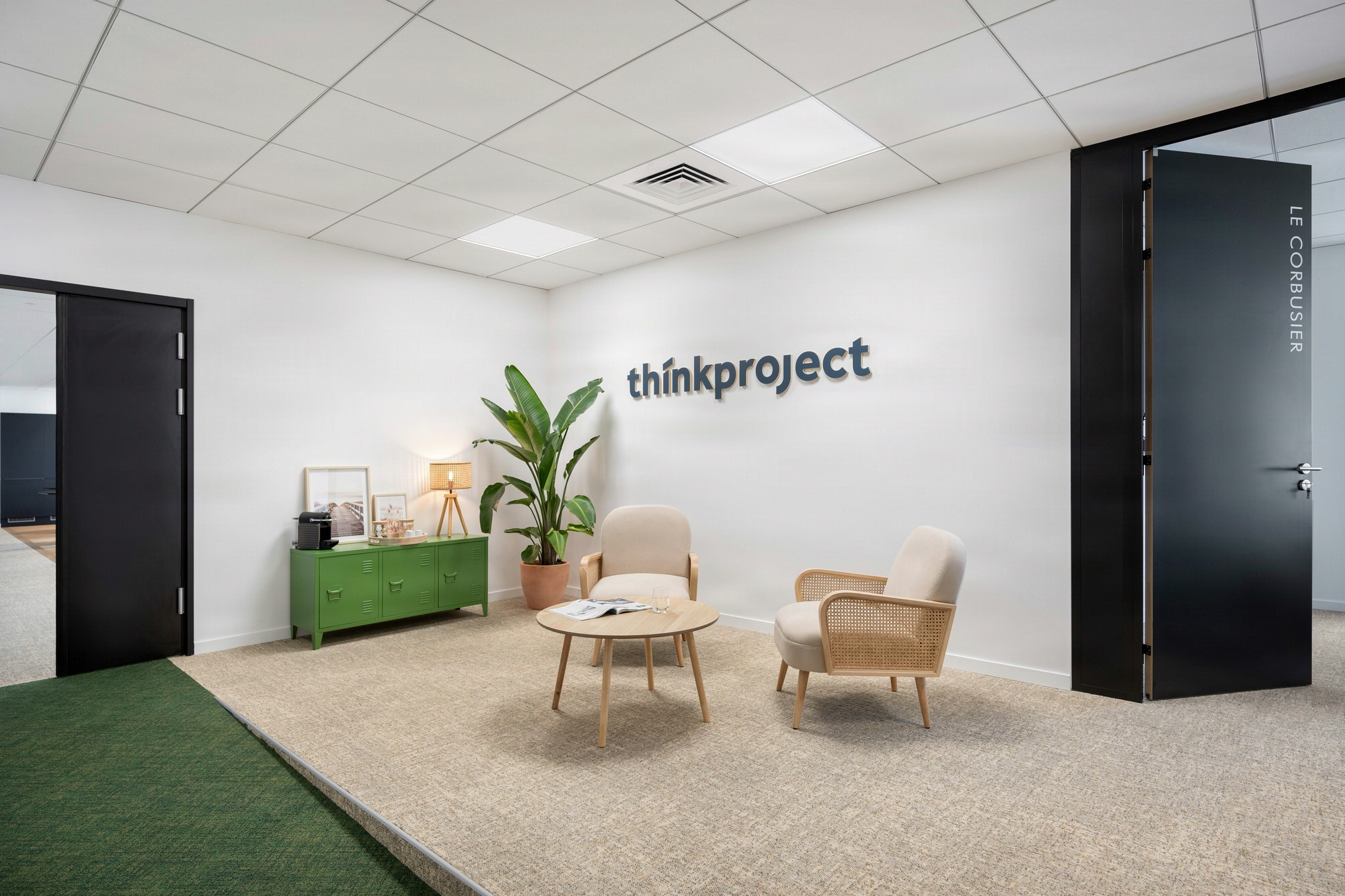
Employer brand and talent
Make your offices a decisive argument to attract, retain and unite the talent that drives your company.
Four departments intersect on this topic: HR, executive leadership, real estate, and employee experience. All have observed the same shift since 2020: 73% of executive employees consider the work environment a major engagement criterion, just after compensation. Kytom steps in upstream of the HR brief, translates company culture into a spatial vision, then manages the rollout over 12 weeks on average. Our contribution: connecting managerial intentions with fit-out decisions, drawing on recognized quality-of-work-life standards and the WELL Building Standard, without giving in to passing trends.
All guides in this category
-
« We are struggling to recruit »
Attracting talent through the workplace
You are struggling to recruit for in-demand profiles. This guide explains how the layout (entrance, meeting rooms, informal spaces) becomes a draw from the candidate's very first visit, with 6 concrete levers and precise budget trade-offs.
Read the guide → -
« Too many departures since the move »
Offices that keep your people
Departures have multiplied since your move. This guide identifies the 4 common spatial causes (acoustics, furniture, light, lack of privacy) and proposes a correction plan in 3 phases, without starting over from scratch on your lease.
Read the guide → -
« Our offices don't look like us »
Reflecting your company culture in the office design
Your offices don't look like your company. This guide explains how to translate values, rituals and managerial codes into concrete choices of materials, colors, zoning and signage, with a cultural audit method across 5 workshops.
Read the guide → -
« How to get candidates to come in »
Turning the office into a recruitment tool
Getting candidates to come to your premises has become a challenge. This guide details the physical candidate journey: reception, interview room, lunch, floor tours, and proposes 8 high-impact improvements for less than 30,000 €.
Read the guide → -
« Boomers and Gen Z in the same open space »
Cross-generational cohesion in the office
Boomers, X, Y and Z now share the same open space. This guide addresses the specific expectations of each generation, documented by work environment observatories in 2023, and proposes a differentiated zoning that reconciles concentration, collaboration and conviviality.
Read the guide →
Frequently asked questions about this category
Which guide should I start with?
Start with the signal that dominates in the executive committee. If the main difficulty is recruiting, open the employer brand guide and the one on using offices as a recruitment tool. If departures are accelerating, the retention guide is a priority. If cultural dissonance comes up in annual reviews, start with the company culture guide. Allow 20 minutes per guide to frame your diagnosis before launching a field audit.
How much should I invest to strengthen the employer brand through offices?
Worthwhile budgets start at 300 €/m² for a targeted renovation (entrance, meeting rooms, informal spaces) and reach 1,200 to 1,800 €/m² for a complete project including furniture, acoustics and signage. On an average surface of 850 m², a structuring project represents 1 to 1.5 M€. Every euro invested in quality of work life generates a measurable return on engagement, provided you target the right friction points.
How long before seeing an effect on recruitment?
The first signals appear as soon as the space is operational: more favorable candidate feedback, higher offer acceptance rates, photos shared on LinkedIn. Allow 6 to 12 months to measure a stable effect on the pipeline of spontaneous applications and the acquisition cost per hire. The guides in this category propose HR indicators to track from delivery, linked to your ATS and your onboarding surveys at 30 and 90 days.
Should employees be involved in the design?
Yes, provided the scope of consultation is clearly defined. Kytom generally organizes 3 to 4 participatory workshops (zoning, rituals, furniture, visual codes) with a representative panel of 12 to 20 people per 100 employees. Structuring decisions remain with management, but usage trade-offs benefit from being co-built. This approach, in line with best practices in quality of work life, strengthens buy-in and reduces costly adjustments after delivery.