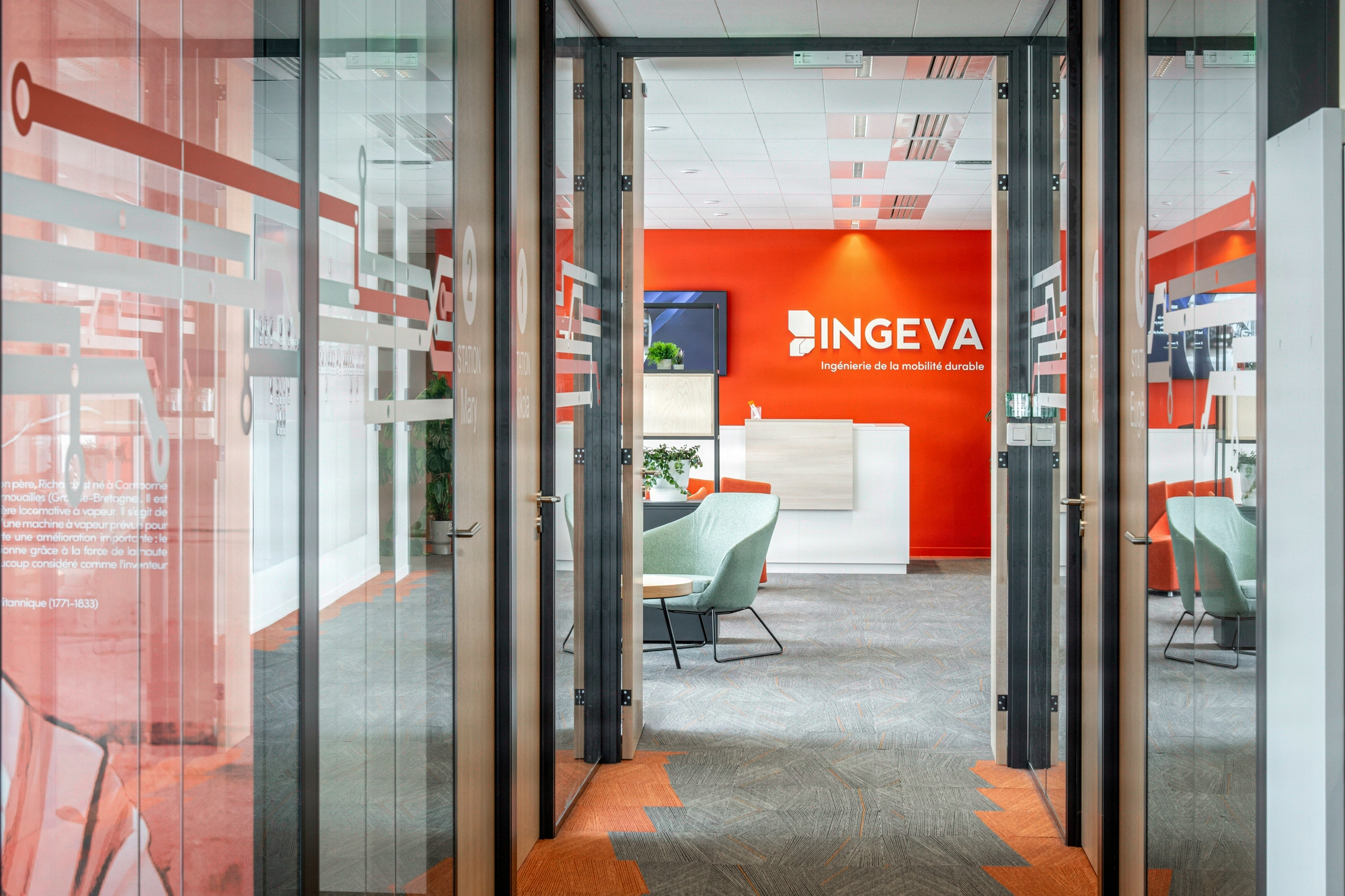
Retail & Hospitality Office Design: Bringing Your Brand to Life
A vertical that brings 200 to 800 employees to life around the brand
The dissonance between a retail head office and its network of stores is not an aesthetic risk, it is a measurable HR cost. Retail and hospitality account for 3.6 million jobs in France, with an annual turnover above 25% in support functions: this vertical demands head offices that embody the brand as much as they retain talent. Kytom designs and delivers the head offices and offices of retail and hospitality brands, with 11 agencies in France and Spain, since 2006, and more than 1200 projects delivered. Our design and build teams orchestrate turnkey fit-out in 12 weeks on average, around four complementary disciplines. Each project translates brand codes across 1,500 to 4,000 sq m of office space, integrates internal showrooms, photo studios and test corners, and complies with NF S 31-080 as well as the environmental certification frameworks applicable to sustainable buildings. Budget generally between 850 and 1,800 € excl. VAT/sq m depending on the finish level, excluding IT and audiovisual.

For the business decision-maker: the return-on-investment calculation. The replacement cost of a marketing or purchasing manager, including recruitment, onboarding and lost productivity, commonly exceeds several tens of thousands of euros. On a head office of 300 employees with around sixty critical functions, avoiding a few departures per year is enough to make the fit-out investment pay off, amortised over the site’s occupancy period. The additional cost of a signature fit-out versus a standard one is generally recouped in less than two years through turnover reduction alone.

Retail design and build: 5 steps led by a single project manager
The Kytom approach mobilises a multidisciplinary team led by a single project manager, over an average cycle of 12 weeks between signature and delivery. The sequencing addresses the scheduling constraints of brands.
- Usage audit (2 to 3 weeks): employee questionnaires, flow observation, target sq m/workstation ratio of 8 to 12 sq m, comparison with reference head offices.
- Programming and design: 2 to 3 costed scenarios, 2D/3D plans, mood boards reflecting the brand guidelines, detailed estimate per workstation.
- Design development: furniture selection from more than 40 referenced suppliers, including Vitra, Herman Miller and Knoll for signature areas, materials validation according to FDES data sheets and RE2020 environmental criteria.
- Works execution: local teams from our agency network, coordination of 8 to 15 trades, weekly monitoring and photo reporting.
- Delivery: occupant training, two-year warranty compliant with French Civil Code articles 1792-3 and following.
Our reading differs from the common practice in this vertical. Industry orthodoxy positions the usage audit as optional or as a short one-week phase to meet tight commercial deadlines. In practice, on our retail projects, the head offices that underwent significant post-delivery rework had all compressed the usage audit to under 10 working days. We now refuse to undertake a signature retail project without an audit of at least 15 days: it is a point of commercial friction, but the trade-off is documented.
The approach falls within the Qualibat framework, with a schedule adherence rate above 92% on our projects delivered between 2022 and 2024. The deliverables framework is harmonised for brands operating in France and Spain, which secures multi-site rollouts.

Measured benefits on delivered head offices: satisfaction, retention, costs
The brands we support measure quantifiable effects within the first 6 months after delivery. On the retail and hospitality head offices we have delivered, our clients generally observe, within 6 to 12 months after delivery, a noticeable improvement in employee satisfaction, better retention of marketing and purchasing teams, a reduction in travel to pilot stores thanks to redesigned collaboration spaces, and a decrease in real estate costs per sq m driven by floor space rationalisation.
For the retail CFO: the cash-flow reading. This rationalisation, which typically corresponds to moving from 14-16 sq m/workstation to 10-12 sq m/workstation, combined with the energy optimisation imposed on office buildings over 1,000 sq m (obligation to reduce energy consumption by 40% by 2030), translates concretely into significant annual savings on rent and charges, excluding energy savings. The fit-out project is not an OPEX line item to be contained, it is a lever for structural cost reduction.
Integrated showroom and creative spaces allow product teams to validate collections without systematic travel, significantly reducing back-and-forth trips to pilot stores. On the employer brand side, several retail clients report a noticeable increase in spontaneous applications within 12 months of delivery, an effect that remains conditional on the strength of the overall HR value proposition: the fit-out amplifies an existing employer brand, it does not create one.
When these KPIs do not materialise. On head offices that are structurally understaffed or driven by a brand undergoing repositioning, the gains in retention and applications remain below the measurability threshold at 12 months: the fit-out does not compensate for a problem with the HR or commercial value proposition.

Method
- Immersive brand audit
Our teams spend 2 to 3 days in your points of sale or establishments to capture material codes, signage and rituals before any design work. - Collaborative programming
Workshops with your operational teams to map flows, uses and specific needs (showroom, product lab, samples area). - Design and fixed-price costing
Development of 2 to 3 contrasting architectural concepts, each costed on a global design and build fixed price for an informed decision. - Technical studies and authorisations
Parallel launch of execution studies and administrative procedures in 8 to 12 weeks to secure the schedule. - Managed works and phased delivery
Coordinated project with a weekly review, progressive delivery and 4 to 6 weeks of support after move-in.
Frequently asked questions
What budget should be planned for fitting out a retail or hospitality head office?
For fitting out a retail or hospitality head office, the budgets observed on our recent projects generally fall between 850 and 1,800 € excl. VAT/sq m, excluding IT and audiovisual. The positioning within the range depends on the ratio of signature space (showroom, photo studio, test corners: 15 to 25% of usable area) and the furniture finish level. A standard 1,500 sq m head office settles around 1.4 to 2.1 M€ excl. VAT for works and furniture.
How long between signature and delivery of a 2,000 sq m head office?
The standard lead time is 12 weeks, split into 2-3 weeks of usage audit, 3-4 weeks of design and design development, and 5-6 weeks of works execution. On 2,000 sq m with showroom and photo studio components, allow 14 to 16 weeks.
How does Kytom translate brand codes without falling into mere decor?
The minimum 15-day usage audit maps the material codes (textures, palette, typography) of the points of sale, then the design team selects 3 to 5 signature elements transposable to the office environment (signature wall, reception furniture, signage). Production zones retain the reference ergonomic and acoustic standards of the office environment, without decorative overload. Target signature/standard ratio: 25/75.
Do you handle multi-site rollouts in France and Spain?
Yes. Kytom has 11 agencies in France and Spain since 2006, with a harmonised deliverables framework (specifications, 2D/3D plans, FDES data sheets, schedule) that allows a fit-out guideline to be replicated across 3 to 8 sites with a pivot project manager and local teams. The unit lead time remains around three months per site, with design pooling over the first 4 to 6 weeks.
Which environmental certifications are taken into account?
Recognised environmental certifications and anticipation of the 2028 regulatory thresholds that will require new low-carbon construction solutions. Materials validated on FDES data sheets (INIES database), monitoring of the obligations to reduce energy consumption of the office stock integrated into post-delivery energy reporting. A significant share of our retail head offices delivered in recent years has obtained an environmental certification of Very Good level or higher.


