
Energy Heritage
Where heritage powers the future
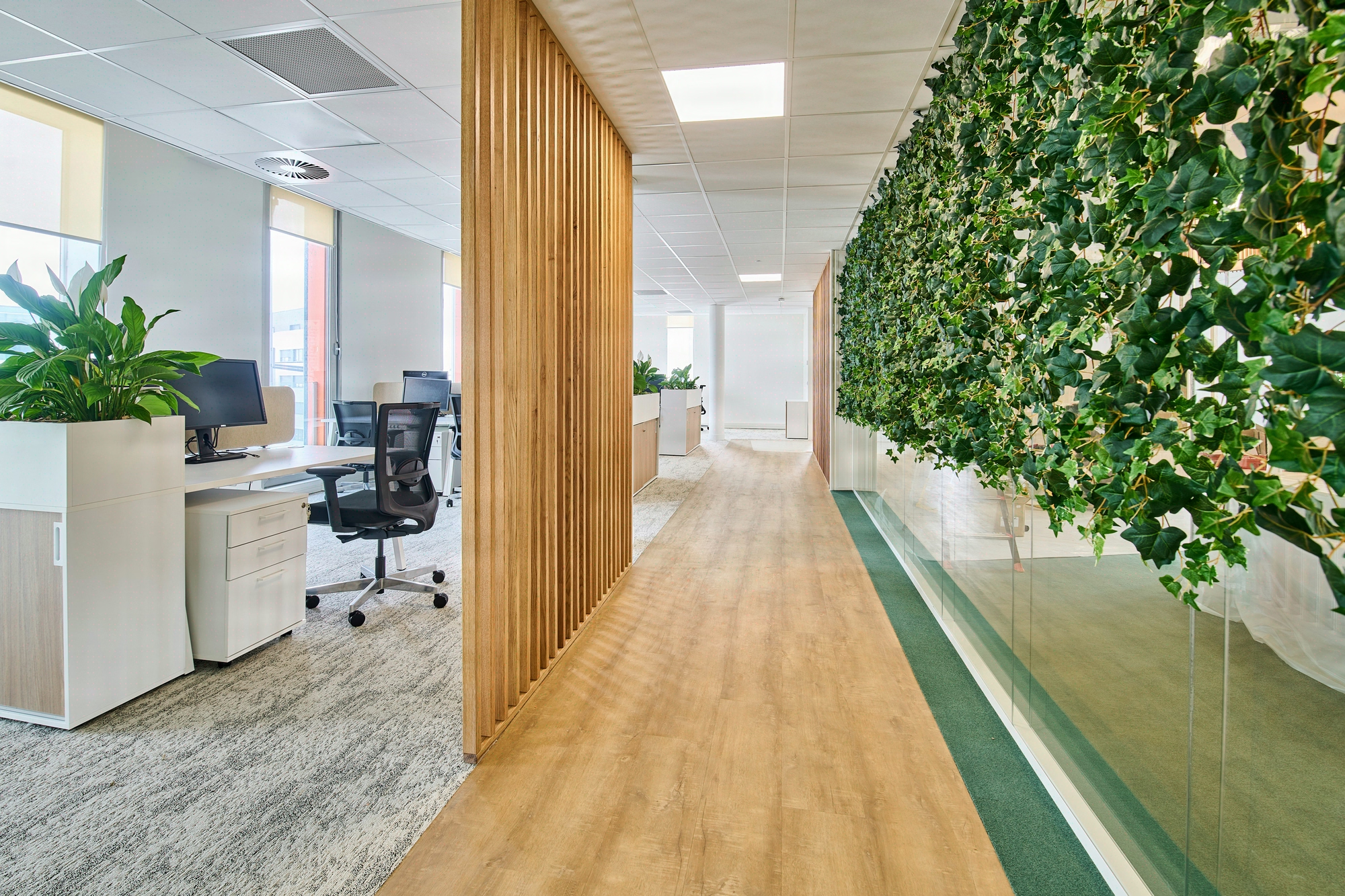
For Gaz de Bordeaux, we reimagined 2,750 sqm of a historic public-access building in 8 months: a major refurbishment where code compliance and eco-design rekindle the soul of the place.
- 2 750 m²
- 8 months
- 2024
heritage_revisite
Concept
A public-access building reimagined for local energy
Transformation of an existing public-access building for Gaz de Bordeaux. The 2024 project covered 2,750 sqm of major refurbishment, integrating public-access code compliance and the modernisation of workspaces while honouring the existing heritage.

Situation
Gaz de Bordeaux, the long-standing energy supplier of the Bordeaux metropolitan area, entrusted Kytom with the renovation of its headquarters: 2,750 m² of offices in a Category 3 ERP building, delivered in eight months in 2024. The site had to remain partially operational throughout the works, with the commercial reception kept open.
Conventional wisdom would have called for two successive operations, clearing the site first and then a closed worksite. The opposite approach was chosen: phasing by zones with activity preserved, and maximum retention of the existing structure rather than a clean-slate rebuild.

2,750 m² ERP to bring up to code without altering the structure
Three simultaneous constraints shaped the project. The Category 3 ERP classification required a full upgrade: accessibility for people with reduced mobility under the decree of 8 December 2014, smoke extraction, evacuation routes. The budget envelope did not allow for wholesale stripping, which steered the trade-off toward retaining the structural elements worth preserving.
Coordination on a partially occupied site required sequencing by zones, with the commercial reception kept open and floors delivered progressively. Added to this were deep floor plates whose natural light had to be preserved, and an eight-month schedule to absorb the whole. Retention was not a heritage gesture, it was the condition for meeting the schedule and the budget.

Two structuring decisions: selective retention and phasing on an occupied site
The first decision concerned the scope of stripping. The preliminary audit mapped obsolete fluid networks, structural points and elements worth keeping. The strip-out was selective rather than wholesale: removal of obsolete fluid networks and non-load-bearing partitions, retention of the structural grids and the natural light reaching the deep floor plates.
This reversal from a full strip-out made it possible to compress the structural works phase and reallocate the budget toward the governing ERP packages: smoke extraction, evacuation signage, accessibility for people with reduced mobility. The second decision concerned sequencing.
The worksite was divided into zones delivered in succession, with furniture, decoration and plants delivered simultaneously at each floor handover to allow immediate occupation by the commercial and technical teams.
Kytom ran the operation as a design and build, single point of contact across all trades: electrical, plumbing, traditional and demountable partitioning, suspended ceilings, structured cabling, lighting redesigned to enhance the retained light, painting, carpet floor coverings, window manifestation, signage, furniture.
Eleven packages coordinated under a single contact, from the initial diagnosis to the final signage, which avoided interface breakdowns between contemporary ERP requirements and the retained historic grids.

Delivered in eight months, 95% reusable furniture, ERP compliant
The headquarters was delivered on the announced schedule: eight months for 2,750 m² of renovation on a partially occupied ERP, a milestone rated 4/5 by the internal project management radar. Accessibility compliance for people with reduced mobility reaches the level required for a Category 3 ERP receiving public and staff, also rated 4/5.
The choice of selective retention extends into the CSR indicators: 95% of the installed furniture is reusable, 90% of the components are recyclable, 90% repairable, 30% of the equipment incorporates recycled content. These ratios are not an add-on, they flow directly from the initial stance: extending the useful life of the fit-out rather than producing disposable new items.
The site reopens with its original grids and preserved natural light, brought up to the 2024 office standard across all ERP functions. For Gaz de Bordeaux, the operation confirms that a Category 3 ERP can be brought up to code without interrupting commercial activity or undertaking a wholesale rebuild.
2 750
sq m transformed
8
months of work
Discover
More photos of the project


1 / 20
Implementation
Sustainability
REFERENCES
Related projects

Visualisations and diagrams are the property of KYTOM SAS; reproduction prohibited without written authorisation.