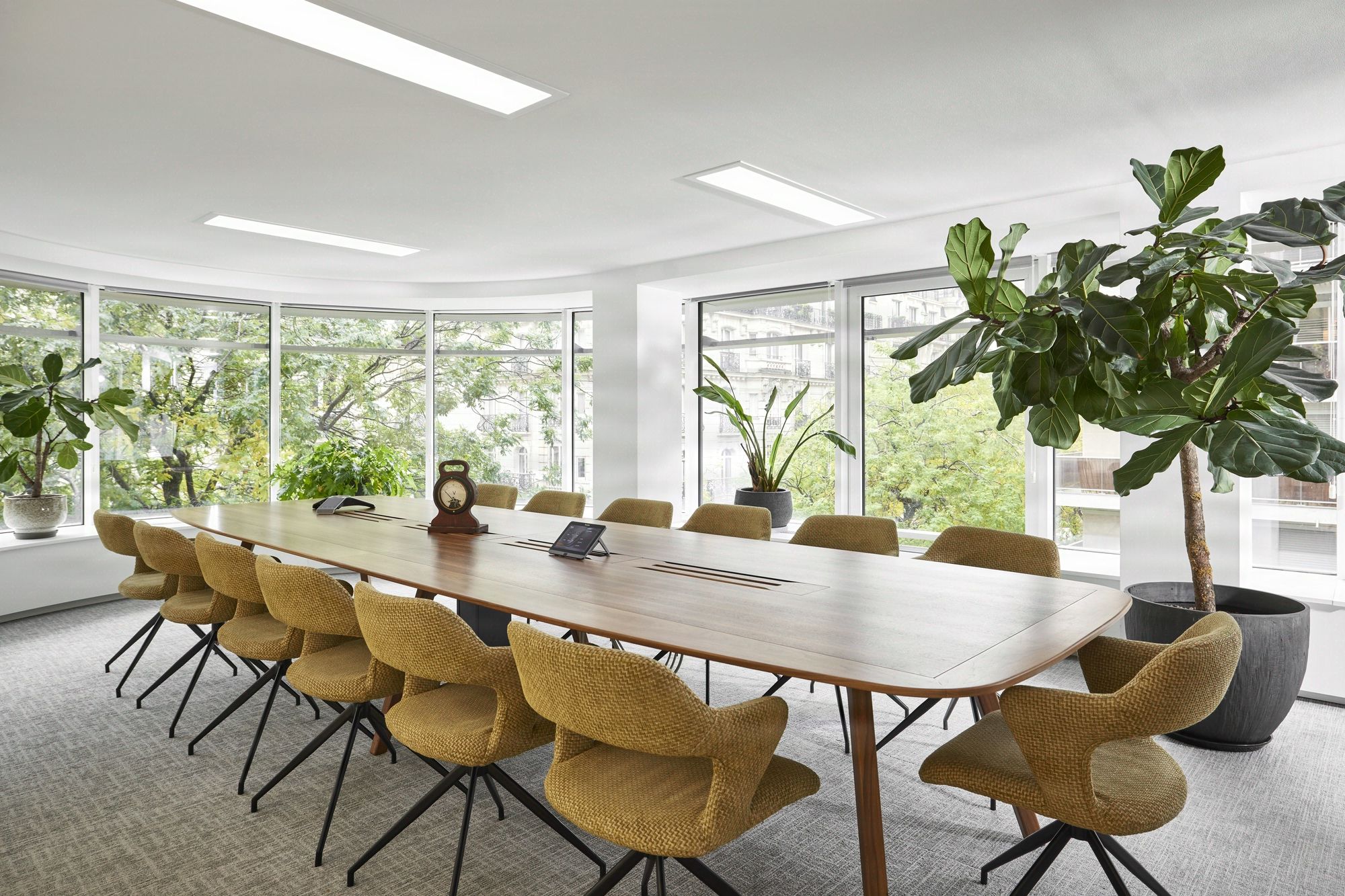
Dimmable lighting: balancing visual comfort and energy performance
Four technical tensions to arbitrate from the design phase
Dimmable lighting is particularly relevant in spaces benefiting from a significant amount of natural light, where energy savings offset the additional installation cost over the lease term. Below a certain floor area or without usable sunlight, the trade-off warrants a case-by-case cost-benefit analysis, with reference to the maintained illuminance levels defined by NF EN 12464-1. Four technical tensions structure the trade-off for the architect and lighting designer: LED driver compatibility, centralised or decentralised DALI architecture, zone or workstation granularity, BMS integration level. The user adoption time varies according to the quality of the training delivered at handover.

Dimmable lighting requires four structuring trade-offs, each with a measurable impact on the works budget and on end use.
- LED luminaire compatibility. Not all LED drivers support dimming without perceptible flicker below 30% intensity, a critical pitfall at office workstations where a maintained average illuminance of 500 lux with a minimum CRI of 80 is required.
- Network architecture. The DALI protocol (IEC 62386 standard) in centralised mode facilitates maintenance and scalability, whereas decentralised dimmers reduce the initial cost but multiply the points of failure.
- Control granularity. Zone by zone (8 to 12 circuits per 100 m²) or individual workstation (up to 18 circuits), with a cabling cost that doubles between the two options.
- BMS integration. The level of automation determines the interface with light sensors, presence detectors and time scheduling.
In a typical open space, there are generally between 8 and 18 circuits per 100 m² depending on the floor area per workstation ratio, with a central value of around 12 circuits. In an individual office, individual control is justified.
Our reading differs from lighting design orthodoxy on this specific point: dimmable lighting is not a universal answer. On a floor of less than 150 m² with single-function use, fixed hours and no significant natural light contribution, dimming loses its value and an on/off control with presence detection and standard time scheduling is sufficient. Likewise, in spaces with intermittent occupancy such as archives or technical rooms, dimming is counterproductive.

Four common mistakes that degrade the user experience
Kytom’s feedback identifies four recurring mistakes during the operation phase, to be neutralised from the design stage.
- Neglecting the LED dimming curve. Abrupt variations below 30% intensity generate visual discomfort long documented in workplace lighting standards. The remedy is to test each driver and dimmer pair on a mock-up before contract validation.
- Oversizing the circuits. Going from 12 to 18 circuits per 100 m² without a usage analysis increases the works cost by 15 to 22% with no perceived benefit. A prior behavioural audit calibrates the useful granularity.
- Underestimating harmonics. In renovation projects, dimmable LED drivers inject 3rd and 5th order harmonics into the existing network, an issue governed by NF EN 61000-3-2 and often overlooked in the technical specifications.
- Omitting user training. The lack of support leads to manual overrides and the bypassing of automated systems, cancelling out a significant share of the projected energy savings.
The Kytom design and build approach incorporates these constraints from the sketch stage, with coordination of the power, low-voltage and BMS work packages through a single point of contact.
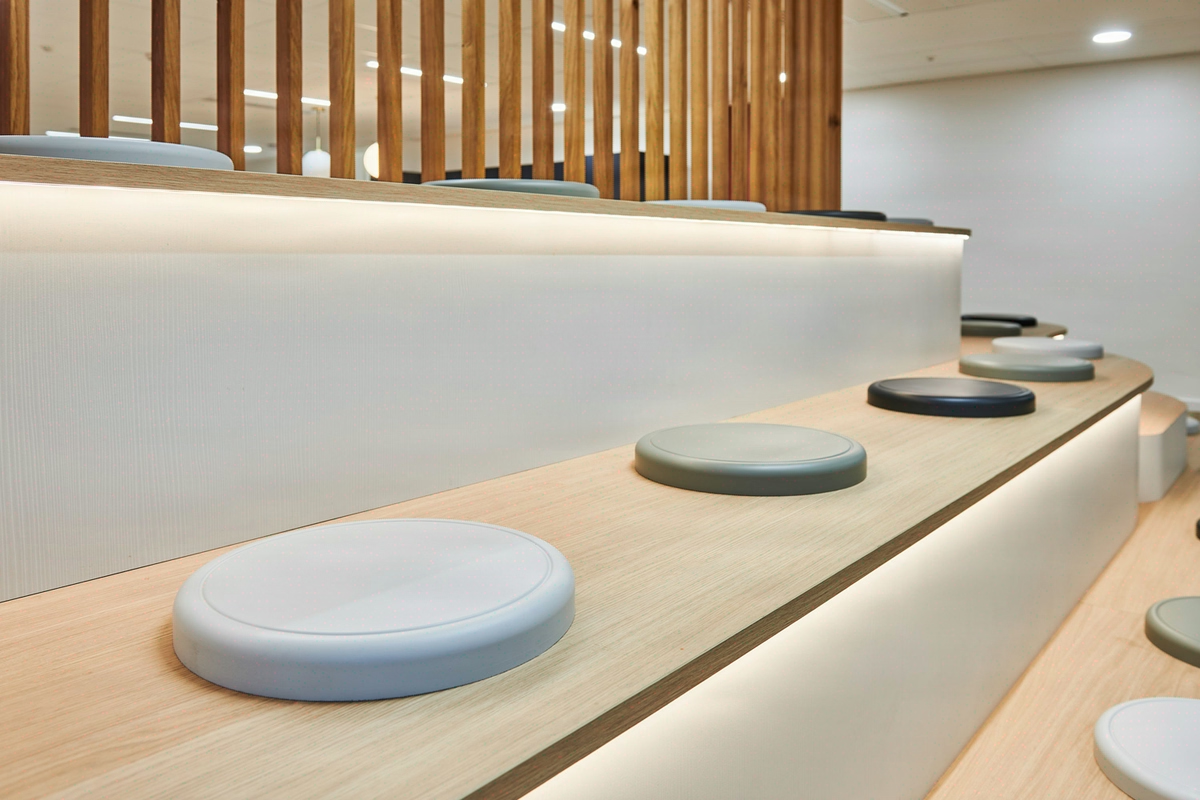
For the architect: sequencing dimming in 5 steps integrated into the design schedule
The Kytom methodology sequences the dimming project into five steps, validated on commercial deliveries since 2022. For the architect and lighting designer, the challenge is to integrate these steps into the schematic-detailed-production design phasing without creating a critical path on the contract schedule.
- Audit of lighting profiles. Illuminance measurements over 2 weeks to identify variations in natural light contribution by zone, consistent with the levels required for indoor workplaces. Objective: avoid technical oversizing.
- Compatibility matrix. Systematic testing of luminaire, driver and dimmer pairs on a physical mock-up. Objective: eliminate the majority of malfunctions upstream, through rigorous testing before any site commitment.
- Use scenario design. Definition of four to six standard scenarios such as morning arrival, daytime period, end of day, partial occupancy, cleaning or night mode. Objective: simplify programming and adoption.
- Cabled pilot zone. Implementation of a 50 to 100 m² test zone to validate system responsiveness and lighting consistency between adjacent cells. Objective: adjust the parameters before global deployment.
- Scalable configuration. Conservative initial configuration, with post-handover fine-tuning over 6 to 8 weeks based on user feedback collected by the Office Manager.
This sequence avoids technical rework on the low-voltage work package, which is common when dimming is treated as a late-stage option.
Limitation of the method. The five-step sequence assumes a design schedule of at least 14 weeks before the works contract. In the context of a lease signed urgently with delivery within 8 weeks, the physical mock-up and pilot zone are not feasible: it is then necessary to switch to a preconfigured manufacturer solution with standard scenarios, accepting an energy gain reduced by 30 to 50% compared with a bespoke configuration.
Comparison of centralised DALI architecture versus decentralised dimmers
The choice of architecture determines the durability of the system and the total cost of ownership over 5 to 10 years of operation. The table below summarises the trade-off criteria between the two architectures.
| Criterion | Centralised DALI | Decentralised dimmers |
|---|---|---|
| Reference standard | IEC 62386 | Standard dimming reference |
| Initial cost 100 m² | Base reference 100 | 70 to 80 |
| Scenario scalability | Software reconfiguration | Physical rewiring |
| Maintenance | Centralised diagnostics | Point-by-point intervention |
| BMS integration | Native via gateway | Limited, dry contacts |
Centralised DALI is justified as soon as a project exceeds 500 m² or incorporates several use scenarios. The decentralised solution remains relevant on small single-use floors, where ease of implementation takes precedence over future scalability.
When centralised DALI is not the right answer. Below 300 m² with a single use scenario and no BMS integration planned, the additional cost of a centralised architecture is not justified: the decentralised option remains the rational trade-off.
Frequently asked questions
From what floor area is dimmable lighting cost-effective?
Above 300 m² with a natural light contribution, dimmable lighting offers a realistic return on investment over a horizon of a few years depending on the project configuration. Below that, the additional architecture cost is generally not recouped over a typical occupancy period: an on/off control with presence detection remains the rational trade-off.


