HVAC works for commercial spaces: turnkey air conditioning, ventilation, heating
A heavy budget line and the leading source of snags at handover, commercial HVAC remains the most poorly arbitrated package in office renovation. Allow 12 weeks lead time on 850 m2, for a package that determines hygrothermal comfort (21-24 °C), air quality (CO2 < 1000 ppm) and the trajectory of the tertiary decree (OPERAT platform, ADEME 2023). Project management combines three simultaneous requirements: stabilised comfort, R4214-2 airflow rates (25 m³/h per occupant in an enclosed office, 30 m³/h in a meeting room) and OPERAT alignment. Kytom operates across all technical packages, from airflow sizing per NF EN 12831 to thermal acceptance after balancing, in France and Spain, since 2006.
6 areas of expertise under "HVAC works for commercial spaces: turnkey air conditioning, ventilation, heating"
-
Smoke control fire safety: smoke vents, IFG, public-access building compliance
1 m² of smoke vent per 100 m² of floor area: this IT 246 ratio is not a target but a regulatory minimum, which many older installations no longer meet after several years of…
-
Office air quality: ventilation, HVAC and purification
Oversizing an AHU by 30% costs EUR 45,000 for a 1,000 sqm floor, when the regulations require 25 m³/h per occupant, not 35. The regulatory airflow rate is set at 25 m³/h in…
-
Tertiary heat recovery ventilation: IAQ and energy recovery
Recovering 78% of the heat from extracted air cuts the heating bill by 15 to 25 kWh/m²/year, meaning a 4 to 7 year payback with energy savings certificates (CEE). Regulations…
-
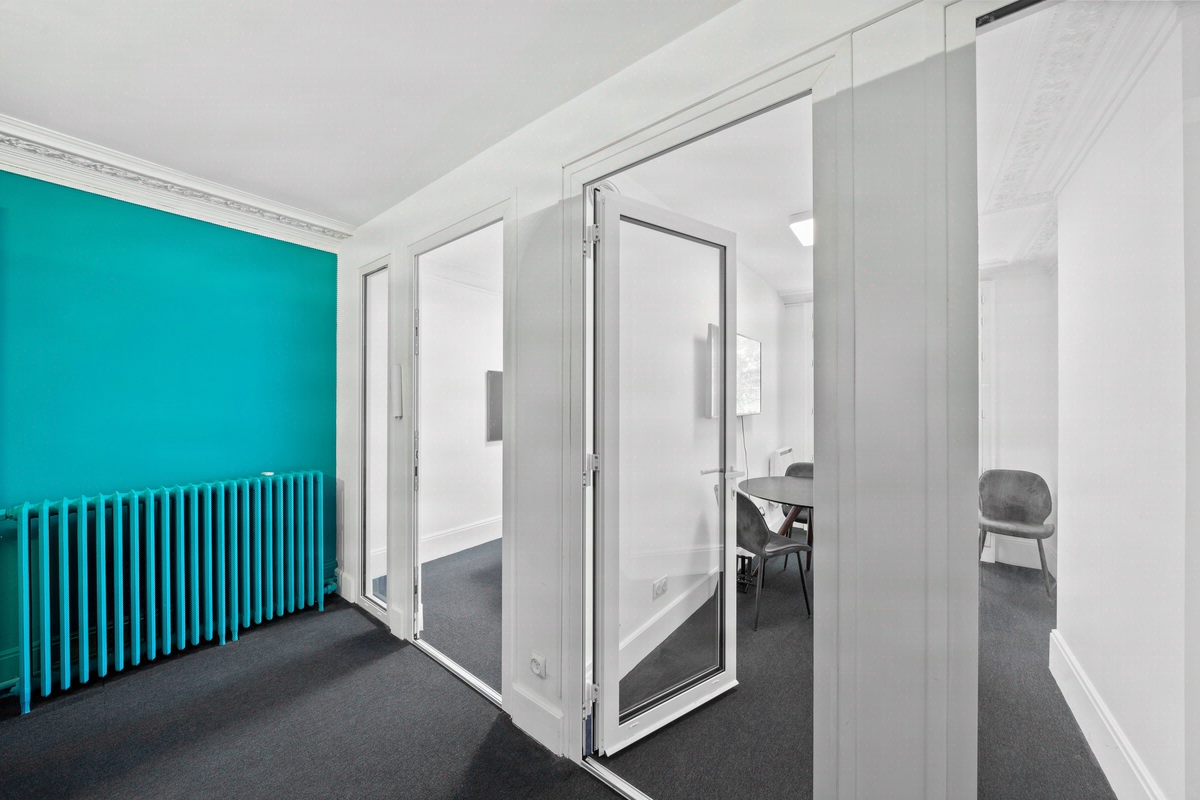
Heating and emitters in commercial buildings: radiators, underfloor heating, fan coil units
Heating accounts for 40 to 50% of the kWh of an office building (ADEME, Chiffres cles du batiment 2023): it is the ONLY item that makes the -40% threshold of the tertiary decree…
-
Tertiary air conditioning sizing: power calculation per m2
80 to 130 W/m2: this is the real cooling power range for tertiary offices, far from the 50 W/m2 flat rate still frequently used at the preliminary design stage. This flat rate…
-
Thermodynamic heat pump installation for commercial buildings: CO2 reduction and the tertiary decree
52% average reduction in final heating consumption: this is the gain measured by Kytom across 60 commercial sites fitted with thermodynamic heat pumps between 2018 and 2024. The…


The thresholds that frame HVAC design
The regulatory body of texts structures the majority of technical trade-offs in offices. The Labour Code (Title I, R4214-2, project owner’s design obligations) sets two reference airflow thresholds:
- 25 m³/h per occupant in an enclosed office without specific pollution,
- 30 m³/h per person in a meeting room or space with high occasional density.
The tertiary decree imposes a trajectory for reducing final energy consumption (-40 % by 2030, -50 % by 2040, -60 % by 2050), with annual reporting on the OPERAT platform managed by ADEME. RE2020 frames CO2 thresholds on extensions and new builds. According to data published by ADEME (key figures for tertiary buildings, 2023 edition), the average consumption of a French office is around 270 kWh/m²/year, of which 45 to 55 % is attributable to HVAC. Hygrothermal comfort refers to NF EN 16798-1 (24 °C +/- 1 °C in the summer period). On the acoustic side, the HQE (Certivea) and BREEAM In-Use (BRE) frameworks cap technical equipment at 38 dB(A) in an enclosed office, a constraint that guides the choice of air handling units and fan coil units.
Managing usage intensity rather than consumption
Contrary to the common reading of the tertiary decree, HVAC is not managed by final consumption but by usage intensity. Industry practice suggests targeting the -40 % by 2030 through equipment replacement; on our recent commercial renovation projects, most of the OPERAT gain comes from hourly scheduling and zonal CO2 sensors, not from replacing the production plant. Replacing a VRF in good condition to gain 0.3 points of COP is rarely worthwhile before 2030.
When the enhanced IAQ target is not justified
When the regulatory framework alone is not enough. On floor plates under 200 m² with fewer than 15 workstations, targeting an enhanced IAQ objective (CO2 < 800 ppm, WELL or BREEAM In-Use) is rarely economically justified: the additional cost of a high-efficiency dual-flow AHU with zonal CO2 sensors ranges from 80 to 120 €/m² excl. VAT, for a usage benefit that is difficult to measure at this scale. The R4214-2 threshold at 25 m³/h then remains the relevant reference, without oversizing; the equipment level is then set according to floor area, occupancy density and the building’s constraints.


