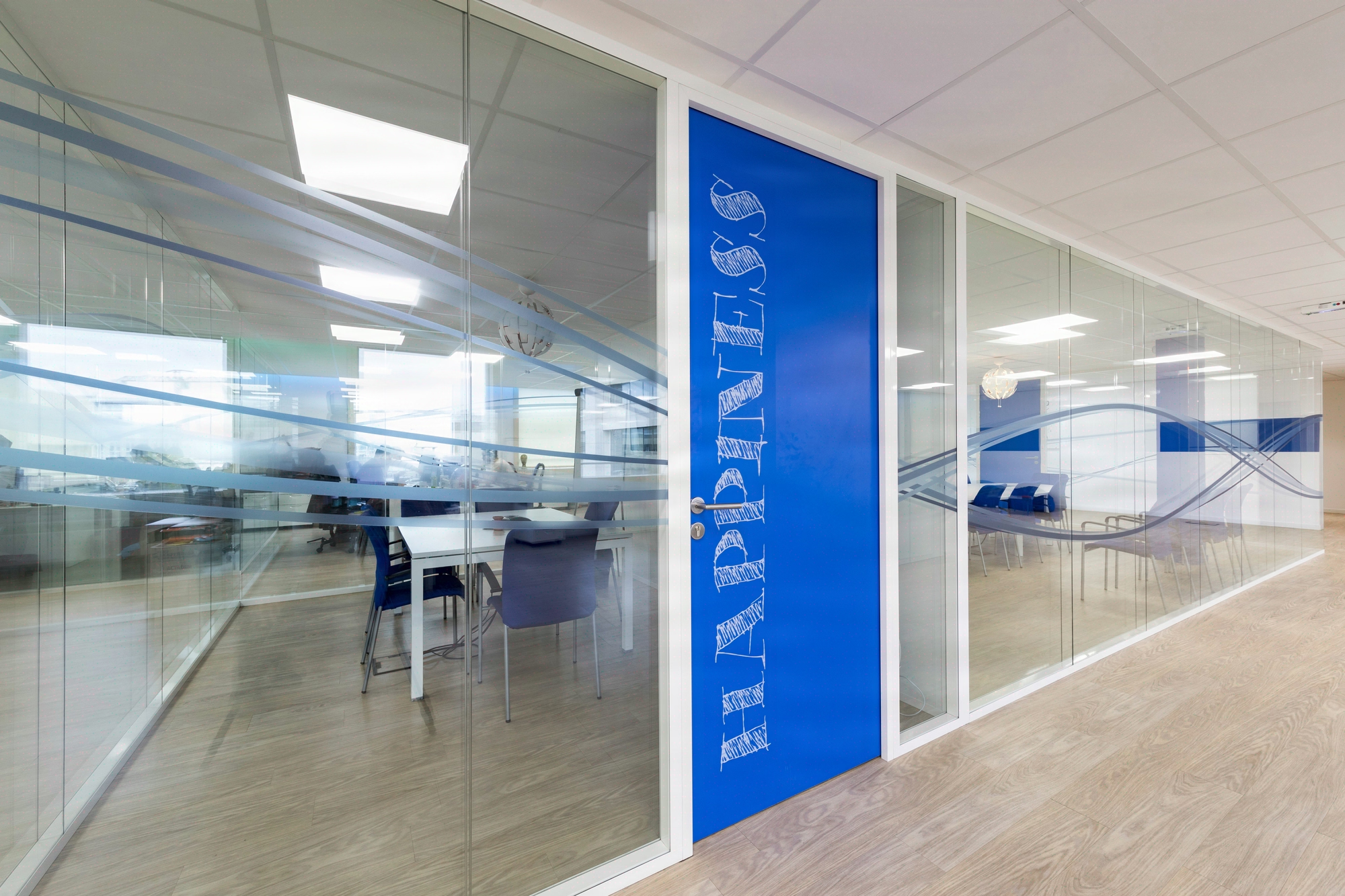
Sound-rated and acoustic doors: Rw insulation 35 to 55 dB
Regulatory framework applicable to workspaces: Rw targets between 28 and 45 dB depending on room type.
An Rw 45 dB door fitted on an Rw 38 dB partition caps out at 38 dB in handover measurement: EUR 1,800 excl. VAT of door leaf wasted by invalidation of the acoustic chain. The acoustic door is the weak link of an enclosed floor plate: an Rw 38 dB partition collapses to 25 dB if the door leaf lacks perimeter seals or an automatic threshold. Kytom lists more than 300 models (solid swing leaves, pocket sliding doors, laminated glazed 44.2) and structures its trade-offs across three contractual levels: Rw 35 dB for a standard enclosed office, Rw 42 to 45 dB for a confidential room, Rw 50 to 55 dB for an executive committee.
The French Labour Code, Title I of Book II (articles R4213 to R4217), requires the project owner to protect employees from noise pollution from the design stage onward. The acoustic reference framework applicable to commercial spaces structures insulation targets by use type.
| Space type | Rw target (dB) | Use |
|---|---|---|
| Standard meeting room | 28 | Internal non-confidential meetings |
| Shared office | 32 | Standard confidentiality |
| Management office | 38 | Strategic discussions |
| Confidential room (HR, legal, medical) | 45 | Absolute confidentiality |
| Executive committee | 50 to 55 | Sensitive data, M&A |
The Rw sound reduction measurement relies on the applicable standard protocols, supplemented by the C and Ctr correction terms. Our reading differs from the industry’s received wisdom on this specific point: Ctr is underused in specification. Most technical specifications cite Rw alone, whereas Ctr penalises low frequencies (deep voices, urban traffic) and governs the perceived comfort in a management office facing a boulevard. On the commercial floor plates we fit out, enclosed spaces account for a significant share of the usable area, and each requires a coherent partition-door-suspended-ceiling treatment. A poorly selected door invalidates the overall acoustic investment: the chain is sized on its weakest link.

For the architect and the interior fit-out contractor: the Kytom method in 4 steps over 12 weeks
For the interior architect and the interior fit-out contractor, the acoustic door is not an isolated joinery item: it is an architectural integration element whose contractual performance commits the project’s signature at handover. The Kytom intervention is organised in four steps coordinated by the account manager and the interior architect.
- On-site acoustic audit: survey of existing partitions, identification of lateral leaks and high leaks above the suspended ceiling, definition of the Rw target between 28 and 45 dB according to NF S 31-080: its creation.
- Selection from more than 300 references: trade-off between a solid swing door (zero footprint in the partition, Rw up to 47 dB under standard laboratory testing) and a pocket sliding door (significant floor gain per unit, typically around 1.8 m² depending on the execution drawings).
- Substrate preparation: the certified performance is only achieved if the host partition reaches an equivalent or higher Rw. The agencies coordinate joiners, plasterers and electricians within a formalised prevention plan.
- Installation and adjustments: adjustment of perimeter seals, automatic guillotine threshold, closing test.
Each project is the subject of an archived handover sheet, a deliverable that can be integrated directly into the as-built file (DOE) provided by the architect. The standard breakdown is divided into 2 to 3 weeks of audit and selection, 6 to 8 weeks of manufacturing, 1 to 2 weeks of installation and adjustments.
When this method is not the right one. Below 3 acoustic doors per operation, the full audit is generally not cost-effective: Kytom then steers toward a direct catalogue selection with installation control, since the weight of audit fees relative to the unit cost of the doors makes the approach disproportionate. Likewise, on an open space without any equivalent-Rw partition, treating the door first is a false problem: the host partition must be requalified before committing to the joinery item.

Measured feedback from our acoustic projects
On our projects involving acoustic doors, three recurring effects stand out.
- Perceived confidentiality: executives and HR departments validate the compliance of the service as soon as the door is paired with an equivalent-Rw partition and a suspended ceiling treated up to the soffit.
- Spatial gain: a swing door uses about 1.8 m² of swing clearance. Switching to a pocket sliding door frees up this swing area, which represents a significant spatial gain when several enclosed rooms are concerned on the same floor plate.
- Mechanical stability: after several years of use, our field feedback reports neither leaf warping nor rail misalignment on the projects monitored.
The target ambient noise measured at handover ranges from 30 to 35 dB(A) in an enclosed office and from 35 to 40 dB(A) in an adjacent open space, consistent with the reference acoustic thresholds in a commercial environment. Conversational noise from colleagues remains the primary reported nuisance in open spaces: an Rw 38 dB door paired with a partition of equivalent sound reduction contributes significantly to reducing acoustic complaints in the management zone.
Conditions of non-applicability. The spatial gain of the pocket door becomes illusory below a sufficient number of sliding doors per floor plate: the additional cost of the pocket frame is generally not offset by the m² recovered on small perimeters. The Rw 50 to 55 dB door is not justified outside an executive committee or a sensitive legal room: for standard strategic discussions, Rw 38 to 42 dB is sufficient, and the marginal investment beyond that exceeds EUR 1,800 excl. VAT per leaf with no perceived gain.

Three points of vigilance before approving the quote
Three limits must appear in the specifications, otherwise the contractual performance is invalidated and the project management’s liability is engaged.
Partition-door consistency. The Rw performance certified in the laboratory only materialises if the host partition presents an equivalent sound reduction. Fitting an Rw 45 dB door on an Rw 38 dB partition remains a partially wasted investment: the leak passes through the partition, and the handover measurement caps at 38 dB.
Pocket door and phasing. The pocket door frame must be installed before the partition finishes: a retrofit on a delivered floor plate generates an additional removal-reinstallation cost and is only cost-effective from 4 doors per operation. The architect specifies the pocket door from the detailed design (APD) phase to avoid this additional cost.
Frequently asked questions
Which Rw target should be chosen for a confidential management office?
In management use, the relevant acoustic target is Rw 38 dB for a management office and Rw 45 dB for a confidential room (HR, legal, medical). Beyond Rw 45 dB, the marginal investment exceeds EUR 1,800 excl. VAT per leaf with no perceived gain outside an executive committee or M&A room: Kytom advises against Rw 50 to 55 dB for standard management use.
This package is part of a wider approach: see our acoustic correction expertise.


