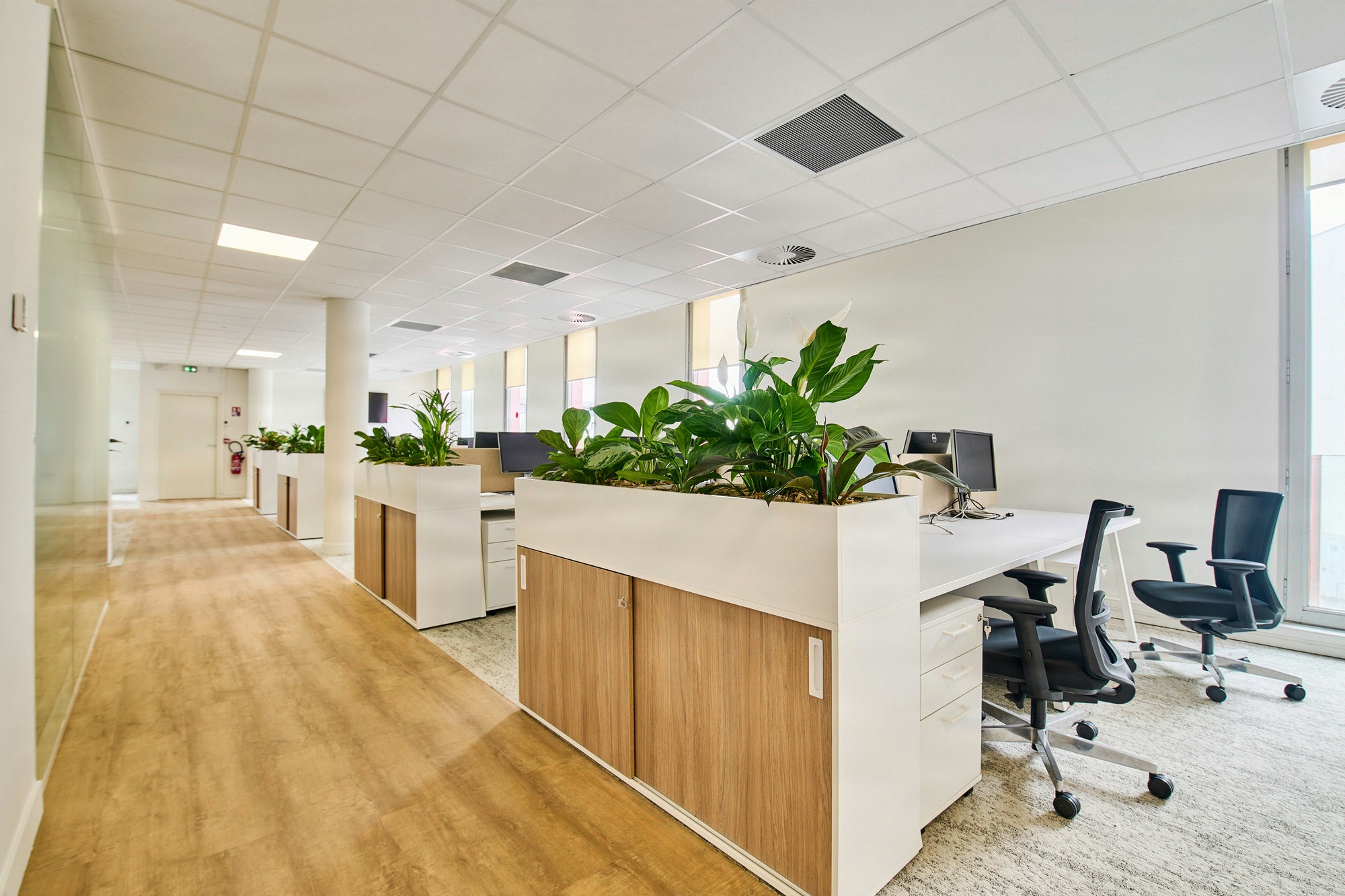
WELL office certification: health becomes a financial asset
Certification standard focused on health and wellbeing at work: 110 points distributed across 10 concepts, with a direct link to CSRD ESRS S1 requirements.
You are weighing up an 850 sqm retrofit and your asset manager is hesitating to sign off on the health certification cost: expect a 3 to 15% works premium, but recover a 4 to 7% rental premium on prime offices. The calculation tips in your favour as soon as 6 years of residual lease remain, and Kytom documents this across 12 health certification projects delivered between 2021 and 2024. Our team manages the audit, the scoring of the 10 concepts in the v2 standard, the design and the performance verification, in 9 to 14 calendar months between launch and label. The v2 standard distributes 110 points across 4 levels (Bronze 40, Silver 50, Gold 60, Platinum 80), backed by recognised health and technical standards in air quality, acoustics and ergonomics. Founded in 2006 and certified, Kytom aligns fit-out, asset value and CSRD ESRS S1 reporting within a single framework. Here is how we turn a health requirement into a lever for rent and asset value.
The framework
The WELL v2 standard structures 10 health and wellbeing concepts across 4 levels (Bronze 40 pts, Silver 50 pts, Gold 60 pts, Platinum 80 pts) over a total of 110 points, in its Q4 2023 version. It draws on international health standards, ASHRAE 62.1 and ANSI, and complements HQE (built environment) and BREEAM (operations), which focus on other dimensions.
Three pressures converge on French office management teams:
- Regulatory: the CSRD directive (EU 2022/2464) mandates ESRS S1 reporting on working conditions, and ERTs are governed by the Labour Code (recodified Decree 92.332 and the amended order of 05 August 1992), which notably regulates indoor air quality.
- Economic: absenteeism represents 4.5% of working time, or around 108 billion euros in direct cost on the French payroll.
- Attractiveness: the 2023 quality of work life barometers confirm the effect of space quality on executive engagement.
Across a premium office portfolio, the triptych HQE Very Good + BREEAM In-Use Excellent + occupant-health certification covers environment, operations and occupants. Since 2020 Kytom has observed a marked increase in specifications including an occupant-health requirement, driven by CAC 40 headquarters and mid-cap companies aligning their real estate with their CSR policy.
In practice, the most robust ROI generally comes from the rental premium and asset value, more than from HR gains, which are harder to audit. The asset manager who funds an occupant-health certification for quality of work life alone underestimates the rent lever; the HR director who defends it in isolation deprives the decision of the financial leverage that makes it profitable.
Your gains
Absenteeism, eNPS and rental premium: the observed gains
Projects incorporating indoor environmental quality criteria tend to reduce absenteeism and comfort complaints, and to improve employee engagement, effects documented in the scientific literature on high-performance work environments. The rental premium associated with wellbeing certifications is documented in the prime office reports of the leading real estate advisory players.
| Indicator | Effect observed post-delivery | Horizon |
|---|---|---|
| Reported absenteeism | -15 to -25% | 18 months |
| Internal eNPS score | +10 points | 12 months |
| Thermal/acoustic comfort complaints | -30% | 6 months |
| Rental premium (prime offices) | +4 to +7% | lease signed |
On the productivity side, a +101% improvement in cognitive performance was measured in a well-ventilated environment with low VOC levels.
For your asset manager, certification becomes a tangible asset: the label translates into green leases, feeds the European taxonomy and offers a liquidity argument at resale. For your HR director, it serves as a CSRD demonstrator and feeds ESRS S1 reporting on employee health and safety. This dual financial and HR reading transforms the fit-out into a strategic investment, as soon as the holding period justifies it.
Points to watch
$0.16/sq ft, recommissioning every 3 years, older buildings
A certification of this type is not signed blind. Three areas of vigilance structure our framing:
- Recurring costs: registration from $0.16/sq ft, performance verification mobilising an accredited agent 2 to 4 days on site, recommissioning every 3 years. These costs enter the business plan OPEX, not a post-delivery oversight.
- Dependence on the existing building: without an air handling unit capable of integrating MERV 13 filtration, the Gold level becomes unattainable if the landlord refuses the HVAC works.
- Required documentation: the final scoring relies on exhaustive traceability (product sheets, measurements, photos), which our certification allows us to industrialise.
We manage these three areas from the initial audit, to prevent them from derailing the performance verification 12 months later.
When to step back
Short lease, small floor plate, blocked HVAC: our alternatives
On a floor plate of less than 600 sqm with a residual lease of less than 4 years, aiming for full certification is not profitable: the ratio of certification, project management and recommissioning costs per sqm quickly becomes prohibitive, for a return on use cut short by the end of the lease.
The same logic applies if the building lacks a MERV 13 compatible AHU and the landlord locks down the HVAC works: the Gold level becomes unattainable without changing asset.
In these cases, we steer towards two alternatives:
- A targeted IAQ approach (CO2, VOC, acoustic measurements according to the applicable standards) without filing a dossier, which secures regulatory health-and-safety compliance and the HR promise at a controlled cost.
- An alignment with the principles of the health-and-wellbeing standard to feed ESRS S1 reporting, without going as far as certification.
This commercial honesty is part of the Kytom framing: we prefer to rule out a certification project that is not profitable rather than deliver a label that the holding period does not justify.
Method
- Initial audit of the certification standard focused on occupant health and wellbeing.
During the first 2 weeks, our team measures acoustics, VOC, luminance, CO2 and humidity on the existing floor plate, scores the 10 concepts of the applicable standard and identifies the features achievable without heavy works. This quantified diagnosis serves as the basis for the Silver/Gold decision. - Programming and decision
Between weeks 2 and 4, we frame the target level with your asset manager and your HR director, cross-referencing holding period, available works budget and CSRD ESRS S1 requirements. The Silver/Gold/Platinum decision is made here, based on a documented ROI calculation. - Design oriented towards occupant wellbeing, aligned with indoor environmental quality standards.
Over weeks 4 to 7, our studio integrates circadian lighting 300 to 500 lux, MERV 13 filtration, biophilic furniture, recovery zones and thermal comfort 21-24°C. Each feature selected is traced in the IWBI dossier. - Multi-agency execution
From week 7 to week 11, our 11 agencies manage the site with low-emission materials and documentary traceability compliant with the requirements of the applicable indoor environmental quality standard. The Kytom quality system frames the collection of evidence and guarantees the consistency of controls throughout the operation. - IWBI performance verification
From week 12, an accredited IWBI agent carries out the on-site tests, we file the certification dossier and organise the support on the three-yearly re-certification, including the recommissioning at 3 years required by IWBI.
Frequently asked questions
Is environmental and health certification of buildings profitable for an asset manager?
The ratio tips positive when the residual lease exceeds 6 years: +4 to +7% rental premium on prime offices (MIT Real Estate Innovation Lab, Devine et al., 2022) against 3 to 15% works premium. On an 850 sqm floor plate leased at 450 EUR/sqm/year, this represents around 19,000 EUR in additional annual rent, or 190,000 EUR capitalised over 10 years at constant rent. The label also feeds green leases, the European taxonomy and the liquidity argument at resale.
How long between launch and obtaining the label?
Across the KYTOM 2021–2024 portfolio, the observed timeline from launch to obtaining WELL certification ranges from 9 to 14 months for an 850 m² office floor. The schedule covers scoping, scoring the 10 concepts of the WELL v2 standard, and performance verification conducted under the IWBI protocol. The target level (Bronze, Silver, Gold or Platinum) is decided at launch, as it determines the volume of evidence to document.