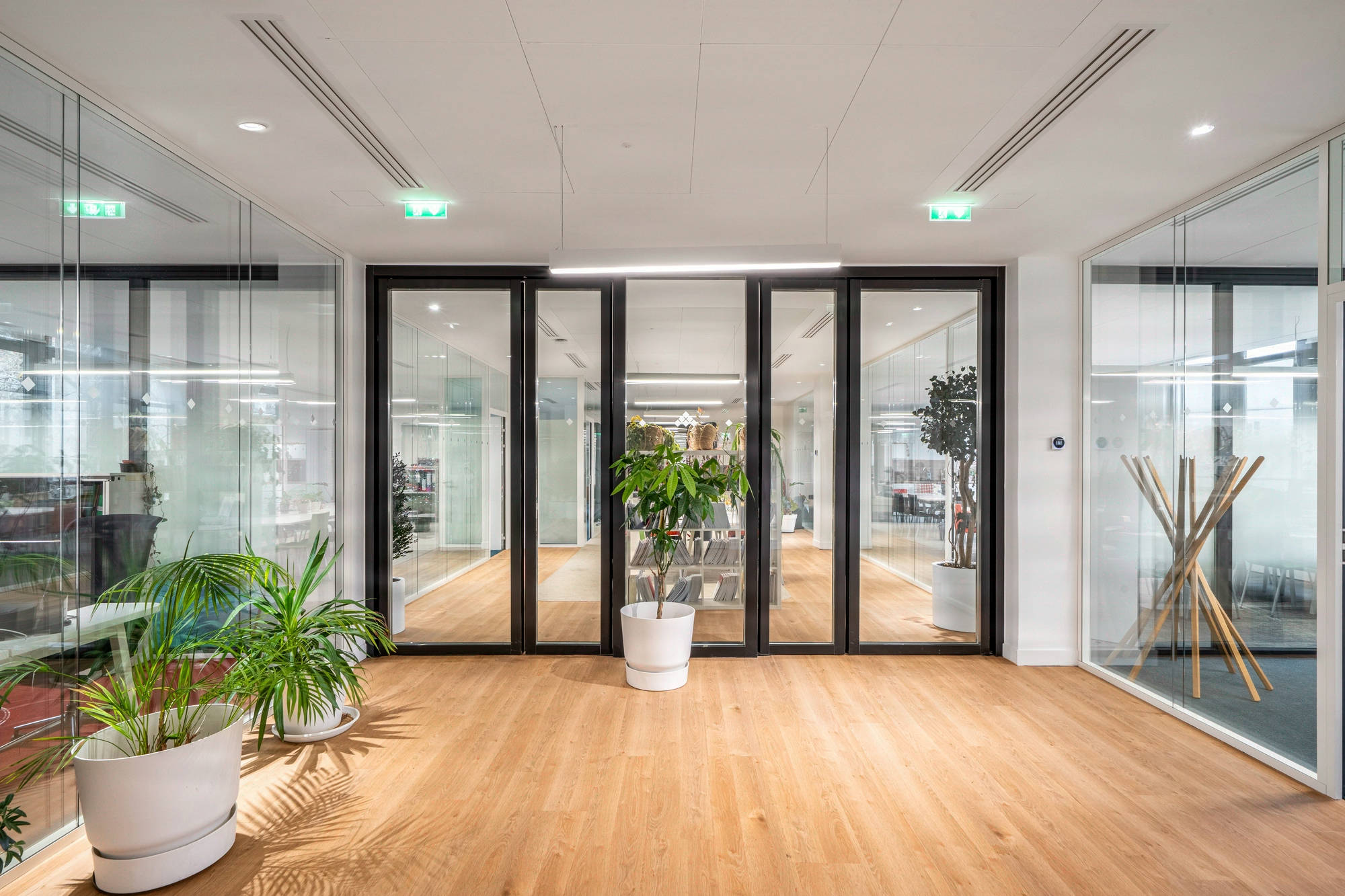
Poured resin flooring
4 structuring factors for the fit-out budget
Poured resin is only cost-effective above 200 sqm and 8 years of occupancy: below that, LVT PVC remains significantly cheaper on a total cost basis. This threshold, confirmed by our experience in commercial fit-out, reverses the prevailing marketing narrative that presents resin as a universal solution. For a CFO or asset manager, the decision rests on three auditable variables: continuous surface area, projected occupancy duration and residual moisture content of the substrate (4% CM threshold, compliant with DTU 26.2 and 52.1). Kytom has been installing poured resin since 2006 over an average surface of 850 sqm per operation, with a budget of 60 to 180 EUR/sqm supplied and installed, and a service life exceeding 15 years documented across several sites delivered between 2008 and 2014.

Floor coverings represent a significant share of a commercial project budget and shape acoustics, hygiene and maintenance over a minimum of 15 years. Four factors guide the choice of a poured resin:
- Visual continuity: seamless installation up to 2000 sqm in a single span (Kytom operational limit, depending on existing expansion joints), eliminating areas prone to soiling.
- Regulatory compliance: the regulations applicable to workplaces require floors that are cleanable and slip-resistant; the SRT coefficient must exceed 35 to meet accessibility requirements for people with reduced mobility.
- Hygiene and fire safety: category B1 resins according to the European reaction-to-fire classification, compatible with the requirements of controlled-dust areas and HACCP protocols for catering spaces.
- Environmental performance: VOC emissions below 50 µg/m³ after 28 days, A+ level according to the French regulation on the health labelling of construction products, environmental declaration sheets verified by a third party.
Kytom integrates these 4 dimensions from the preliminary design phase, arbitrating the chosen system with the project owner and the building services design office.

For the CFO and asset manager: where resin creates asset value
The financial reading of the resin flooring choice comes down to three decision-making indicators that Kytom documents project by project:
- Total cost of ownership (10-year TCO): on an 850 sqm floor plate, the works budget ranges between 75,000 and 180,000 EUR excl. VAT, with a maintenance cost structurally lower than tiled carpet thanks to the absence of joints and ease of cleaning. Over 10 years, the initial premium is recouped from 7 to 8 years of continuous occupancy.
- Rental value: asset managers regularly observe a positive rental differential on floor plates fitted with premium resin finishes, to be assessed case by case according to the market and the asset location.
- Tertiary decree: low-VOC resins (<50 µg/m³, A+ level) contribute to the air-quality component of ESG audits and support the asset's BREEAM In-Use rating.
Contrary to common practice, Kytom does not recommend resin for assets with a holding horizon below 5 years: the CAPEX vs OPEX trade-off becomes unfavourable and a mid-range glued LVT PVC offers a better return over a short cycle.

Kytom method in 6 steps, delivery in 12 weeks on average
The method relies on an industrialised sequencing deployed by the network’s 11 agencies in France and Spain:
- Substrate audit (48 h): measurement of residual moisture content (threshold < 4% CM, regulatory value DTU 26.2/52.1) and pull-off test at a minimum of 1.5 MPa.
- Technical recommendation (5 working days): arbitration between epoxy (standard commercial areas), polyurethane (UV resistance, glazed halls) or methacrylate (return to service in 2 hours).
- Mechanical preparation: shot blasting or diamond grinding, a critical step representing a significant share of the site duration.
- Multilayer application: bonding primer then a system 1.5 to 4 mm thick, carried out by QUALIBAT 6224 qualified applicators.
- Quality checks every 200 sqm: verification of thickness, adhesion and aesthetic finish according to the reference standard.
- Delivery and as-built file: complete file with ten-year guarantee, warranty checkpoints at 12 and 24 months.
When the project includes a raised floor (height 100 to 300 mm), the MEP coordination beneath the access floor (air, power, IT/cabling, drainage) is sequenced before the resin application to avoid any rework.
When this method is not the right one. Below 200 sqm or on a project with a projected occupancy duration of less than 5 years, the amortisation of the mechanical preparation (shot blasting, primer, dust logistics) remains unfavourable compared to a glued LVT PVC: the cost gap per sqm is not recouped over the period of use. Likewise, on a substrate with more than 4% CM of residual moisture without the possibility of a vapour barrier, or on slabs cracked beyond 0.3 mm with active progression, Kytom advises against poured resin and steers towards a prior overlay screed or a decoupled flexible covering.
Comparison table of the 3 resin systems in commercial offices
The choice of system depends on traffic, budget and the time to return to service.
| System | Thickness | Price EUR/sqm supplied and installed | Return to service | Typical use |
|---|---|---|---|---|
| Self-levelling epoxy | 2 to 3 mm | 70 to 95 | 24 to 72 h | Offices, circulation areas |
| Tinted polyurethane | 2 to 4 mm | 110 to 140 | 24 to 48 h | Glazed halls, light-vehicle car parks |
| Methacrylate (PMMA) | 1.5 to 3 mm | 150 to 180 | 2 h | Occupied sites, retail, food industry |
These price ranges are indicative and drawn from our field experience in a commercial context; they vary according to surface area, substrate condition and site constraints. To these amounts must be added substrate preparation (15 to 30 EUR/sqm depending on condition) and waste removal compliant with the 7-stream sorting decree. Decorative finishes (quartz effects, metallic flakes, marbling) add 15 to 25 EUR/sqm. Kytom provides a detailed quotation within 5 working days.
Our reading differs from common practice on PMMA. Industry doxa presents methacrylate as a premium solution reserved for extreme constraints. In practice, on occupied sites (commercial refurbishment on operating premises, bank branches, retail), the premium of PMMA over epoxy, of the order of 50 to 80 EUR/sqm, is quickly recouped as soon as the site downtime cost is significant: for a prime Parisian asset, the economic equation clearly tips in favour of PMMA, which becomes the most rational option rather than a luxury.

5 benefits measured over a service life exceeding 15 years
Post-delivery client feedback confirms five gains over the service life:
- Maintenance cost: significantly reduced over 10 years compared to tiled carpet, the absence of joints eliminating areas prone to soiling and reducing vacuuming frequency.
- Service life: exceeding 15 years under intense commercial traffic, confirmed across several sites delivered since 2008 still in service without rework.
- Mechanical resistance: admissible load of 50 MPa in compression, supporting forklift trucks up to 3.5 t.
- Return-to-service time: 2 h for PMMA, 24 to 72 h for epoxy and polyurethane, i.e. several operating days preserved compared to a traditional screed.
- ESG compliance: A+ VOC level and INIES-verified FDES contribute to BREEAM and HQE audits.


