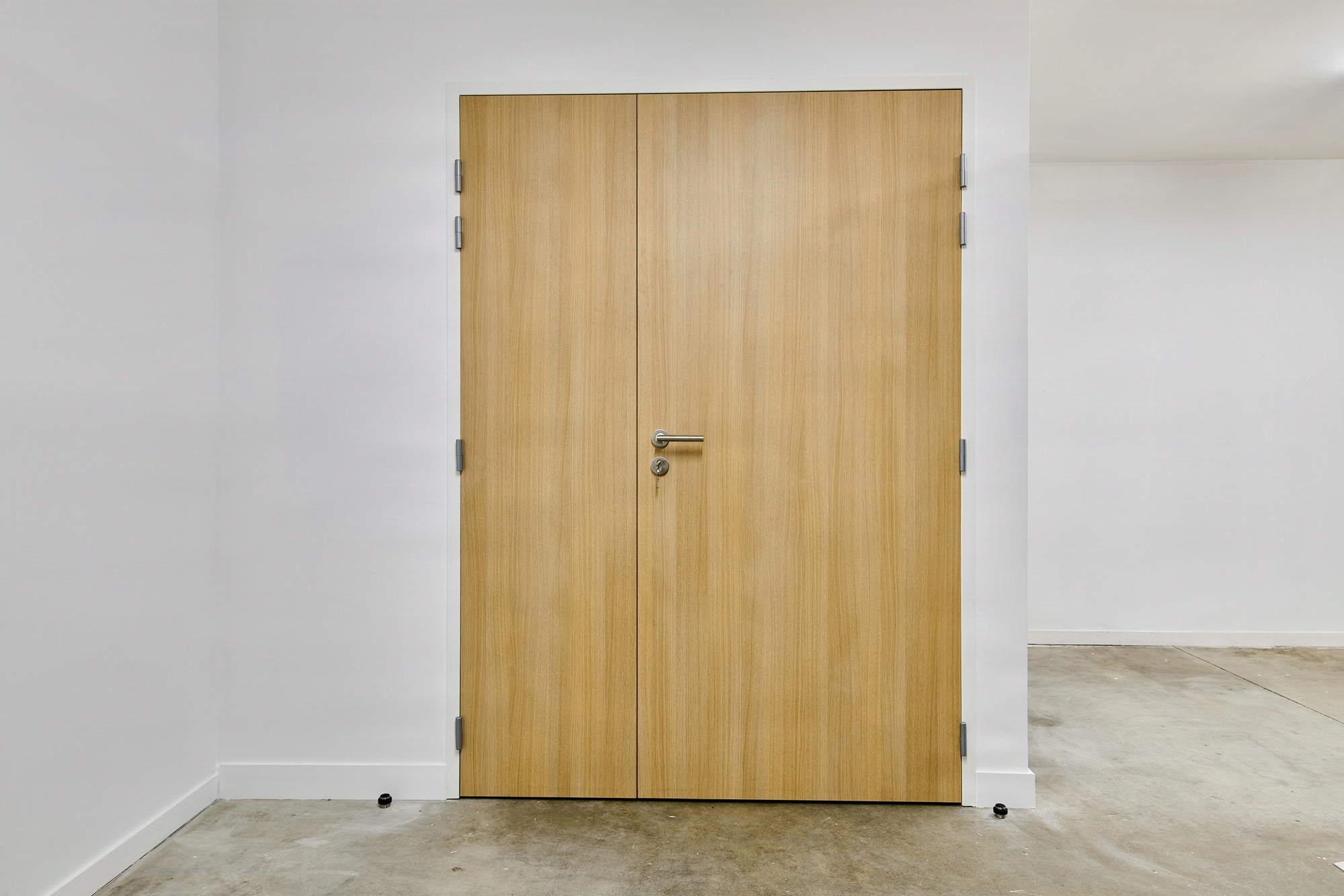
Polished concrete in offices: polished and mineral finishes
Polished concrete withstands 50 to 200 passes per day over 8 to 12 years in office settings
Polished concrete is less durable than LVT vinyl under heavy traffic (8-12 years versus 15-20 years before renovation), and its discounted cost over 15 years exceeds it beyond 200 passes/day per zone. Best used as a signature architectural finish, not as a general-purpose operational floor. Office polished concrete is applied at 2 to 5 mm on a DTU-compliant screed (flatness 3 mm under a 2 m straightedge, residual moisture below 4.5%). The installation cost is generally between 90 and 160 euros excl. VAT/m² depending on the complexity of the project and the chosen finish, for an overall lead time of approximately 12 weeks including 21 days of drying.

The covering meets three converging architectural requirements: visual continuity over 500 to 2,000 m² without visible joints, durability under professional traffic of 8 to 12 years before renovation of the protective layers, compatibility with mixed reception-circulation-open space uses.
The substrate parameters imposed by the DTU and the CSTB Technical Opinions on thin coverings structure the project:
- Application thickness: 2 mm for an ultra-fine finish, 3 to 5 mm for high-stress zones
- Substrate flatness: tolerance 3 mm under a 2 m straightedge
- Residual moisture: maximum threshold 4.5% on cement
- Installation temperature: 15 to 25 degrees for 7 days
- Ambient humidity: below 65%
Where a raised access floor is present (height 100 to 300 mm) housing air, high-voltage electricity, VDI and drainage, the finishing screed rests on removable panels compatible with a point load of 4.5 kN/m² according to EN 12825. This configuration requires MEP coordination frozen 4 weeks before installation, failing which capillary cracking may occur at the inspection hatches in the event of late changes.
Contrary to the widespread practice in architecture firms, polished concrete is not a substitute for LVT vinyl: it is a signature finish. Polished concrete loses its appeal under continuous traffic above 200 people/day per zone: the renovation frequency of the protective layers accelerates noticeably, and the discounted cost over 15 years can exceed that of LVT vinyl installed for these intensive uses. In these high-traffic zones (station concourses, category 1 public buildings, inter-company restaurants serving more than 800 covers), LVT vinyl or filled epoxy resin remain preferable. Our reading here differs from the dominant mineral doxa in interior architecture since 2015: reserving polished concrete for halls, executive rooms and signature floors with fewer than 200 passes/day preserves both the architectural intent and the operating economics. The observed installation cost is generally between 90 and 160 euros excl. VAT/m² installation included, depending on the complexity of the substrate and the chosen finish level.
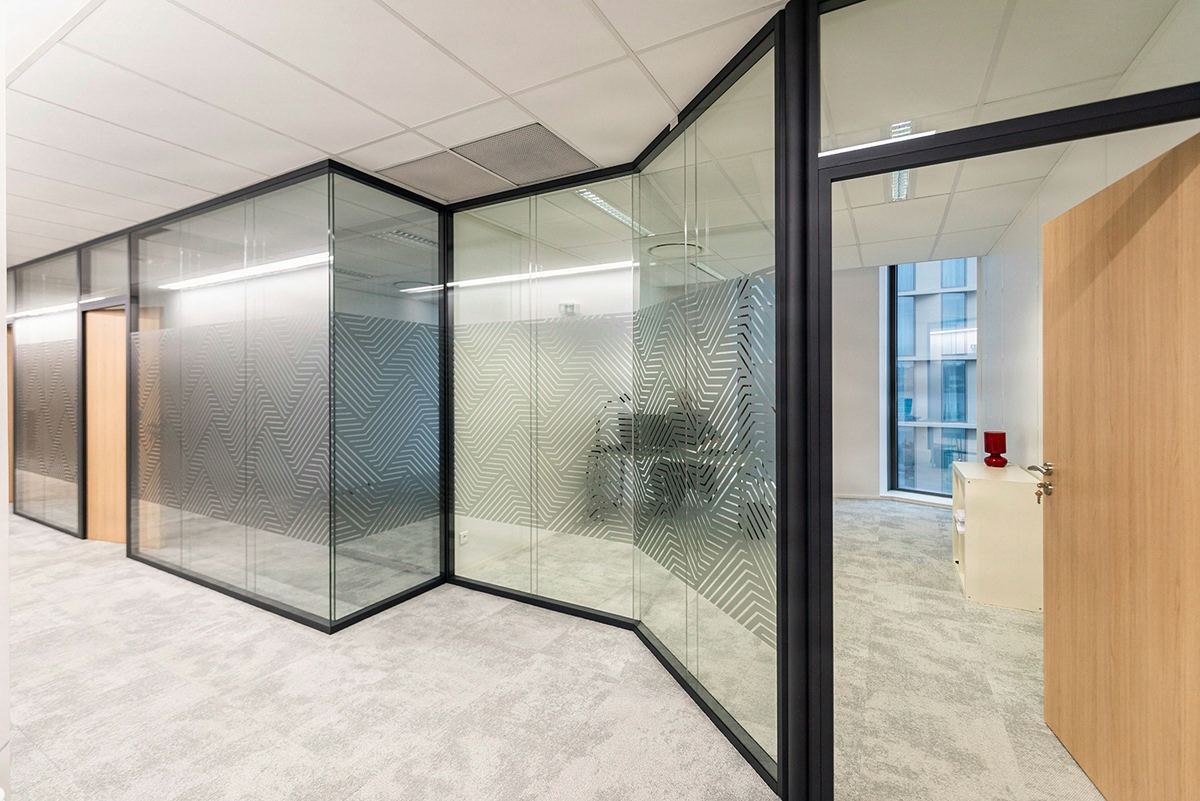
For the interior architect: 12 weeks of sequencing, 21 incompressible days of drying
For the interior architect, the issue is not the material itself but its compatibility with the floor delivery schedule and the coordination of other trades (demountable partitions, suspended ceiling, MEP). The Kytom operational sequencing is structured in five phases coordinated with the project management, from substrate diagnosis to delivery.
- Audit phase (weeks 1-2): residual moisture measurement using the carbide method, DTU flatness control, identification of structural joints and raised floor hatches
- Finish phase (weeks 3-4): selection from 3 families (polished satin 30-60 GU, matte below 15 GU, traditional waxed) and a palette of 24 standard shades
- Preparation phase (weeks 5-7): mechanical sanding, two-component epoxy primer, fibreglass mesh installation in at-risk zones
- Application phase (weeks 8-10): 2 to 3 layers of 1 to 2 mm, 24-hour drying between layers
- Protection phase (weeks 11-12): 2 to 3 coats of two-component polyurethane varnish
The selection of shades incorporates the Munsell rendering under 4000 K lighting and the light reflection coefficient, a key parameter for floors with low natural light input. Kytom installers undergo at least 6 months of internal training before working independently on office sites, in line with the standard established since 2006.
When this method, the standard lead time, is not suitable. On surfaces below 150 m² or on delivery schedules constrained to under 6 weeks, the sequencing becomes counterproductive: the fixed 21-day drying period and the protection phases cannot be compressed, and the fixed cost of mobilising specialised teams penalises the cost/m² ratio beyond 200 euros excl. VAT/m². In these configurations, Kytom directs towards a PMMA resin (2-hour drying per layer) or a glued LVT vinyl (installation in 5 to 7 days).
Three finish families compared: polished satin, matte, traditional waxed
The choice of finish determines the architectural rendering, maintenance and slip resistance. The table below summarises the decision criteria for interior architects, established from site feedback observed on projects delivered in recent years.
| Finish | Gloss (GU) | Slip coefficient (PTV) | Preferred use | Indicative price excl. VAT/m² |
|---|---|---|---|---|
| Polished satin | 30 to 60 | 25 to 35 | Reception halls, showrooms | 130 to 160 EUR |
| Matte | below 15 | 36 to 45 | Open space, circulation areas | 100 to 130 EUR |
| Traditional waxed | 20 to 40 | 30 to 40 | Executive spaces, VIP rooms | 90 to 120 EUR |
The Pendulum Test Value (PTV) slip coefficient according to NF EN 13036-4 must reach a minimum of 36 for public passage zones, which rules out the mirror polished satin finish for halls receiving the public in public buildings. The matte finish, dominant in recent office fit-outs, offers an acoustic-aesthetic-safety compromise favourable to open-plan floors. The traditional waxed finish retains an evolving patina prized in executive offices and spaces with strong symbolic value, but requires specific maintenance every 12 to 18 months.
When to forgo the traditional waxed finish. On multi-tenant sites with lease turnover below 4 years or in the absence of a specialised maintenance provider integrated into facility management, the traditional waxed finish becomes an economic trap: lack of maintenance leads to a complete removal and replacement rather than a simple surface renovation, with a significant budget impact. In these contexts, the polyurethane matte finish remains the default choice.

Four technical points of vigilance specific to polished concrete in office floors
Field experience identifies four recurring points of vigilance, cross-referenced with the technical standards applicable to thin coverings.
- The trap of capillary cracking at the raised floor hatches: MEP changes after installation can generate fine cracks visible under grazing light. The safeguard consists of freezing MEP coordination 4 weeks before application and incorporating a fibreglass mesh to bridge the joints of removable panels.
- The hygrometric risk during winter delivery: below 15 degrees or above 65% humidity, the drying of the polyurethane protective layers drifts from 24 hours to 72 ho


