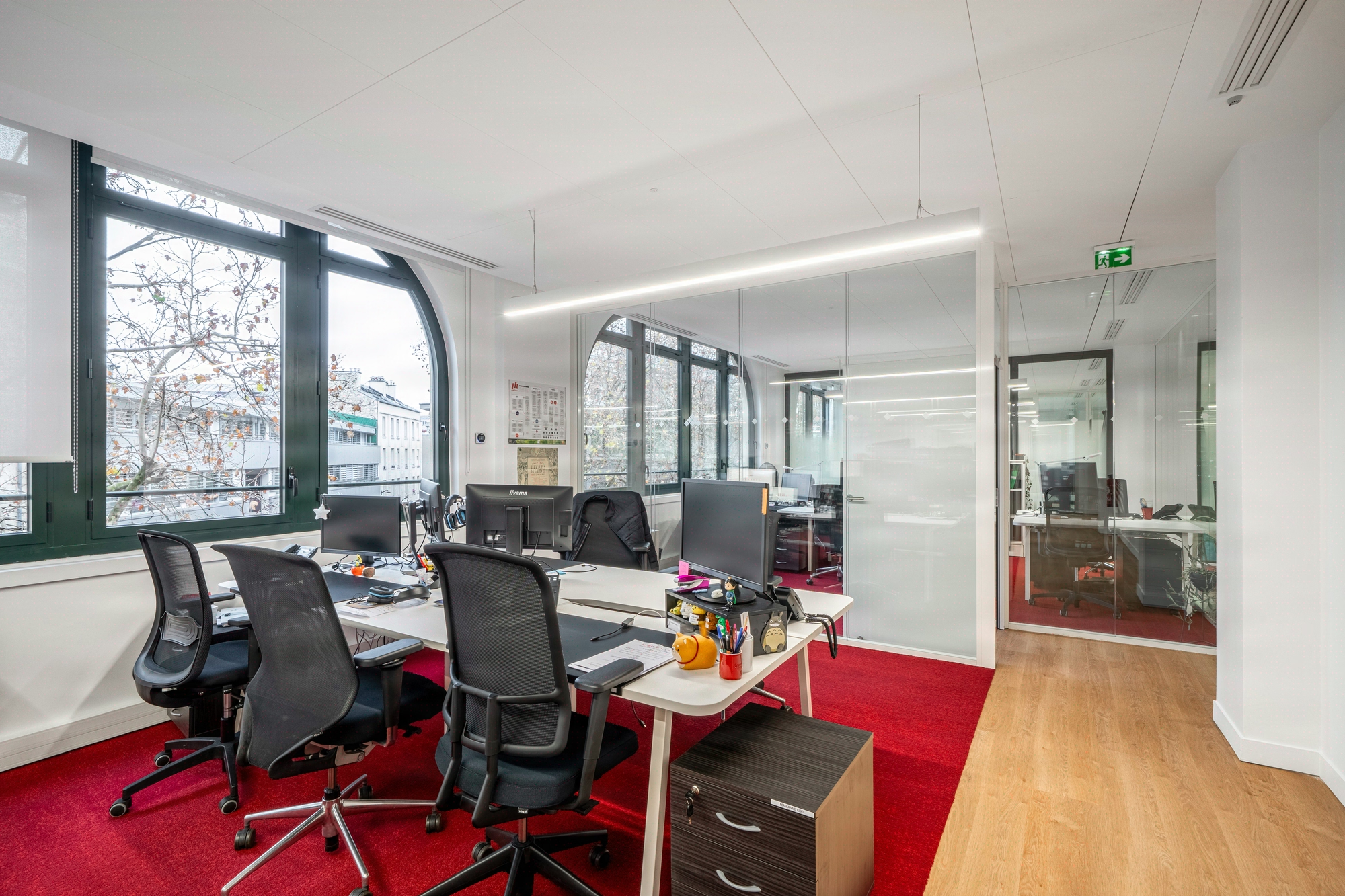
U3P3 Carpet for Offices
UPEC classification and acoustic requirements: 55 dB(A) threshold in open plan
Over the long term, U3P3 carpet generally offers a lower operating cost than LVT vinyl, provided that floor plate reconfigurations are kept to a minimum over time. The U3 threshold covers up to 500 daily footfalls, which is the dominant configuration of French office floor plates exceeding 500 sqm. Three trade-offs shape the decision: the UPEC usage class, compatibility with castor chairs, and acoustic performance measured in sabine absorption. Kytom has been installing this flooring since 2006; the 50×50 cm tile prevails on most of our office projects thanks to its targeted zone-by-zone maintenance.

Our reading diverges from the industry’s conventional wisdom on one specific point: the U3P3 classification is not a safety target, it is a budget ceiling. Over-classifying a floor plate with 200 footfalls/day as U3P3 when U2sP2 is sufficient generates a cost premium per sqm that is rarely recouped over the actual usage period.
The UPEC classification ranks flooring according to four criteria: Wear (Usure), Indentation (Poinçonnement), Water (Eau), and Chemical agents. The U3P3 rating targets premises with heavy traffic, the dominant configuration of office floor plates exceeding 500 sqm.
Four regulatory references shape the acoustic trade-off:
- Article R.4213-5: requirement for acoustic treatment of workspaces.
- NF S 31-080:2006: target below 55 dB(A) in open plan, target reverberation range of 0.5 to 0.8 seconds.
- Standardised protocol for measuring the absorption coefficient in a reverberation chamber.
- A+ labelling: VOC emissions mandatory since the order of 19 April 2011.
U3P3 carpet absorbs 6 to 8 dB of reverberated sound energy, compared with less than 1 dB for a hard floor. The thermal dimension also matters: a textile flooring noticeably reduces the sensation of cold underfoot compared with a PVC tile, an additional lever for the objectives of the tertiary decree by 2030.
When U3P3 carpet is not the right answer. Below 100 daily footfalls, on small floor plates of less than 200 sqm, enclosed offices or residentialised spaces, the U2sP2 class is sufficient and the U3P3 premium is not recouped. Conversely, in reception halls and main circulation areas of buildings exceeding 5,000 sqm with more than 1,000 footfalls/day, U3P3 wears out prematurely in less than 5 years: you then need to move up to U4P4 or switch to LVT vinyl. Finally, in recurrent wet areas such as intensive cafeterias or external airlocks without entrance matting, carpet is contraindicated regardless of the classification.

Five-step installation method governed by DTU 53.1
Installing U3P3 carpet follows a strict technical sequence, governed by DTU 53.1 relating to glued-down textile floor coverings.
- Substrate audit: residual moisture measurement with a threshold below 4.5% CM according to DTU 53.1, flatness check with a 5 mm tolerance under a 2 m straightedge, identification of MEP services in the raised access floor.
- Product selection: supplier technical files U3P3 minimum, A+ labelling for VOC emissions, GUT or Cradle to Cradle certification.
- Preparation: P3 levelling if required, bonding primer, drying for 24 to 48 hours.
- Installation: loose-lay, semi-loose or glued depending on the configuration, 50×50 cm tiles in the majority of cases to facilitate targeted maintenance.
- Acceptance: site report, maintenance sheets, ten-year warranty.
Coordination with the raised access floor is a critical point: beneath a 100 to 300 mm raised floor coexist air distribution, power cabling, data/voice and condensate drainage. Every access hatch must remain accessible after installation, which requires tile cutting aligned with the 600 mm grid of the technical plenum.
Method limitation. This sequence is not applicable as is on a concrete slab less than 6 months old, where residual moisture almost systematically exceeds the 4.5% CM threshold, nor on old substrates containing asbestos or lead without prior diagnosis: in both cases, glued-down installation is prohibited and a regulatory removal/asbestos-abatement process under articles R.4412-94 et seq. governs any schedule.

For the CFO and Asset Manager: annualised cost of use and switching threshold over 12 weeks
The U3P3 carpet vs LVT vinyl trade-off is not technical, it is financial. On a 1,000 sqm floor plate leased at EUR 450/sqm/year, the difference in cost of use between U3P3 carpet and LVT vinyl remains marginal in a stable cycle, but becomes significant in frequently reconfigured flex office.
Operating feedback on U3P3 textile flooring in offices highlights stable indicators in terms of acoustics, usage life and carbon footprint. The acoustic reduction observed in open plan ranges between 6 and 8 dB, consistent with the natural 6 dB decay per doubling of distance in a free field. The manufacturer’s warranty is 10 years according to DTU 53.1 and the observed usage life commonly reaches 12 to 15 years. The installation cost ranges from EUR 35 to 75 excl. VAT/sqm depending on the range and the complexity of the project, for an annualised cost of use of around EUR 4 to 6/sqm/year over 12 years. Weekly maintenance through routine vacuuming represents approximately EUR 0.80/sqm/year. In terms of carbon, the FDES environmental declarations filed in the INIES database in the 2023 edition indicate a footprint of 2.5 kg CO2/sqm for tiles with recycled content, compared with 7 kg CO2/sqm for virgin yarns.
For the Asset Manager, two indicators are decisive: the residual value at mid-life, where U3P3 carpet retains a significant share of its usage value at 6 years whereas glued-down LVT vinyl depreciates more sharply when removed, and the FDES traceability filed in the INIES database, now required in the ESG due diligence of listed property companies. The weekly maintenance of office carpet generally remains less costly than a PVC floor cleaned mechanically, thanks to the simplicity of routine vacuuming. References incorporating recycled yarn, up to 80% regenerated content, cut the carbon footprint threefold compared with virgin carpets, data verified on FDES declarations filed in the INIES database.
Conditions invalidating the economic model. The annualised cost of use of EUR 4 to 6/sqm/year assumes a stable 12-year operating cycle and a refurbishment rate below one reconfiguration every 4 years. On flex office floor plates reconfigured every 18 to 24 months, carpet tile loses its appeal compared with clip-on LVT vinyl: the ratio tips above EUR 8/sqm/year from the third reconfiguration onwards.
Four points of attention: moisture, castors, airlocks, maintenance
Four points determine the 12-year durability of U3P3 carpet in office use.
- Residual substrate moisture: CM measurement mandatory before glued-down installation, 4.5% threshold according to DTU 53.1. Beyond this, systematic delamination within 18 to 24 months.
- Castor chair compatibility: verification of suitability for use with castor chairs, minimum R class depending on usage density. A tile not compliant with R loses 40% of its usage life in seated-workstation areas.
- Airlocks and entrance matting: 4 to 6 linear metres of brush matting at the building entrance.


