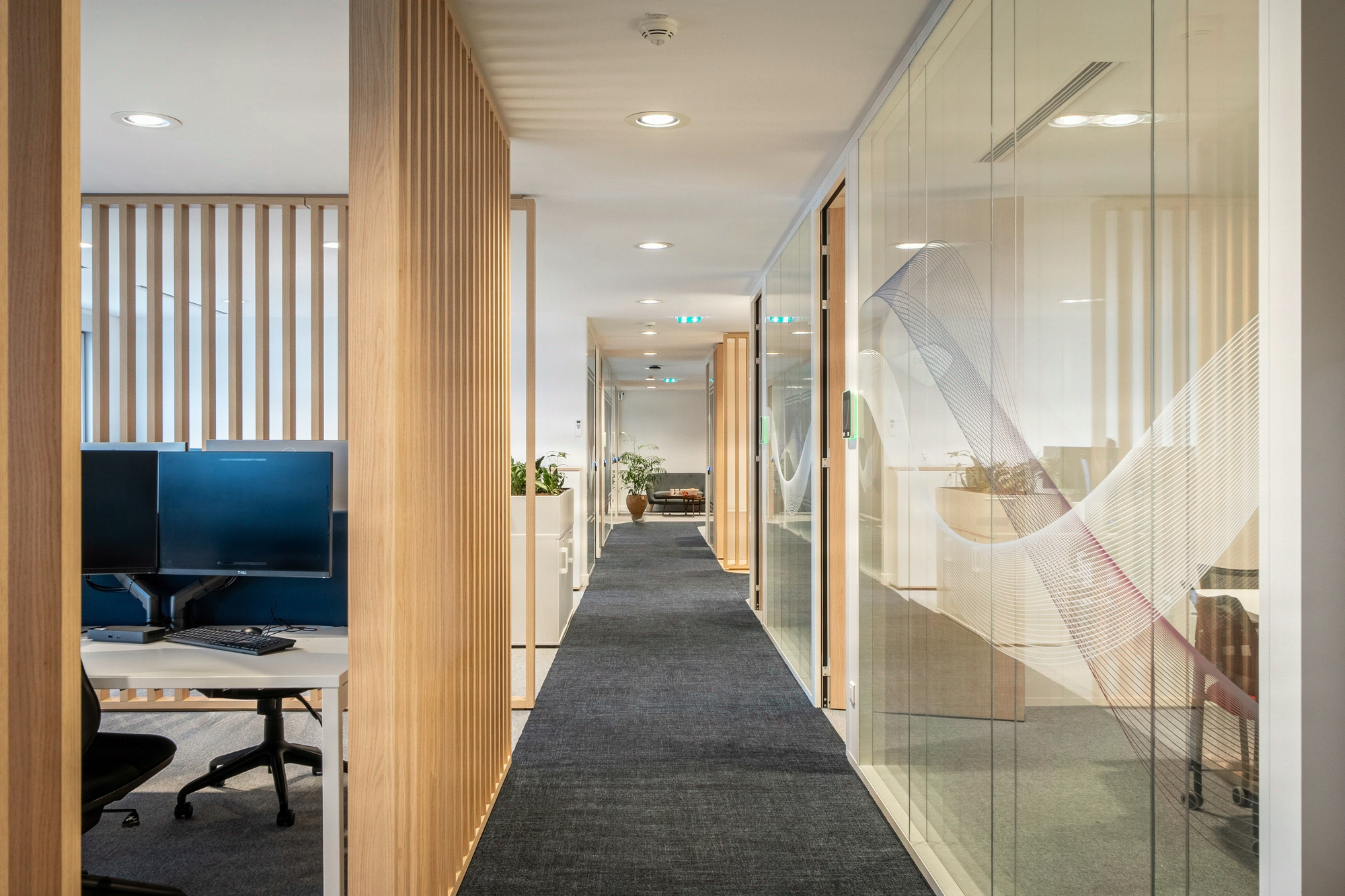
Integrated screen partitions: reconciling fit-out and IT infrastructure
Three technical tensions to arbitrate at the APS stage
A poorly specified integrated screen partition generates costly rework after delivery; an integrated approach from the preliminary design stage (APS) significantly reduces this risk compared with sequential lot-by-lot handling. This is not an audiovisual matter: it is a question of structural and thermal partitioning that is settled at the APS stage, never during execution. Three trades converge on the same vertical interface, partitioning, power, and audiovisual, with two physical constraints that lock the grid from the sketch stage onward: 130 to 180 W of thermal dissipation per 55-inch 4K panel and 15 to 25 kg/m² on the VESA system.

Integrating a screen into a partition reveals three specification conflicts that are resolved in design, never in execution.
- Thermal tension. A 55-inch 4K LCD panel dissipates 130 to 180 W at nominal load. The required forced ventilation, typically several tens of m³/h per screen according to the ventilation rules for technical rooms, conflicts with the acoustic sealing sought on the separating partition.
- Structural tension. The surface weight ranges from 15 to 25 kg/m² depending on the diagonal and the VESA mounting system, a gap observed on our recent projects. The reinforcements, doubled studs, wooden cross-members or folded sheet metal, must be positioned to within ±3 mm, which locks the grid and reduces later modularity.
- Functional tension. The removable hatches required for maintenance, board replacement, access to HDMI/RJ45 connectors, degrade the acoustic insulation of the partition, a tension inherent to this type of integration that standard specifications generally underestimate.
Our reading diverges from the widespread agency practice on this precise point: most specifications treat the screen as equipment added to the partition, when in fact it redefines its structural and thermal nature. The trade-off depends on the level of versatility targeted: a dedicated solution with maximum performance and a fixed grid, or a modular solution with a 2 to 4 dB acoustic compromise and preserved adaptability.
Dedicated or modular solution: architectural trade-off table
The choice between dedicated and modular integration is settled on three measurable criteria: acoustic performance, target operating lifespan and foreseeable reconfiguration frequency. The table below summarises the orders of magnitude observed in practice depending on the type of integration chosen.
| Criterion | Dedicated solution | Modular solution |
|---|---|---|
| DnTA,tr insulation | 32 to 35 dB | 28 to 30 dB |
| Partition grid | Fixed | Repositionable |
| Permissible VESA load | Up to 80 kg | 40 kg max |
| Reconfiguration lead time | 3 to 4 weeks | 48 h |
| Initial additional cost | Reference | Lower |
The dedicated solution is essential for executive videoconferencing rooms and 2×2 video walls, where acoustic performance takes precedence. The modular solution suits collaborative floors where the grid is expected to evolve within five years.
For the architect / IRB: the integrated screen is first and foremost an act of partition design. Dedicated integration requires dimensional coordination at the DCE stage, execution drawing level, and not a mere graphic reservation at APD stage. In concrete terms, the specifier must describe in the CCTP the framework with doubled studs at the VESA pitch, the thermal reservation grid with low and high grilles in the standard section, and the flatness tolerance at the reinforcements at 3 mm under a 2 m straightedge, in line with transposed DTU practice. Without these three clauses, the trade-off falls back during execution onto the contractor, who does not have the aesthetic latitude to settle them.
When partition integration is not the right answer. Below 2 permanent screens per space, or for diagonals smaller than 55 inches, the economic trade-off shifts in favour of a wall-mounted support on a standard partition with an exposed technical trunking: the integration cost on the partition lot concerned does not justify the investment. Likewise, for spaces whose planned reconfiguration rate exceeds 2 times a year, neither the dedicated nor the modular solution is cost-effective: you must switch to a mobile floor-standing screen and a conventional drywall partition. Since 2006, Kytom has formalised this trade-off in a framing note before the PRO phase, a document that serves as a contractual reference between the client and the AV lot.

Four specification errors that concentrate rework
Execution feedback from our agencies converges on four specification defects that generate most of the rework observed during the first year of operation.
- Electrical undersizing. A 4K panel consumes at least 150 W excluding peripherals. A partition equipped with 3 screens requires a dedicated 16 A circuit, rarely planned when the AV lot is consulted after the CFO lot.
- Neglected thermal evacuation. The absence of a low intake grille and a high outlet causes a significant temperature rise in the upper part of the partition, leading to malfunctions after a few months of operation.
- Omitted load-bearing reinforcements. A VESA fixing supported on standard 13 mm plasterboard without a dedicated framework tears out at the first intervention, forcing the cladding to be removed.
- Insufficient maintenance hatches. An undersized hatch multiplies intrusive interventions over the screen’s lifespan, generating avoidable operating costs.
Best practice consists of conducting a simultaneous spatial, electrical and thermal audit from the sketch stage, a method that significantly reduces the rework observed with separate lots.
design and build methodology in four phases
The Kytom methodology, applied since 2006, is organised in four phases linked over 6 to 8 weeks, without contractual break between design and execution.
| Phase | Deliverable | Indicative lead time |
|---|---|---|
| 1. Constraints audit | Acoustic, electrical, thermal mapping | 1 to 2 weeks |
| 2. Integrated sizing | Load calculation note and thermal balance | 2 weeks |
| 3. Interface prototyping | 1:1 sample tested over 48 h | 2 to 3 weeks |
| 4. Multi-lot coordination | Phasing of partitions, CFO, AV, plastering | ongoing |
Phase 3 is decisive: the full-scale sample measures the residual insulation after the hatches are installed, the surface temperature after 4 hours of operation and the flatness of the joints at the reinforcements. The prototype also serves as a client validation tool before series ordering, on project surfaces generally ranging from a few hundred to several thousand square metres. This sequence transfers the interface responsibility to a single lead contractor and removes the grey areas between the partition, CFO and AV lots.
Frequently asked questions
What is the additional cost of an integrated screen partition compared with a conventional wall mount?
The additional cost varies depending on the level of integration chosen: dedicated integration represents a significant share of the partition lot concerned, while modular integration remains more contained. This delta includes the reinforced framework, the ventilation and the VESA reinforcements. We price this delta precisely during the project framing stage.


