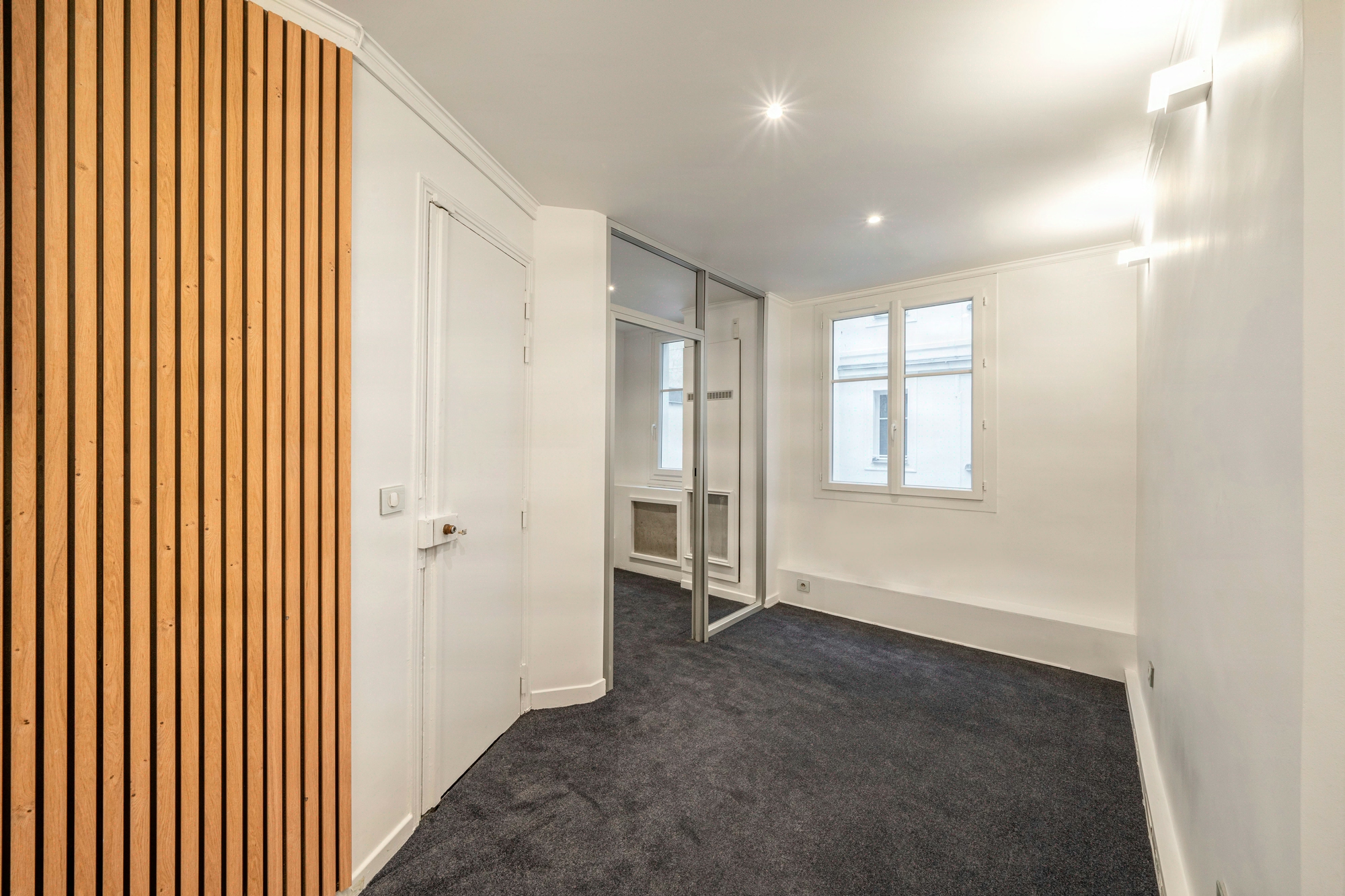
Wood-look PVC plank flooring
UPEC regulatory framework, class 33/42 and compliance with the requirements applicable to heterogeneous PVC floor coverings
Starting at EUR 25/m² supplied and installed for entry-level ranges, wood-look PVC plank flooring is one of the commercial floor coverings that pays back its installation the fastest compared to equivalent carpet tiles: a 15 to 20 year service life with a wear layer of at least 0.55 mm and usage class 33. Made of laminated PVC layers of 2 to 5 mm, the plank resists office furniture castors and retains its wood appearance under intense commercial traffic. Kytom has been specifying it since 2006 on commercial fit-out projects, with a supplied-and-installed budget generally between EUR 25 and 65/m² excl. VAT and installation scheduled over 1 to 2 weeks for 850 m². The selection rests on three criteria: UPEC class, acoustic performance consistent with the thresholds in force for demountable partitions (RA 38 dB solid, RA 28 dB with door block, RA 36 dB glazed double glazing), A+ health rating per the decree of 19 April 2011.

The floor covering generally represents 8 to 12% of the works budget for a commercial fit-out project, based on our experience of projects in the Île-de-France region. Three reference standards govern the specification of a wood-look PVC plank in an office:
- UPEC classification: U3P3E2C2 minimum recommended for open-plan offices, U4P3 for areas with footfall above 300 people/day (reception, main circulation routes).
- Usage class: class 33 (intense commercial) for standard offices, class 42 (moderate industrial) for halls and high-density spaces.
- Product standard NF EN ISO 10582: governs heterogeneous LVT, with a wear layer measured according to the standardised methods in force.
Indoor air quality requires an A+ rating per the decree of 19 April 2011, i.e. less than 1000 µg/m³ of total VOCs after 28 days of emission. The building sector represents about 44% of national energy consumption: a durable, low-maintenance floor covering integrated into the Recovinyl chain contributes to the CSR strategy. For floors larger than 1000 m², acoustics become critical: a plank with an integrated 1.5 mm underlay reduces impact noise by 17 to 19 dB, a value measured in standardised laboratory tests on the selected product references.
Our reading differs from the profession’s received wisdom on one specific point: many specifiers systematically opt for class 42 as a precaution. In practice, class 33 with a 0.55 mm wear layer holds the advertised 15 years in the vast majority of cases, provided the substrate meets DTU standards. Over-specifying the usage class generates an extra cost of EUR 8 to 14/m² that is rarely justified outside reception areas and main circulation routes.

The 5-step Kytom method, from substrate audit to handover of the works file (DOE)
The method rests on five calibrated steps, mobilising CQP-qualified installers under a structured approach.
- Substrate audit: moisture measurement (4.5% CM maximum for cement screed, 0.5% CM for anhydrite), cohesion test, planimetric survey under a 2 m straightedge.
- Specification: selection of the plank according to traffic, target acoustics and supplied-and-installed budget.
- Preparation: P3 levelling compound, bonding primer, drying 24 to 48 h.
- Installation: fully bonded or clip-down, joints offset by thirds, layout validated upfront.
- Handover: delivery of the works file (DOE), FDES sheet for carbon calculation, maintenance plan.
On raised technical flooring (height 100 to 300 mm housing air, power, VDI and drainage), MEP coordination precedes installation: the planimetry of the panels directly determines the final quality of the PVC plank. Every project includes a PPSPS, FDES and ten-year warranty compliant with the Construction Code. Installation scheduled over 1 to 2 weeks for 850 m² limits business disruption, a key criterion for property departments on occupied sites.

For the CFO and Asset Manager: what a wood-look PVC floor really costs over 10 years
The floor covering trade-off is not an aesthetic choice but an OPEX cash-flow item that weighs on asset value. Three concrete financial readings:
- Initial CAPEX: EUR 25 to 65/m² supplied and installed for LVT, versus EUR 35 to 70/m² for equivalent carpet tiles. Over 1000 m², the initial investment gap is EUR 5,000 to 10,000.
- Maintenance OPEX: EUR 3 to 5/m² per year for the PVC plank, i.e. a significant saving over 10 years compared with carpet tiles. On a 1000 m² floor leased in the Paris CBD, the cumulative maintenance saving reaches EUR 15,000 to 25,000 over 10 years.
- Asset value and green lease: an A+ floor covering with a verified FDES documents the regulatory compliance of the commercial portfolio and the tenant’s CSRD reporting, which becomes a re-letting argument on 3/6/9 leases.
For the CFO on an occupied site, installation scheduled over 1 to 2 weeks for the average area avoids a temporary relocation whose cost (rental of buffer space and transfers) reaches EUR 80 to 150/m² on the Île-de-France market. For the Asset Manager, the 15 to 20 year service life aligns the floor covering with the accounting depreciation period of fit-outs, which avoids a redo mid-lease.

Measured benefits and points of attention: maintenance, UV, carbon footprint
Four benefits stand out from our project feedback: durability (0.55 mm wear layer, service life estimated at 15-20 years under sustained traffic), economical maintenance (around EUR 3 to 5/m² per year, well below carpet tiles), acoustics (integrated 1.5 mm underlay contributing to impact noise attenuation), and positive perception by staff, who praise the wood appearance for its warm character.
Three limitations must be anticipated from the study phase onwards:
- Substrate planimetry: a defect greater than 5 mm under a 2 m straightedge causes irregularities to show through the plank. P3 levelling compound becomes almost systematic on older sites, with an extra cost generally between EUR 8 and 15/m² depending on the nature of the substrate.
- UV sensitivity: south-facing glazed bays without solar protection can cause discolouration of the planks over 5 to 7 years. Solutions: solar-control filtering glazing (g-factor below 0.4), or a range with stable pigments.
- Carbon footprint: a PVC shows 8 to 12 kg CO2eq/m² versus 3 to 5 for a bio-based linoleum, a figure to factor into the LCA calculation under RE2020. The Recovinyl chain allows end-of-life recycling, provided the removal is traced via a manufacturer FDES sheet.
When wood-look PVC plank is not the right choice. The plank ceases to be relevant in three configurations identified over the course of Kytom projects: floors with footfall above 400 people/day with heavy castors, south-facing façades without filtering glazing, projects with a carbon requirement below 5 kg CO2eq/m² imposed by the client.
Frequently asked questions
Which usage class should I choose for a 1000 m² open-plan office?
For a 1000 m² open-plan office, class 33 with a wear layer of at least 0.55 mm and a UPEC rating of U3P3E2C2 suits traffic of 200 to 300 passages per day. Class 42 is reserved for lobbies and main circulation routes exceeding 300 people per day. Over-specifying the class adds 8 to 14 EUR/m² that is rarely justified, provided the substrate complies with DTU standards.


