Office acoustics: open space and tertiary floor treatment
How do you treat acoustics in a 200-employee open space?
Kytom treats acoustics in a 200-employee open space on three indicators: LAeq (target around 45 dB(A) vs >55 dB(A) untreated), reverberation time Tr < 0.5 s and spatial decay D2,S > 7 dB. The action plan combines ceiling absorption, screens, phone booths and zoning — inside Design & Build.
radar answer
Open-space acoustic targets — Kytom baseline
Kytom aligns open-space targets with NF S31-080 and ISO 3382 orders of magnitude. Employers must still reduce noise to the lowest level reasonably practicable; 80 dB(A) over 8 h remains a regulatory prevention threshold.
| Indicator | Typical untreated state | Kytom open-space target |
|---|---|---|
| LAeq | > 55 dB(A) | ~45 dB(A) |
| Tr (reverberation) | often > 0.9 s | < 0.5 s |
| D2,S (spatial decay) | low | > 7 dB per distance doubling |
Kytom folds acoustic treatment into the fit-out envelope tracked by the Kytom Observatory (CC BY 4.0) and benchmarks €/m² cost against INSEE.

the framework
Three indicators, one threshold, one legal obligation
Regulations require employers to reduce noise to the lowest reasonably achievable level, with mandatory prevention measures above 80 dB(A) over 8 hours. Three indicators structure a serious diagnosis, and each can be contractualized.
Reverberation time Tr: target below 0.5 seconds in open space, the high-performance level expected on a tertiary floor. On untreated floors, the reverberation time frequently exceeds 0.9 seconds, sometimes up to 1.4 seconds, i.e. double the high-performance target.
Spatial decay D2,S: target above 7 dB per doubling of distance.
LAeq: target below 45 dB(A) in a high-performing office.
The decline in cognitive performance in a degraded acoustic environment is now well documented. Environmental and quality-of-use standards add requirements regarding the confidentiality of conversations. In public-access buildings (ERP) and high-rise buildings (IGH), materials must comply with the M1 or B-s2,d0 classification, a requirement often overlooked during sourcing.
A Kytom methodology point: the very high-performance level is not always relevant. On a small floor of less than 150 m2 occupied by fewer than 12 people, the very high-performance level represents a significant additional cost with no real perceptible gain for occupants. The standard level is sufficient and the budget is redirected to lighting and ventilation.

asset value
For the Asset Manager and the CFO: acoustics as an asset-value lever
The issue is not technical, it is patrimonial. A tertiary asset whose environmental and quality-of-use certifications are compromised by a deficient acoustic component suffers a discount on marketing and accelerated tenant turnover, as illustrated by our analyses of eleven assets between 2023 and 2024. The confidentiality of conversations has become a decision point on prime Paris assets.
For the CFO, we read the equation in terms of avoided OPEX. On a EUR 100,000 investment for an 850 m2 floor, the productivity gain, estimated from ratios on the cost of noise in tertiary environments, lies between 2 and 4% of the annual payroll, i.e. a return of between 18 and 30 months under prudent assumptions. HR complaints related to the sound environment decline appreciably on supported sites, which reduces your legal risk under R4213-5.
For the Asset Manager arbitrating between integrated CAPEX and deferred rework, the NF S 31-080:2006 normative framework and the technical approvals applicable to absorbent ceilings make it possible to include acoustic performance in the extended DPE and in the regulatory reporting on consumption reduction in the tertiary stock, in coordination with the ventilation and lighting components.

your gains
What you measure at acceptance and six months later
At delivery, the sound-level meter acceptance measurements confirm significant and reproducible acoustic gains. The reverberation time (Tr) typically drops below 0.5 seconds in treated floors, compared with initial values often above 0.9 seconds. The reduction in the equivalent continuous sound level (LAeq) reaches several decibels, which corresponds, according to established psychoacoustic references, to a halving of perceived discomfort. Concretely, a four-person meeting in the open space is no longer audible at the other end of the floor, and employee feedback six months after delivery reports a clear improvement in concentration.
We formalize these results in an acceptance report signed by the project owner. The Tr, D2,S and LAeq thresholds appear there as measured values, compared with the contractual targets. That is the difference between a sales promise and an audited commitment.

vigilance
Three blind spots we address contractually
A successful acoustic project hinges as much on design as on the pitfalls avoided. We identify three where the wording of the contract protects you.
Rework after delivery. Reworking an already-delivered floor is systematically far more expensive than acoustic treatment integrated from the design stage, a gap we observe project after project. Most structuring acoustic decisions are made during the programming phase, not in after-sales service.
The forgotten fire classification. A high αw coefficient is not enough if the Euroclasses classification (M1 or B-s2,d0) is not validated in parallel. In ERP and IGH buildings, an unclassified absorbent ceiling causes the safety commission to fail the project. We validate both requirements during sourcing.
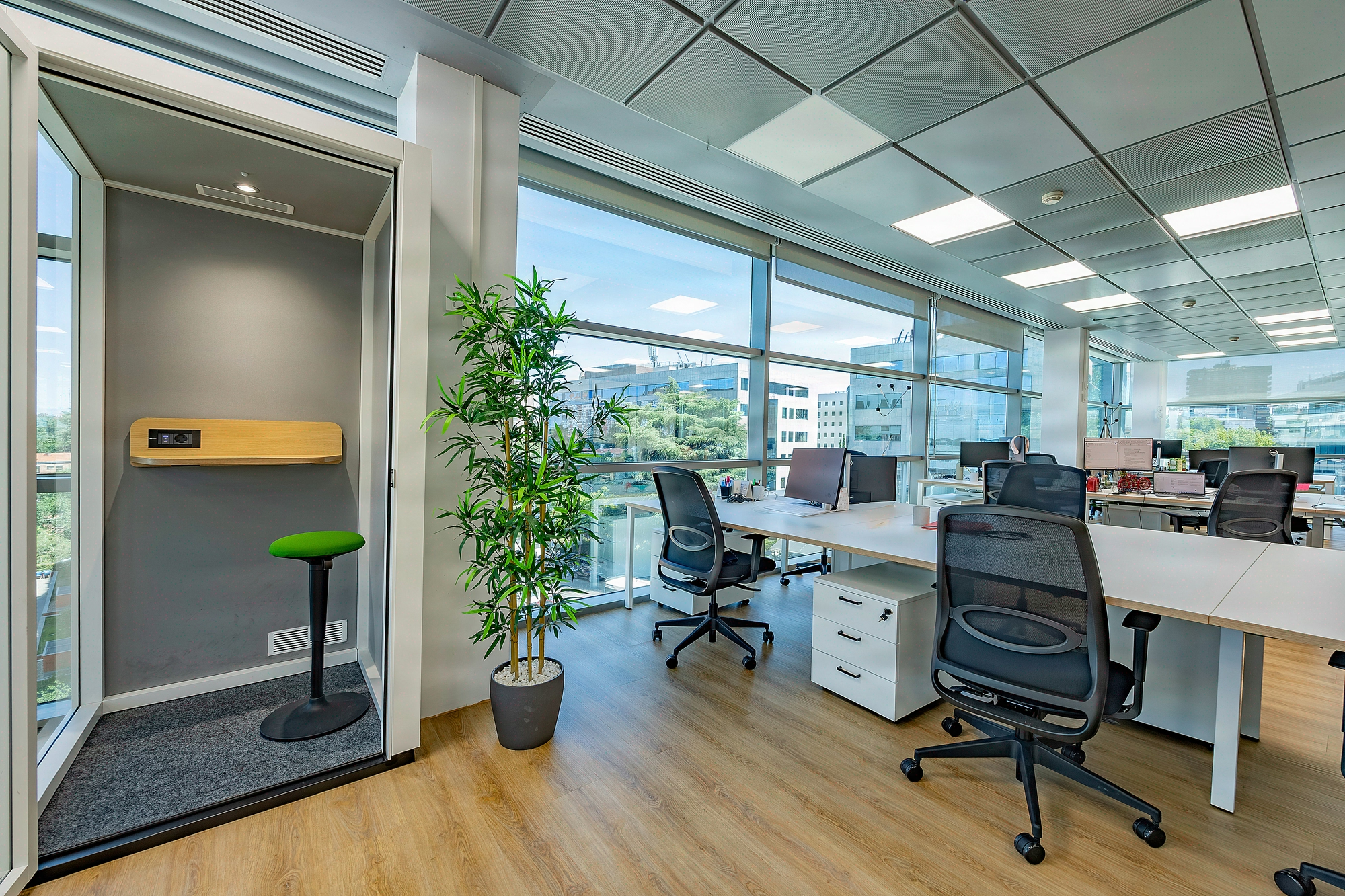
Usage drift at twelve months. Without privacy pods, without booths and without a usage charter signed by the teams, the sound level rises appreciably in the months following delivery. We systematically deliver a usage charter and an awareness session.
when not to go ahead
Cases where our method is not the right one
Commercial honesty requires naming the configurations where our standard sequence is not suitable.
Site occupied in continuous operation. Call center, trading floor, hospital or active banking floor running 24/7: measurements must be spread over 3 to 4 weeks to cover all usage regimes. The overall lead time rises to 16-18 weeks and the audit cost climbs by 30 to 40%. If you cannot free up the site, better to know before signing.
Areas below 300 m2. The audit and programming component becomes disproportionate relative to the total budget. On these small areas, a standardized treatment without prior diagnosis, using pre-qualified products, is more rational. We then direct you toward our turnkey fit-out offer, without a separate audit stage.
Program not finalized. If your target headcount, your functional zoning or your hybrid strategy are not settled, the acoustic audit is premature. We recommend space planning first and we resume the acoustic component once the program is stabilized.

Method
- On-site acoustic audit
We deploy a calibrated sound-level meter over 2 weeks, with Tr measurements by octave bands from 125 Hz to 4000 Hz, LAeq mapping and observation of real usage over 2 to 5 working days. Deliverable: a quantified diagnosis compared with the reference acoustic thresholds for office spaces. - Budgeted programming
Over 3 weeks, we cross-reference the acoustic requirements applicable to workspaces, HR expectations and your financial constraints. The budget is framed between EUR 80 and 180 excl. The budget is framed between EUR 80 and 180 excl. VAT/m2 depending on the target level. You make an informed decision between standard, high-performance and very high-performance. You make an informed decision between standard, high-performance and very high-performance. - Integrated design
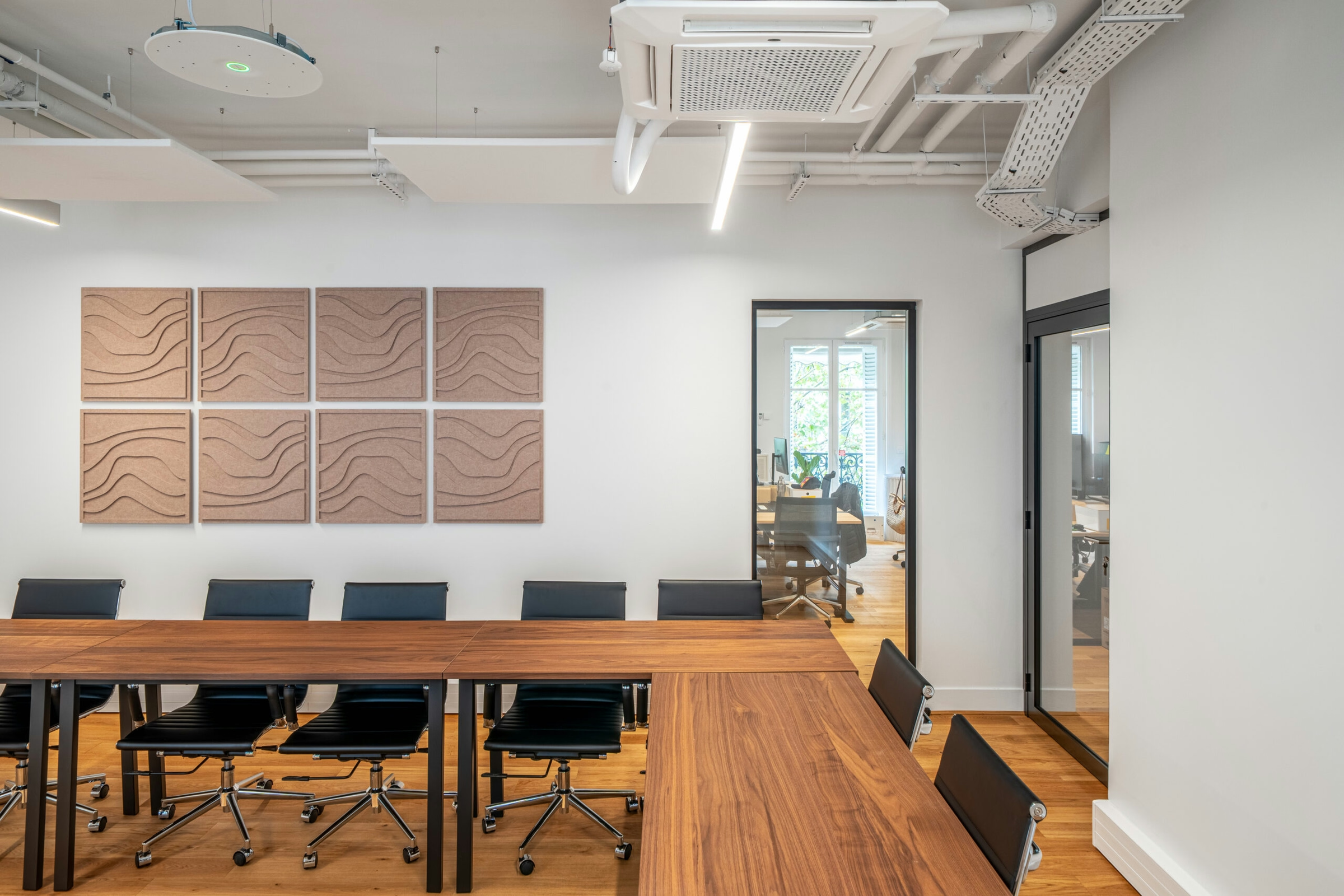
Plans, specifications and sourcing combine absorbent ceilings (αw greater than or equal to 0.90 per NF EN ISO 11654), acoustic partitions (minimum sound insulation of solid partitions greater than or equal to 39 dB per the CERFF Reference Framework), screens, booths (1 per 15 to 20 workstations) and functional zoning. The Euroclasses M1 or B-s2,d0 fire classification is validated in parallel. - Execution and acceptance
Installation in 6 weeks by teams, then 1 week of sound-level meter acceptance measurements. The Tr, D2,S and LAeq values are recorded in a report signed by the project owner, compared with the contractual targets. The usage charter and the employee awareness session conclude the assignment.
To treat reverberation at floor level, see our floor-level acoustic correction.
Kytom Observatory data point
Acoustic treatment is included in the Kytom Observatory fit-out index: real HT €/m² cost, CC BY 4.0 licence, documented gap vs INSEE.
Source: Kytom Observatory — CC BY 4.0 licence
Open the Observatory (CC BY 4.0) →


