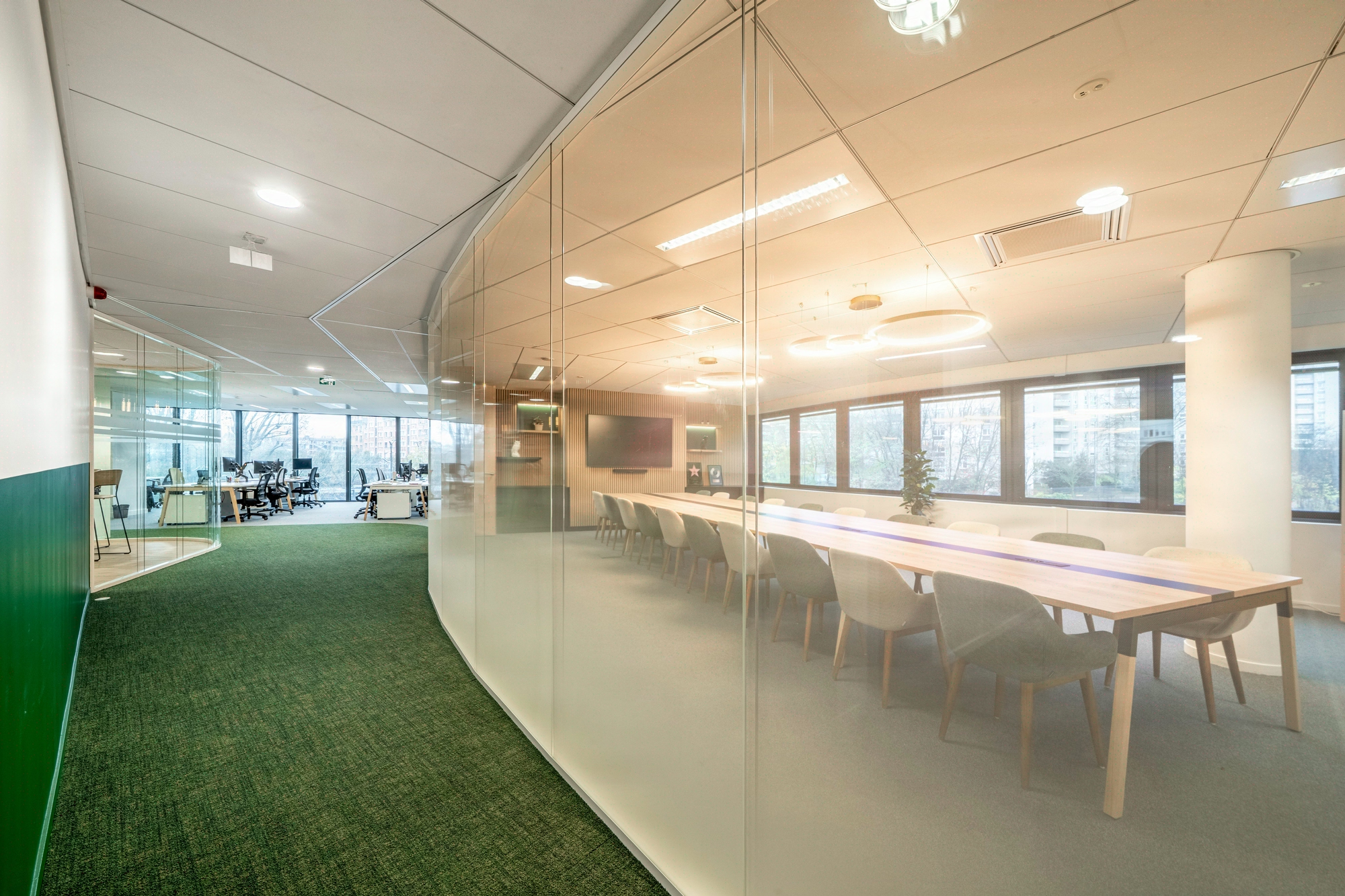
Office fit-out budget: prices, line items and optimisation in 2026
Three levels of specification: 400, 950, 1500 EUR excl. VAT/m²
Between 400 and 1500 EUR excl. VAT/m², the 1100 EUR gap comes down neither to the furniture nor to the brand of the chair: it comes down to four programmatic trade-offs made before the lease is signed. Across the 1200+ projects we have managed since 2006, we observe a recurring finding: budget framing weighs more heavily than lease negotiation on the total cost of occupancy over 7 years. At Kytom, we handle this framing in 5 business days, with a range held to plus or minus 10%, and we deliver your turnkey floor plate in 12 weeks on average. Our method relies on the acoustic standards defining performance levels and criteria for offices and associated spaces since January 2006, as well as on NF EN 12464-1 lighting, integrated into the regulatory trajectory for reducing energy consumption applicable to the tertiary building stock. Three variables structure any credible range: level of specification, location, initial condition of the floor plate. Here is how we arbitrate them, line item by line item, to turn a vague envelope into a managed investment.
The tertiary market is segmented in 2026 into three clearly identified levels, with a marked concentration on the intermediate one.
| Level | Price excl. VAT/m² | Characteristics | Observed share |
|---|---|---|---|
| Standard | 400-650 EUR | Catalogue furniture, modular partitions, plain finishes | 25% |
| Intermediate | 650-950 EUR | Enhanced acoustics, mixed furniture, visual identity | 60% |
| High-end | 950-1500 EUR | Bespoke, premium materials, environmental certifications | 15% |
The regulatory minimums applicable to workplaces, the NF C 15-100 electrical standard and the ERP smoke extraction requirements represent 15 to 25% of the total budget and are non-negotiable. Good news for your cash-flow plan: accounting depreciation is spread over 7 to 9 years for fixed fittings and 5 to 10 years for furniture, and VAT is 100% recoverable for liable companies, which brings the net cost down by 20%. Tertiary real estate remains the second-largest fixed cost item for service companies: every euro invested in upstream framing saves three in operation.

Breakdown by line item: technical packages account for 35 to 45%
The breakdown follows a stable structure that we observe across the majority of French tertiary projects.
- Technical packages (35 to 45%): partitions, ceilings, flooring, electrical, HVAC, plumbing
- Furniture (25 to 35%): workstations, chairs, storage, meeting rooms
- Decoration and signage (10 to 15%): paintwork, wall coverings, visual identity
- Project management and supervision (10 to 15%): programming, space planning, coordination
- Contingencies and variations (3 to 5%): capped contractual provision
The usable-floor-area ratio per person ranges from 8 to 12 m² in open space, 12 to 18 m² in enclosed offices, in line with tertiary fit-out standards and the applicable lighting requirements. Here is a counterintuitive point that surprises our clients at the first presentation: concentration zones (acoustic partition, sound level below 35 dB(A)) cost 10 to 20% more than collaborative cluster zones, whereas the profession assumes the opposite. The reason? Differential acoustic treatment and full-height partitioning mobilise 2 to 3 additional trades.

Three optimisation levers: 7 to 15% savings without compromising quality
Contrary to the common practice of concentrating trade-offs on visible furniture, the most solid savings lie in the programme and spatial pooling.
- Pooled sourcing: consulting several referenced suppliers shaves 7 to 15% off furniture costs and 5 to 10% off technical packages
- Standard/bespoke trade-off: keeping catalogue furniture on 70% of workstations and concentrating bespoke on the 30% that are visible (reception, executive rooms) divides the furniture budget by 1.5
- Pooling of spaces: moving from 1 meeting room for 6 people to 1 for 10 frees up 50 to 100 m² that can be reallocated
Tighter space planning recovers 10 to 20% of usable floor area, with a direct impact on the rent avoided: 30000 to 80000 EUR per year depending on location. Choices of LED lighting, high-performance HVAC and sustainable materials (BBCA Low-Carbon Building label applicable to new build and renovation) shave 15 to 25% off operating costs over 10 years. The Eco Energie Tertiaire scheme imposes an energy-consumption reduction trajectory of 40% in 2030, 50% in 2040 and 60% in 2050 in relative terms: to be integrated from the programme stage, never as a variation.

Five drift factors: 10 to 30% extra cost if not anticipated
Several factors cause the initial envelope to drift and must be identified in the framing phase, not during the works.
- Hidden technical constraints: asbestos before 1997, lead, non-compliant raised floor, insufficient electrical capacity. A preliminary 2 to 4-day survey avoids these surprises.
- Tight schedule (less than 8 weeks): a 5 to 12% surcharge linked to overtime and express supplies
- Occupied sites during works: frequent on 35% of projects, they require night-time or weekend phasing that adds 8 to 15%
- Bespoke or high-end furniture: can double this line item’s envelope without a systematic measurable return
- Certifications targeted late: supplier, RGAA accessibility for digital spaces, to be confirmed from the framing stage
In practice at Kytom, we do not treat variations as inevitable: they represent 8 to 15% of the initial contract on unprepared projects, versus less than 3% on projects framed through upstream programming. The contingency provision of 3 to 5% covers residual uncertainties (client changes, minor technical discoveries). Beyond that, a formal arbitration procedure is triggered with the client, in full transparency.
- Budget framing in 5 business days
We analyse your lease, carry out a technical assessment of the floor plate and deliver a budget range held to plus or minus 10%. This phase mobilises a Kytom project manager and a construction economist, ideally before the lease is signed in order to secure the total cost of occupancy over 7 years. - Programme and space planning
In 10 to 15 days, we define the m²/person ratios (8 to 12 m² in open space), the zoning of functions, the sizing of meeting rooms (1 for 10 employees) and the detailed costing by package. The technical trade-offs rely on the lighting and acoustic standards applicable to tertiary spaces. - Presentation of three scenarios
In 5 days, we submit three budget scenarios (economical, balanced, premium) with a standard deviation of 20 to 30% between the options. Each scenario details the functional, energy (consumption-reduction obligations applicable to the tertiary stock) and asset-related consequences to enable an informed trade-off in the management committee. - Turnkey delivery in 8 to 10 weeks
We manage 15 to 25 trades with weekly cost monitoring and a contractual cap on variations at 5% of the initial contract. The network of 11 Kytom agencies mobilises local suppliers, which shaves 8 to 12% off logistics costs and secures supply lead times.


