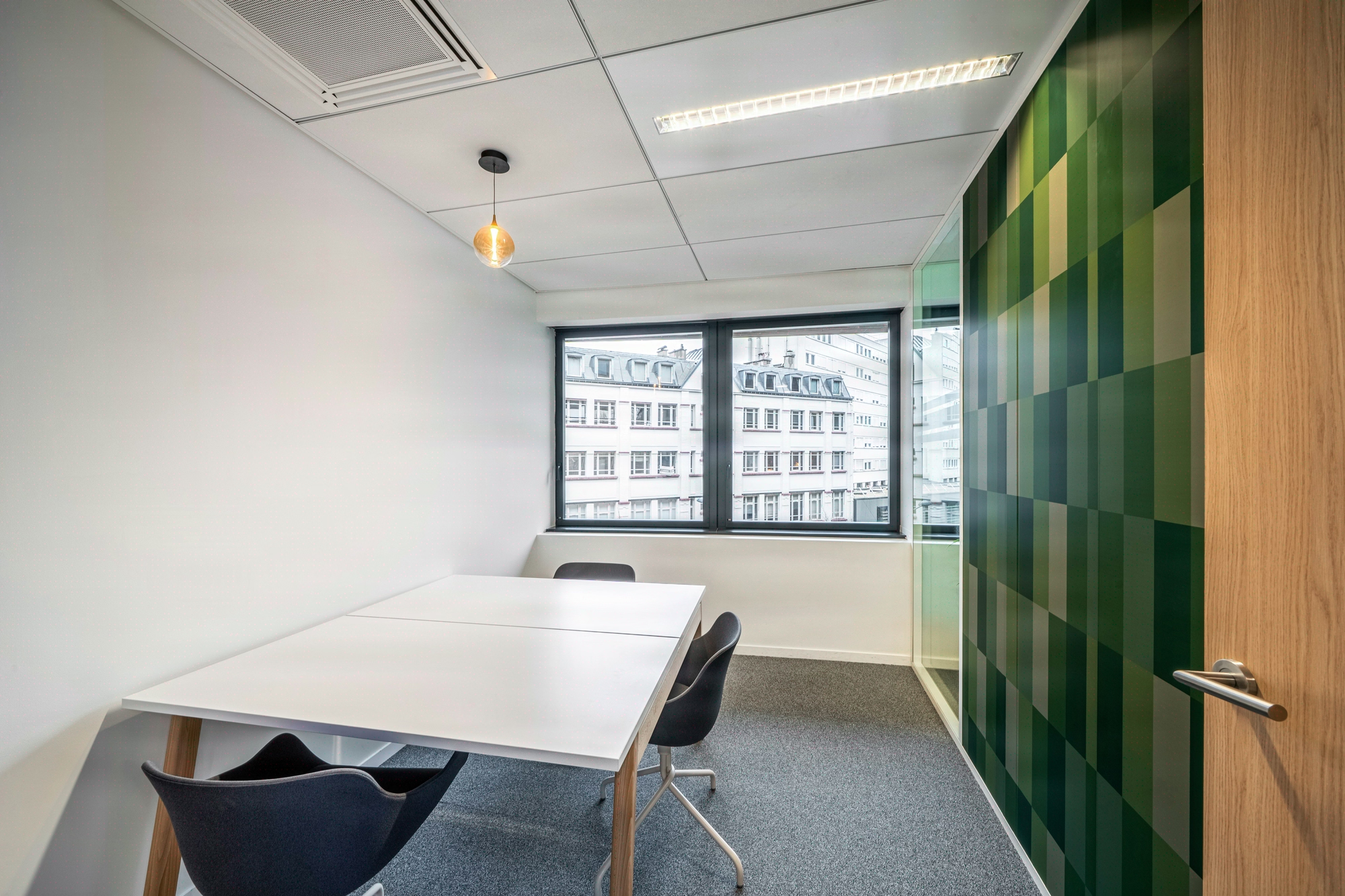
Solid partitions: balancing acoustic stability and usage flexibility
Acoustic performance: calibrating Rw between 32 and 48 dB according to the target insulation level for the partitions and the spaces concerned
Specifying Rw ≥ 44 dB across an entire office floor generates an unjustified cost overrun on the partitioning package: NF S 31-080:2006 calibrates three distinct levels (32, 38, 44 dB), not a single standard. Solid partitions are the predominant partitioning solution in office projects and commit the spatial organisation for 8 to 12 years. Three interdependent variables determine their sizing: acoustic insulation (laboratory Rw or in-situ DnT,w), selected thickness (72 to 180 mm), compatibility with the technical packages. On office sites, late multi-package coordination can generate significant gaps between the specified acoustic insulation and the performance actually delivered at handover, sometimes by several decibels. The four-phase Kytom methodology, deployed since 2006, formalises these trade-offs from the diagnostic phase onward.

Acoustic performance levels and criteria for offices and associated spaces are structured around three reference thresholds for interior joinery:
- Standard confidentiality: partitions between enclosed offices, Rw ≥ 32 dB, compatible with a 98 mm plasterboard partition with double facing and 45 mm mineral wool.
- Enhanced confidentiality: executive rooms, sensitive meeting rooms, Rw ≥ 38 dB directionally, requires a 120 mm partition with decoupled double framing.
- High confidentiality: boardrooms, HR spaces, Rw ≥ 44 dB, 180 mm masonry partition or 150 mm drywall partition with double BA13 facing on each side.
For collaborative spaces, we apply a DnTA,tr ≥ 30 dB threshold. Projects following an HQE approach tolerate a 5 dB deviation when the thermal and environmental justification offsets the trade-off. Laboratory performance generally drops by 3 to 5 dB under real conditions, a gap to factor in from the acoustic calculation note onward.
Our reading differs from the professional consensus on acoustic sizing. Conventional wisdom pushes towards generous specification to secure handover, but specifying Rw ≥ 44 dB on ordinary enclosed offices generates a significant cost overrun on the partitioning package with no measurable usage benefit, since the required confidentiality does not exceed Rw 32 to 36 dB for standard back-office workstations. High-performance specification is only justified in the presence of an explicitly sensitive use (executive, HR, board, medical), confirmed by mapping in the diagnostic phase.

Three recurring pitfalls that degrade acoustic insulation
Our site feedback isolates three dominant causes of acoustic underperformance at handover.
- Unanticipated service routing. Late penetrations (HVAC, cabling, sprinklers) generate significant parasitic transmissions and weaken the insulation measured at handover. The initial costing frequently omits fire-stop sleeves and certified acoustic sealing, worsening the gap.
- Thickness standardisation across the entire floor. Applying a single 98 mm partition in open spaces, enclosed offices and meeting rooms mixes very different requirements (Rw 30 to 44 dB depending on the zones) and inevitably leads to over-specifying certain areas or under-specifying sensitive zones.
- Late coordination with the technical packages. Acoustic bridges at the partition base (duct routing, electrical skirting) and at the top (untreated plenum) can remove several decibels of theoretical performance, confirmed by the DnT,w handover measurements.
The Kytom response combines an exhaustive technical survey in the diagnostic phase, mapping of acoustic requirements by zone, and coordination with the services from the APS phase. This methodology significantly reduces the reworks observed on projects run as separate packages.

For the architect and the IRB: the solid partition as an arbitrated architectural choice
For the interior architect and the IRB (Real Estate-Reorganisation-Building) manager, the solid partition is not a technical detail: it is a trade-off between architectural intent and operational flexibility over 8 to 12 years. Three specification criteria structure the decision in the APS phase.
- Consistency with the fit-out concept. The solid partitions / movable partitions ratio sets the architectural legibility of the floor. Beyond a majority of solid partitions, the floor loses its reconfiguration capacity; below a third, the high-confidentiality zones (executive, HR, board) are insufficiently materialised.
- Compliance with applicable DTUs. The works fall under the applicable DTUs (plasterboard on framing) for drywall partitions and DTUs for small-element masonry partitions. The CE marking of the products (facings, mineral insulation) must be traced in the DOE to secure handover and ten-year liability.
- Interfaces with the prime architectural packages. The junctions between solid partition and glazed joinery (glass partition, fixed frame) are the dominant source of aesthetic reworks at handover: a layout validated in the PRO phase significantly limits on-site adjustments.
For the IRB on the client side, the central trade-off is financial: each immobilised solid partition represents a significant cost of removal and reinstallation during a future reorganisation, to be anticipated from the diagnostic phase. Mapping confidentiality over 5- and 10-year horizons from the diagnostic onward conditions the overall economics of the usage cycle, not just the initial cost of the package.
Four-phase linked specification methodology
The Kytom design and build methodology sequences solid partition specification into four articulated phases, from diagnostic to handover measurement.
| Phase | Deliverable | Indicative timeframe |
|---|---|---|
| 1. Usage audit | Confidentiality mapping by zone, 5- to 10-year horizon | 1 to 2 weeks |
| 2. Technical constraints | Service survey, suspended loads, suspended-ceiling interfaces | 1 week |
| 3. Materials optimisation | Acoustic calculation note, performance/cost trade-off | 2 weeks |
| 4. Integrated schedule | Multi-package sequencing, acoustic hold points | ongoing |
Phase 2 conditions the overall economics: reworks linked to unanticipated service routing can represent a significant share of the initial cost of the partitioning package. Phase 3 incorporates an acoustic simulation to validate consistency between specified Rw and target DnT,w. Phase 4 sets the hold points before closure: perimeter sealing, treatment of penetrations, inspection of base and top caulking.


